New Issue: Orbital Catastrophe Ahead? Read Now

Strong Earthquake Hits Kamchatka. Tsunami Risk Waning

A powerful magnitude 7.8 aftershock off Russia’s Kamchatka Peninsula that arose from July’s magnitude 8.8 earthquake is raising concerns about possible tsunami impacts, although risk appears to be waning

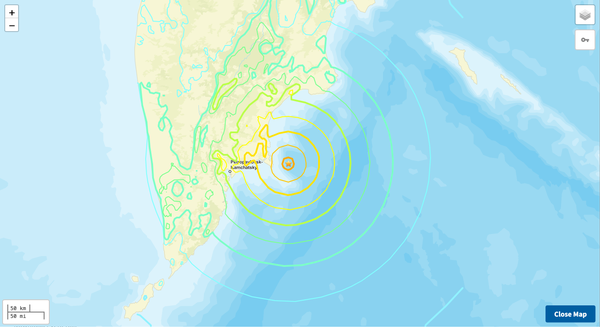
Earthquake epicenter diagram

A seismic map shows the epicenter and intensity of a major earthquake that struck off the eastern coast of Russia’s Kamchatka Peninsula on September 18, 2025, EDT.

USGS

Join Our Community of Science Lovers!

Less than two months after a magnitude 8.8 earthquake rocked Russia’s Kamchatka Peninsula, another strong earthquake occurred early on September 19 local time.

Although tsunami waves have been observed closer to the earthquake’s epicenter off Kamchatka’s eastern coast, shortly before 5 P.M. EDT, officials at the Pacific Tsunami Warning Center announced an “all clear” for Hawaii, ruling out the possibility of giant waves crossing the Pacific Ocean.

The U.S. Geological Survey made an initial estimate of the new earthquake’s magnitude as 7.8, meaning that the July 29 event released more than 30 times the energy of this one and produced waves with about 10 times the magnitude of the latter. (The scale by which scientists measure earthquakes is logarithmic, not linear.)


On supporting science journalism

If you're enjoying this article, consider supporting our award-winning journalism by subscribing. By purchasing a subscription you are helping to ensure the future of impactful stories about the discoveries and ideas shaping our world today.


A set of concentric circles cropped within a rectangular frame are scaled to show the amplitude of earthquakes measuring 4.0, 5.0, 6.0, 7.0, 8.0 and 9.0 on the Richter scale. Each whole number increase corresponds to a 10-fold increase in amplitude. A second set of concentric circles cropped within a rectangular frame are scaled to show the energy released by earthquakes measuring 4.0, 5.0, 6.0 and 7.0 on the Richter scale. Each whole number increase corresponds to a 32-fold increase in energy.

Amanda Montañez

The July event was among the 10 strongest earthquakes on record; this new temblor won’t make that cut. According to Reuters, the Kamchatka region’s governor said that there have been no reports of damage from the recent event in the sparsely populated region.

USGS has already confirmed that the magnitude 7.8 event is an aftershock of the earlier earthquake, making it the latter quake’s largest aftershock to date. Both earthquakes occurred on the Kuril-Kamchatka plate boundary, which stretches from northern Japan, along the eastern coast of the Kamchatka Peninsula, toward the Aleutian Islands. Here, the Pacific plate is sinking under the North American plate, making the region one of the world’s most seismically active, according to USGS.

The July earthquake spurred concerns of a serious tsunami but ended up not producing such a phenomenon because of local geology.

If you live in Hawaii or along the western coast of the U.S. when a tsunami risk is declared, monitor tsunami alerts from the federal government and follow the directives of local emergency response personnel.

Meghan Bartels is a science journalist based in New York City. She was previously a senior reporter at Scientific American. Before that she spent more than four years as a writer and editor at Space.com, as well as nearly a year as a science reporter at Newsweek, where she focused on space and Earth science. Her writing has also appeared in Audubon, Nautilus, Astronomy and Smithsonian, among other publications. She attended Georgetown University and earned a master’s degree in journalism at New York University’s Science, Health and Environmental Reporting Program.

More by Meghan Bartels

Subscribe to Support Independent Journalism

Great science journalism requires human expertise, time, effort and creativity. And it costs money. That’s why I and the journalists here at Scientific American hope you’ll join our community.

When you subscribe, you are supporting staff and freelance journalists who are passionate about telling science stories that are true, important and compelling. Our editors and reporters are often experts in their fields, which means they understand the nuances of big discoveries and can untangle the breakthroughs from the hype. With a subscription, you are also supporting rigorous fact-checking to ensure the words we publish are precise and accurate. And you’re supporting original illustrations, graphics and photos that bring you closer to an advanced laboratory, an ice sheet in Antarctica or a space mission in orbit. You’re helping us craft other types of high-quality journalism as well: Our newsletters are carefully written, edited and curated by staffers you have or will come to know and love. Our Science Quickly podcast is based on original reporting, collaboration with editors and scientists and exacting production.

Subscriptions keep this engine running so we can continue to deliver thoughtful, rigorous and independent science journalism to you. In an era of viral misinformation, this work is crucial. If you value what we do, I hope you’ll consider joining us as a subscriber

Thank you,

Jeanna Bryner, Editor in Chief, Scientific American

Subscribe