

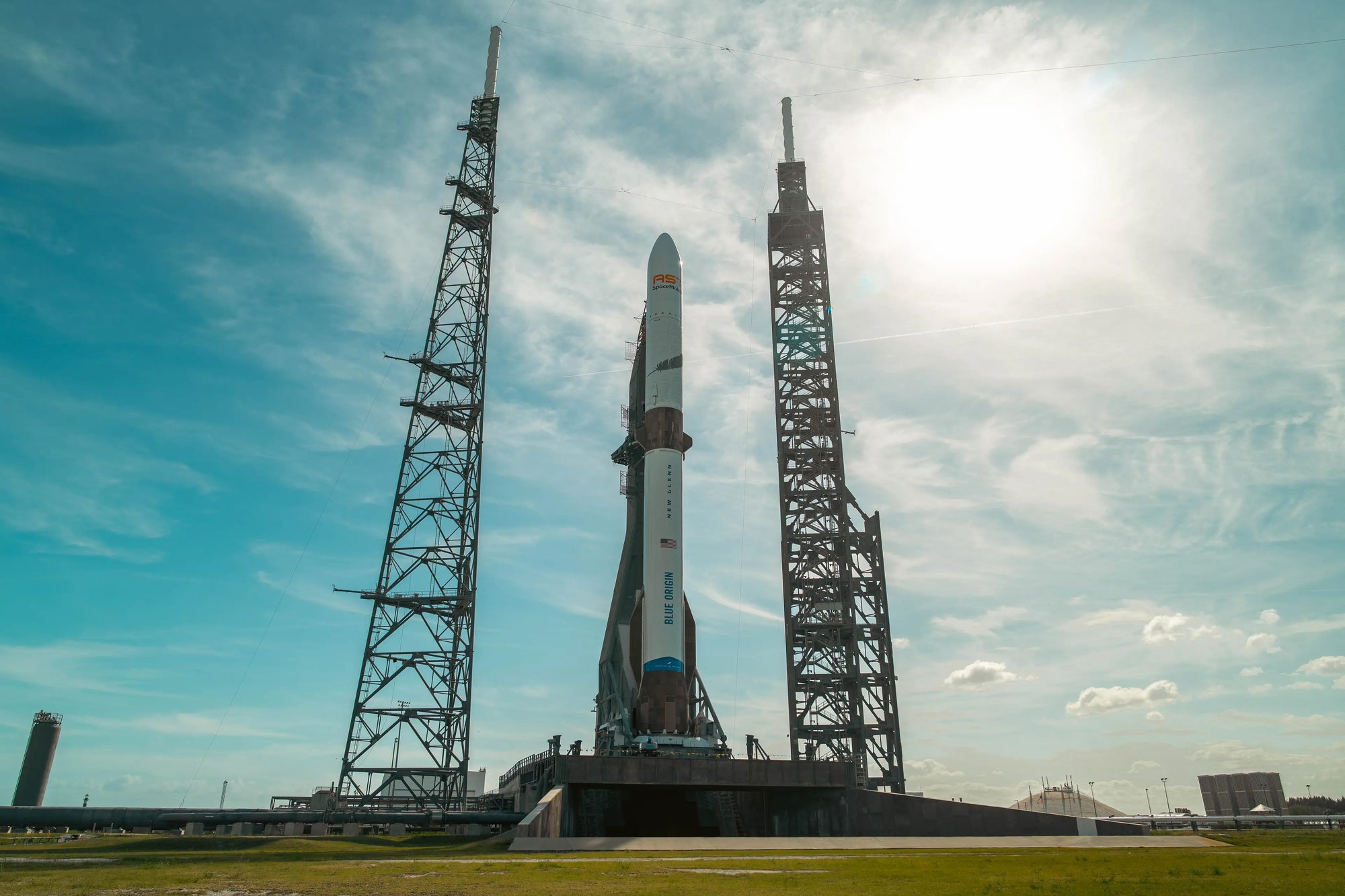
New Glenn, a giant rocket built and operated by Jeff Bezos’s aerospace firm Blue Origin, exploded in a massive fireball on its launchpad in Florida on Thursday. The catastrophe risks derailing the company’s planned NASA-backed missions to launch lunar rovers and participate in the space agency’s Artemis III and Artemis IV crewed flights aimed at putting astronauts back on the moon.
“All personnel are accounted for and safe,” Bezos wrote in a post on X after the explosion. “It’s too early to know the root cause but we’re already working to find it. Very rough day, but we’ll rebuild whatever needs rebuilding and get back to flying. It’s worth it.”
In a separate post on X, Blue Origin said, “We experienced an anomaly during today’s hotfire test. All personnel have been accounted for. We will provide updates as we learn more.” The company also warned that debris from the explosion may wash ashore in the coming days and advised the public not to touch it and to report anything they find.
On supporting science journalism
If you're enjoying this article, consider supporting our award-winning journalism by subscribing. By purchasing a subscription you are helping to ensure the future of impactful stories about the discoveries and ideas shaping our world today.
SpaceX CEO Elon Musk responded to the explosion with an X post of his own. He wished Blue Origin a speedy recovery from the accident, which obliterated the rocket and severely damaged New Glenn’s launchpad.
Through SpaceX and Blue Origin, Musk and Bezos have been vying for off-world economic dominance, with each pursuing projects to ring Earth with many thousands of communications satellites and orbital artificial intelligence data centers. But the highest-visibility arena for this rivalry is the moon; SpaceX and Blue Origin are both on deck to provide critical support for NASA’s Artemis program to return astronauts to the lunar surface and build a moon base.
The explosion has dire implications for Blue Origin’s lunar prospects: The destroyed launchpad is the company’s sole facility for sending New Glenn into space. And it will likely require months of extensive repairs, delaying and complicating Blue Origin’s contributions to NASA’s lunar ambitions. The space agency plans to land astronauts on the lunar surface by 2028 via the Artemis IV mission and considers itself to be in a race with China, which is seeking to send astronauts to the moon by 2030.
Prior to Thursday’s explosion, the rocket had been scheduled to launch a batch of 48 satellites for another Bezos project: Amazon’s Leo constellation, which is an emerging competitor with SpaceX’s Starlink Internet network. The satellites were not onboard the rocket when it exploded.
The explosion occurred around 9 P.M. EDT during a routine preflight “static fire” test of the seven engines on New Glenn’s first stage, with the 322-foot-tall rocket secured to its launchpad at Launch Complex 36 at the Cape Canaveral Space Force Station. Video of the incident shows the engines apparently igniting, followed by flames shooting up the rocket’s exterior. Then comes the eruption of a giant, bright fireball that destroys the rocket and its launchpad.
The U.S. Space Force Eastern Range, which coordinates all launches from Florida, said in a statement that “the Eastern Range remains fully mission capable and continues to support operations at all other launch complexes.”
NASA “will work with our partners to support a thorough investigation of this anomaly, assess near-term mission impacts, and get back to launching rockets,” said the agency’s administrator Jared Isaacman in an X post. “We will provide information on any impacts to the Artemis and Moon Base programs as it becomes available.”
Blue Origin
Blue Origin and SpaceX are each developing a human landing system (HLS) for future Artemis missions. Blue Origin’s Blue Moon Mark 2 and SpaceX’s Starship HLS are both core components of the space agency’s Artemis III mission, slated for next year. Placed in low-Earth orbit via their company’s respective rockets, the two HLS spacecraft would be targets for Artemis III astronauts arriving separately in an Orion crew capsule, who would attempt docking and other maneuvers.
Given the catastrophic destruction of its rocket and its only New Glenn launchpad, the likelihood of Blue Origin being ready for Artemis III now appears perilously low. Meanwhile SpaceX is proceeding with development of its fully reusable Starship vehicle, with its latest flight—the program’s 12th, and the first for Starship’s “V3” design—being largely successful, setting up a 13th test flight that will send the giant rocket into Earth orbit. But Starship still must demonstrate multiple unproved capabilities that are crucial to NASA’s plans—such as the in-space refueling, via multiple launches, that’s required for sending the vehicle out of low-Earth orbit to the moon.
Blue Origin’s mishap will inevitably affect the company’s capabilities for other NASA missions, too. New Glenn had been scheduled to fly a smaller uncrewed spacecraft, the Blue Moon Mark 1 lander, to the lunar surface later this year. And on Tuesday NASA had announced additional contracts with Blue Origin for a pair of New Glenn launches to send lunar terrain vehicles to the moon as soon as 2028. The vehicles would be driven by astronauts during future Artemis missions.
It also compounds New Glenn’s rocky path to reliable use. Next week’s launch would have been only New Glenn’s fourth, after its third flight on April 19 placed a satellite for the company AST SpaceMobile in an orbit that was lower than planned because of a malfunction of the rocket’s second stage. The $23-million satellite burned up in Earth’s atmosphere as a result.
The explosion is “a major setback for Blue Origin at a particularly important moment for the company” that “highlights a broader challenge for the United States,” says Kathleen Curlee, an aerospace analyst at Georgetown University. “Policymakers increasingly want a resilient space ecosystem with multiple providers capable of supporting national security missions, civil exploration and commercial activity,” she says. “Delays to Blue Origin’s progress make that objective harder to achieve—and reinforce how difficult it remains to build alternatives to SpaceX’s current lead in launch capability.”