
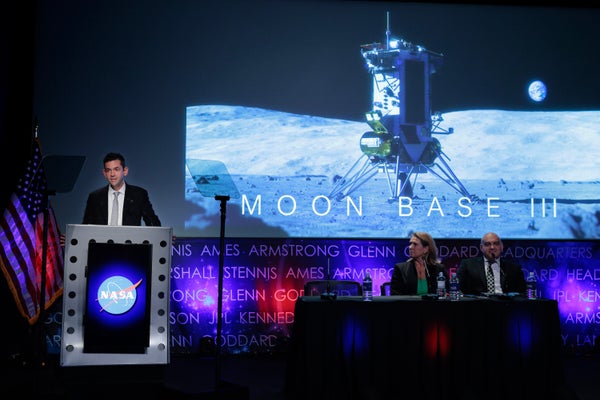
WASHINGTON, D.C.—On Tuesday NASA administrator Jared Isaacman and other officials unveiled the space agency’s next small steps toward its long-sought giant leap of creating a “permanent” human outpost on the moon in the 2030s. The announcement included contract awards to private companies for new crewed lunar vehicles and additional uncrewed cargo landers, as well as additional technological milestones and timelines for NASA’s planned sequence of crewed missions as part of its Artemis program.
“We are moving with the confidence and the purpose to accomplish the missions that only NASA is capable of achieving,” said Isaacman in introductory remarks for the official “Moon Base” proceedings, a follow-up to an announcement in March that revealed NASA’s overarching lunar exploration plans. “And we are really just getting started.”
Taking place on a brightly lit stage at the agency’s headquarters, NASA’s rollout of its latest lunar ambitions stood in stark contrast to years past, when similar announcements were often conveyed in obscure bureaucratic missives. This new higher-visibility approach shows just how much the space agency is seeking stronger engagement from the general public, as well as from a burgeoning U.S. space industry.
On supporting science journalism
If you're enjoying this article, consider supporting our award-winning journalism by subscribing. By purchasing a subscription you are helping to ensure the future of impactful stories about the discoveries and ideas shaping our world today.
Overall, the announcements marked a sort of lunar coming-out party for Jeff Bezos’s rocket firm Blue Origin, whose Mark 1 lunar cargo lander will ferry science equipment and technology tests to the moon’s south pole. This remote lunar region is the intended site of future Artemis astronaut landings and, of course, the much ballyhooed moon base. Besides its Mark 1 for cargo missions, Blue Origin is also supplying a crewed spacecraft, the Mark 2 lander, as an option for carrying astronauts to the moon’s surface in the Artemis IV mission targeted for 2028. The other option would be a lunar lander variant of SpaceX’s Starship vehicle; many experts had considered the Elon Musk–owned aerospace company to be the leader in this two-way race, but uncertainty has grown about SpaceX’s prospects because of delays in Starship’s development.
The U.S. moon rush accelerated last December, when a Trump administration executive order told NASA to prioritize a 2028 crewed lunar landing and the establishment of a lunar outpost by 2030. In response, NASA turned to the private space industry to follow a $30-billion-plus plan that would end with a nuclear-powered moon base. Announced in March, the 11-year plan called for 79 launches and 73 landers to dramatically ramp up lunar infrastructure, including parts of a canceled “Gateway” project that was once intended as a moon-orbiting way station.
On Tuesday NASA officials awarded contracts in excess of $200 million apiece to two private aerospace companies: Astrolab of Hawthorne, Calif., and Lunar Outpost of Golden, Colo., for building and delivering the first astronaut-toting lunar terrain vehicles (LTVs). These solar-powered vehicles should travel at 10 kilometers per hour with a 200-kilometer range and are capable of autonomous navigation. If all goes well, says NASA’s Robert Pickle, who manages the LTV program, one or both companies should have their vehicles on the moon ahead of the Artemis IV and Artemis V landings to help scout the surrounding terrain before and after each mission. “We are hoping to fly both of them to the moon,” Pickle says.
Blue Origin will land both of the LTVs via separate missions using its Mark 1 Endurance lander, a cargo version of its lunar lander, NASA also reported on Tuesday. The moon base plan announced in March turned next year’s Artemis III mission, formerly scheduled to send astronauts to the moon’s surface, into a high-stakes crewed test of one or both of SpaceX’s and Blue Origin’s lunar landing vehicles in Earth orbit. (NASA will announce Artemis III’s four astronaut crew members on June 9 at Johnson Space Center in Houston.)
So far, neither SpaceX nor Blue Origin has soft-landed anything on the moon, but that should soon change. Last week SpaceX tested an improved version of Starship that will be the basis of its candidate lander in a largely successful suborbital launch and splashdown in the Indian Ocean. And Blue Origin will seek to prove the mettle of its Mark 1 lander this fall, when it voyages to the moon’s south polar Shackleton Crater on a technology demonstration mission for NASA. That mission, officially dubbed “Moon Base I” at Tuesday’s event, includes a three-dimensional camera system to observe landing effects on the lunar surface’s rocky regolith and reflective laser arrays for range finding for future landings.
“We’re trying to stay humble; this is a first deep-space mission for us. But things are looking good,” says John Couluris of Blue Origin, citing recent thermal and radio communication tests of the Mark I lander. Many of the lander’s parts are identical to those of its Mark 2 lander, intended for the Artemis III mission next year. “Having a successful Mark 1 mission will be a huge confidence builder,” he says.
Wrapping up Tuesday’s announcements, NASA also revealed new details for “Moon Base II” and “Moon Base III” missions, each of which are planned to launch later this year as part of a broader surge in U.S. moon rovers. Moon Base II would use a different cargo lander, the Griffin lander built by U.S. firm Astrobotic, to deliver a smaller Astrolab-built FLIP (Flexible Logistics and Exploration Lunar Innovation Platform) rover to the lunar surface. Moon Base III would involve yet another private U.S. cargo lander, the Intuitive Machines–built Nova-C Trinity lander, transporting an international assortment of science payloads to the moon. Its highlight would be the Lunar Vertex, an investigative project from the Johns Hopkins University Applied Physics Laboratory that is meant to study bright spots on the moon called lunar swirls, which are thought to mark regions that are more shielded from cosmic radiation.
“We’re going to experiment on the things that we know are ahead of us that we’re going to need to build a permanent infrastructure,” said NASA’s moon base chief Carlos García-Galán. That permanent infrastructure, García-Galán revealed in remarks about NASA’s plans for rocket-powered terrain-surveying lunar drones, should eventually encompass hundreds of square kilometers, starting with the first landings announced on Tuesday. “Now [we get to] the hard part, which is delivering on time and having successful missions back-to-back,” García-Galán said.