New Issue: Orbital Catastrophe Ahead? Read Now

China delays ambitious Chang’e 7 moon mission until 2027

The search for frozen water is crucial to both China’s and NASA’s plans to establish permanent moon bases

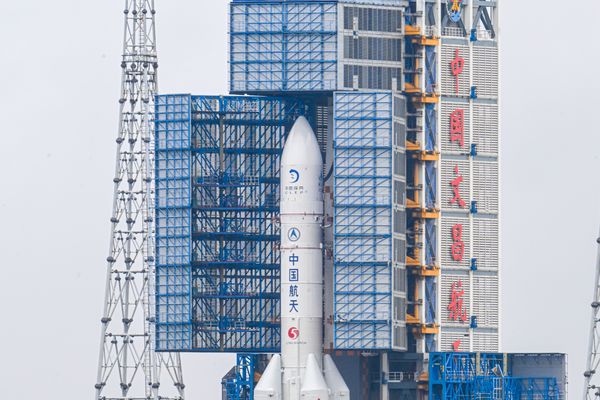
The combination of the Chang’e 7 lunar probe and the Long March-5 Y14 carrier rocket is transferred vertically to the launching area at the Wenchang Spacecraft Launch Site on August 19, 2026 in Wenchang, Hainan Province of China.

The combination of the Chang’e 7 lunar probe and the Long March 5 carrier rocket is transferred vertically to the launching area at the Wenchang Space Launch Site in the Chinese province of Hainan.

VCG/VCG via Getty Images

Join Our Community of Science Lovers!

China’s lunar ambitions took a hit after the country called off the launch of a spacecraft that it has aimed to make the first to ever land on the moon’s south pole.

Chang’e 7 was supposed to launch onboard a Long March 5 rocket on August 24, but the launch was scrubbed on Sunday evening, China’s Manned Space Agency (CMSA) said in a statement. Poor weather conditions linked to Typhoon Narra were likely a factor. As a result, the mission will be put on ice until at least 2027.

The decision to delay the mission was reached after extensive review, the CMSA said, and reflects the need for “absolute safety.”


On supporting science journalism

If you're enjoying this article, consider supporting our award-winning journalism by subscribing. By purchasing a subscription you are helping to ensure the future of impactful stories about the discoveries and ideas shaping our world today.


China and the U.S. are in a race to send humans back to the moon, a feat that that U.S. accomplished in the 1960s and that has never been achieved by any other country. Chang’e 7 is to play to a crucial part in China’s ambitions: the probe is designed to search for frozen water in the Shackleton Crater, a pit that spans some 21 kilometers (13 miles) and sits beside the lunar south pole.

No spacecraft has ever landed in that region, which scientists consider to be among the likeliest places to find water on the moon. Locating water that can be used by humans is vital to establishing any long-term lunar presence. NASA and China are eyeing the region to establish a crewed base—and because this real estate is so precious, it matters who gets their first.

NASA plans to establish a lunar colony by 2036, while China hopes to begin construction of the International Lunar Research Station, a moon base built in collaboration with Russia, in 2031. The CMSA has stated it aims to put humans on the lunar surface no later than 2030, while NASA’s Artemis IV mission to land humans on the moon for the first time in more than half a century is tentatively scheduled for early 2028.

Subscribe to Support Independent Journalism

Great science journalism requires human expertise, time, effort and creativity. And it costs money. That’s why I and the journalists here at Scientific American hope you’ll join our community.

When you subscribe, you are supporting staff and freelance journalists who are passionate about telling science stories that are true, important and compelling. Our editors and reporters are often experts in their fields, which means they understand the nuances of big discoveries and can untangle the breakthroughs from the hype. With a subscription, you are also supporting rigorous fact-checking to ensure the words we publish are precise and accurate. And you’re supporting original illustrations, graphics and photos that bring you closer to an advanced laboratory, an ice sheet in Antarctica or a space mission in orbit. You’re helping us craft other types of high-quality journalism as well: Our newsletters are carefully written, edited and curated by staffers you have or will come to know and love. Our Science Quickly podcast is based on original reporting, collaboration with editors and scientists and exacting production.

Subscriptions keep this engine running so we can continue to deliver thoughtful, rigorous and independent science journalism to you. In an era of viral misinformation, this work is crucial. If you value what we do, I hope you’ll consider joining us as a subscriber

Thank you,

Jeanna Bryner, Editor in Chief, Scientific American

Subscribe