
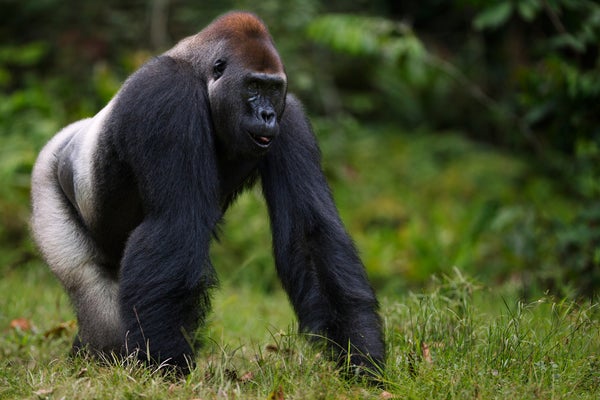
Human evolutionary science has long been caught up in a debate: Did our last common ancestor with apes walk on its knuckles, like chimpanzees do, or was it more flat-handed? The answer to that question may lie in the anatomy of modern apes and extinct human species’ wrists.
The human-ape family tree doesn’t follow a straight path; it’s gnarled and branching. Scientists estimate it sprouted sometime between eight million and six million years ago, when an unknown ancestral species split into two lineages: nonhuman apes, such as chimpanzees and bonobos, and hominins, upright-walking primates such as Neanderthals, Denisovans and anatomically modern humans.
In the absence of any fossil of this last common ancestor, it’s difficult for scientists to know what this creature may have looked like or how it behaved. While the search for such a fossil continues, some researchers have turned to other, less direct means of studying our ancient lineage, including fossils of extinct human “cousins” in the family tree, as well as the biology of modern humans and apes.
On supporting science journalism
If you're enjoying this article, consider supporting our award-winning journalism by subscribing. By purchasing a subscription you are helping to ensure the future of impactful stories about the discoveries and ideas shaping our world today.
In a new study published on Tuesday in the journal Proceedings of the Royal Society B: Biological Sciences, researchers utilized both methods—they analyzed scans of wristbones from nonhuman primates such as gorillas, orangutans and chimpanzees, as well as more than 50 hominin wristbone fossils. They found evidence that humans and our closest primate relatives—African apes—share wrist traits that may be related to walking on knuckles, although more research is needed to say definitively what a more ancient human species used those traits for, the authors say.
“There appear to be traits which evolved in the common ancestor of humans and African apes that, based on existing biomechanical research, could have been advantageous for knuckle walking,” says Laura Hunter, who conducted the research while a Ph.D. student at the University of Chicago. Some of the features include a “reorganization” of bones on the thumb side of the wrist in both knuckle-walking apes and humans, Hunter says.

A diagram showing seven of eight wristbones. (The eighth bone, the pisiform, is pea-shaped in humans and rod-shaped in nonhuman apes. It was excluded from the study for feasibility reasons.)
“Did Modern Human Carpal Morphology Evolve from Knuckle Walking Traits?” by Laura E. Hunter et al., in Proceedings of the Royal Society B: Biological Sciences, Vol. 293. Published online May 19, 2026
The study is “excellent,” says Tracy Kivell, director of the department of human origins at the Max Planck Institute for Evolutionary Anthropology in Leipzig, Germany, who was not involved with the new research. While previous studies working to answer this question have focused on specific wristbones, this is “most comprehensive analysis of the wrist that we’ve seen yet,” Kivell says.
Hunter and her colleagues theorize that these shared traits may have “stuck around” in the human lineage through our evolutionary history not for knuckle walking but because they happened to also be advantageous for “object manipulation or sophisticated tool behaviors,” she says—a process biologists call “exaptation.”
There are some important caveats to the work. For one, the study is focused on just the wrist—it doesn’t reveal much about other parts of the body that may have been involved in knuckle walking or movement broadly, Kivell says.
The other wrinkle is that scientists can’t know for sure whether similarities between the human and ape wrists prove our common ancestor walked on its knuckles, if they were used in another wrist function such as climbing or if they are just a relic of our species’ relative proximity on the primate family tree. “I think we won’t ever know this answer until we find fossils from that time period,” Kivell says.
“I think it is important to emphasize that the title is a question, not a statement,” Hunter says, referring to the study, whose title asks, “Did Modern Human Carpal Morphology Evolve from Knuckle Walking Traits?” “There’s still a lot of work that definitely can be done to really figure out what exactly was happening with our ancestors,” she adds.
That’s part of the difficulty in studying fossils, Hunter notes—because the species are extinct, we may never know how our ancestors behaved.
“If only we could go back in time and see what they were doing,” she says.