
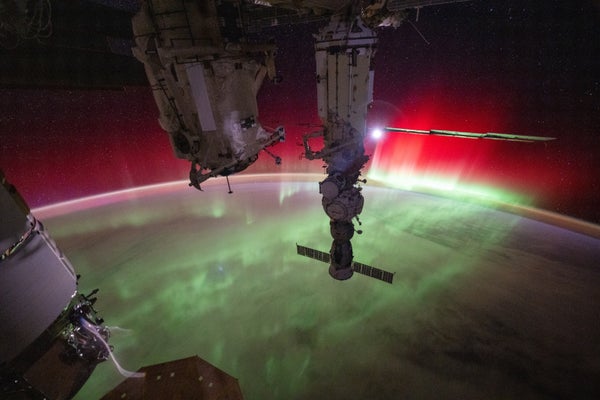
A heavy but harmless solar storm collided with Earth over the weekend, fueling shimmering auroras centered on the North and South Poles. In the Northern Hemisphere, the dancing blue, green and pink displays appeared as far south as Texas and Mississippi—and an astronaut onboard the International Space Station (ISS) captured the scene from above in a mesmerizing time-lapse video that also shows off the moon and sunrise.
Astronaut Matthew Dominick captured this stunning time-lapse of the Northern Lights from the International Space Station. NASA/Matt Dominick
The storm has subsided, but people in Canada and some other northern regions may still glimpse flashes of color in the night sky. A large group of sunspots may pass into Earth’s view this weekend and produce solar flares that could keep up the auroral activity.
On supporting science journalism
If you're enjoying this article, consider supporting our award-winning journalism by subscribing. By purchasing a subscription you are helping to ensure the future of impactful stories about the discoveries and ideas shaping our world today.
This most recent round of auroras came from a barrage of five solar outbursts called coronal mass ejections, or CMEs. These are naturally occurring eruptions of magnetized plasma that sometimes hurtle towards Earth, disrupting our planet’s magnetic field. When that happens, the resulting solar storm produces charged particles that collide with elements in the Earth’s atmosphere to create auroras. For example, reactions with atomic oxygen produce red or green light displays.
Solar storms don’t just create auroras, though—they can also jostle satellites, short Internet cables and overwhelm the power grid. The recent storm reached a strength of G4, or “severe,” at its peak. That level is one notch below that of a May storm that was well-managed but stymied the work of satellite operators and confused some GPS-guided farming equipment. The scale space weather experts use to rate solar storms ranges from G1 (minor) to G5 (extreme), and both G4 and G5 events are uncommon. For both the May storm and this one, the National Oceanic and Atmospheric Administration warned major power grid operators and air-traffic controllers about potential technological effects, allowing them to implement protective measures such as radiation shields and back-up systems. As a result, critical infrastructure appears to have made it safely through this latest storm.
“Most space weather events, even those in the extreme category, can be mitigated successfully,” says Shawn Dahl, a space weather forecaster at NOAA’s Space Weather Prediction Center. People “can watch the aurora, enjoy the beautiful show and focus on the spectacular rather than the consequential.”
NASA astronaut Matthew Dominick secured his view by pointing a camera out the window of the space station’s cupola. In the video he captured, vibrant fuchsia and pale green auroras undulate above Earth’s surface. The moon appears in the background, and later the sun rises and illuminates a Soyuz spacecraft in a blue light. In a phone call from the ISS, Dominick told Scientific American that he has been working on the technique to capture time-lapse videos for some time and was excited to show people how breathtaking auroras look from space. “It was intense,” Dominick said. “I'm up here with a couple of veteran folks that have spent more than a year of their life in space across missions, and all of them have unanimously said they’ve never seen anything like it.”
People interested in witnessing the lights themselves—albeit from the ground—should check the Space Weather Prediction Center’s 30-minute aurora forecast and look late at night from a location that’s away from city perimeters to avoid light pollution that can obscure the show. The best vantage points are those closer to Earth’s poles, and auroras typically appear brightest within an hour or two of midnight (between 10 P.M. and 2 A.M. local time). Digital cameras may also capture faint forms of light that are invisible to the naked eye, Dahl adds.
Those who miss this week’s display will likely have future chances to spot auroras. Scientists predict that several strong solar storms will rock the planet in the next two years as the sun moves through the “maximum” of its 11-year magnetic cycle. At the cycle’s peak, solar outbursts such as coronal mass ejections occur as frequently as two or three times per day. The enhanced activity increases the chances of solar storms and their by-products: majestic auroras and potential technological disruptions.
Additional reporting by Kelso Harper.