New Issue: Orbital Catastrophe Ahead? Read Now

Early Arctic Cold Blast Will Sweep Across the U.S., Potentially Breaking Records

An early cold snap will chill much of the U.S., potentially breaking records in the Southeast

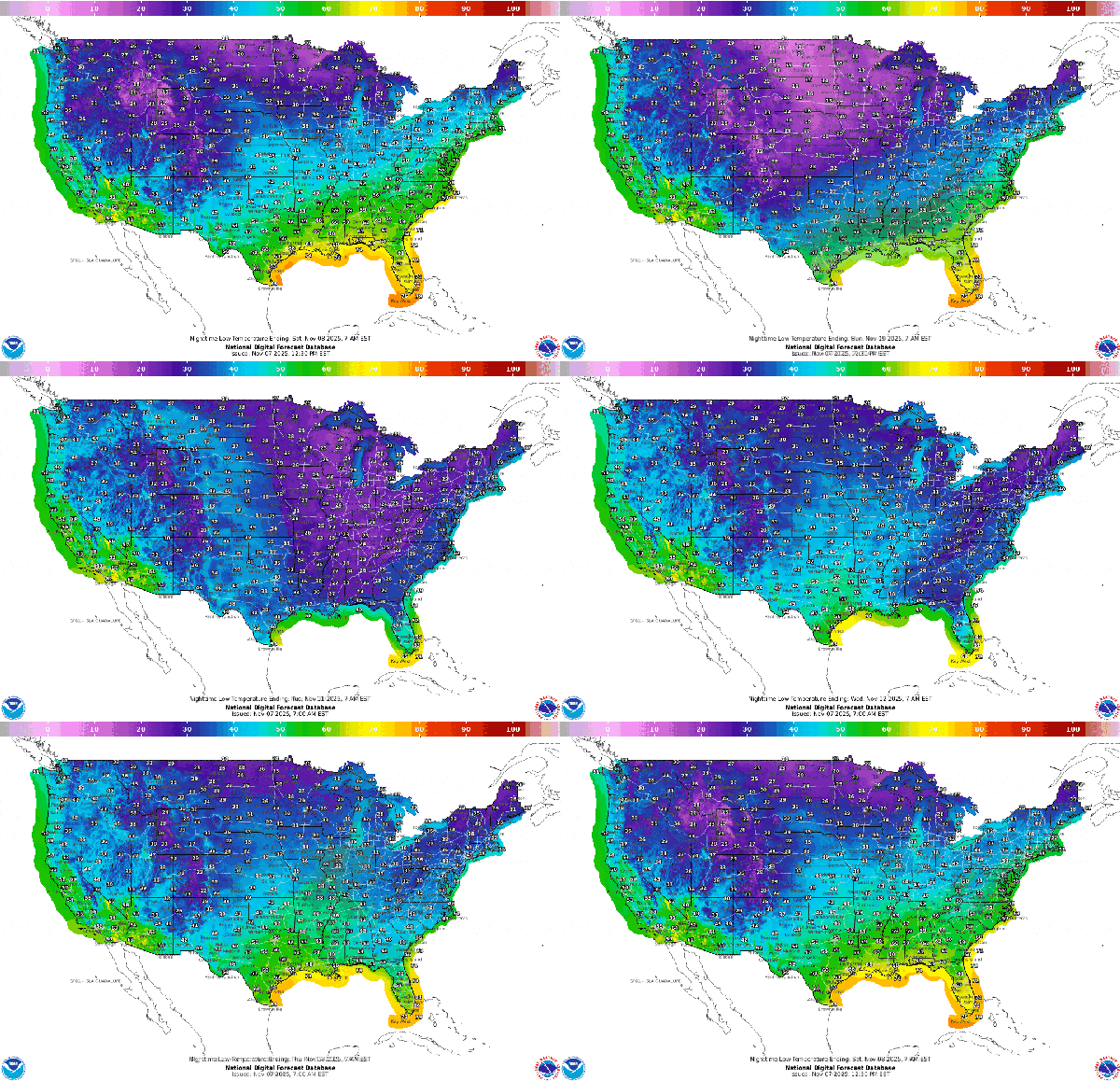
A map of the US showing color-coded temperatures. The blues and purples showing the coldest temperatures push southward and eastward over time

Temperatures will drop across country as a cold snap moves first into the central U.S. and then eastward.

NOAA

Join Our Community of Science Lovers!

A blast of frigid air will plunge into the central U.S. and move eastward over the next few days, potentially breaking records in a notably early cold snap. The most extreme cold will occur around November 10.

The event will be particularly notable in the southeastern U.S., where daytime and nighttime low temperatures may break records that have been held for decades, including some that have been in place for more than a century. All told, half the residents of the contiguous U.S. could experience temperatures below freezing, according to calculations by the New York Times.

The freezing temperatures may surprise many, given that swaths of the nation are currently relatively warm, with daily highs above average—parts of central Texas are even expected to crack 90 degrees Fahrenheit (32 degrees Celsius) on Friday, says Ashton Robinson Cook, a meteorologist at the National Weather Service’s Weather Prediction Center.


On supporting science journalism

If you're enjoying this article, consider supporting our award-winning journalism by subscribing. By purchasing a subscription you are helping to ensure the future of impactful stories about the discoveries and ideas shaping our world today.


But cold air is currently brewing over Canada. Simultaneously, a mass of low-pressure air is developing over the Great Lakes. Because air swirls counterclockwise around low-pressure systems, Cook says, the alignment will sweep frigid air deep into the central U.S. next Sunday and, from there, into the southeastern states next Monday and Tuesday.

Predominantly, the system will only affect temperatures, but parts of the Great Lakes region may see a few inches of snow. Cook notes that the precipitation forecast is still subject to change, however.

Because severe low temperatures will be concentrated in the Southeast, Floridians will need to beware of a notable regional hazard: cold-shocked iguanas that fall out of trees after losing blood flow, which can begin at temperatures as high as 50 degrees F (10 degrees C). Any such animals should be left alone, experts note, as they might not take kindly to rescue attempts once they warm up again.

Fortunately, the blast of frigid air will dissipate quickly, with temperatures rising throughout the southern and southeastern U.S. by next Wednesday. “The silver lining with this impending cold snap is that it should be relatively brief,” Cook says. “But it could be pretty intense.”

Meghan Bartels is a science journalist based in New York City. She was previously a senior reporter at Scientific American. Before that she spent more than four years as a writer and editor at Space.com, as well as nearly a year as a science reporter at Newsweek, where she focused on space and Earth science. Her writing has also appeared in Audubon, Nautilus, Astronomy and Smithsonian, among other publications. She attended Georgetown University and earned a master’s degree in journalism at New York University’s Science, Health and Environmental Reporting Program.

More by Meghan Bartels

Subscribe to Support Independent Journalism

Great science journalism requires human expertise, time, effort and creativity. And it costs money. That’s why I and the journalists here at Scientific American hope you’ll join our community.

When you subscribe, you are supporting staff and freelance journalists who are passionate about telling science stories that are true, important and compelling. Our editors and reporters are often experts in their fields, which means they understand the nuances of big discoveries and can untangle the breakthroughs from the hype. With a subscription, you are also supporting rigorous fact-checking to ensure the words we publish are precise and accurate. And you’re supporting original illustrations, graphics and photos that bring you closer to an advanced laboratory, an ice sheet in Antarctica or a space mission in orbit. You’re helping us craft other types of high-quality journalism as well: Our newsletters are carefully written, edited and curated by staffers you have or will come to know and love. Our Science Quickly podcast is based on original reporting, collaboration with editors and scientists and exacting production.

Subscriptions keep this engine running so we can continue to deliver thoughtful, rigorous and independent science journalism to you. In an era of viral misinformation, this work is crucial. If you value what we do, I hope you’ll consider joining us as a subscriber

Thank you,

Jeanna Bryner, Editor in Chief, Scientific American

Subscribe