
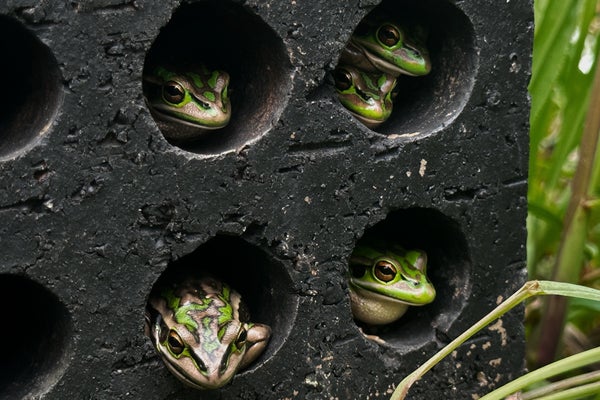
Frogs and other amphibians the world over are dying in droves from a nasty fungal infection that penetrates their skin and stops their heart. Scientists now have evidence that offering frogs their own little “sauna” in the winter might help them fend off the disease.
The illness, called chytridiomycosis or chytrid disease, was first identified a few decades ago. Since then, it has killed off at least 90 amphibian species worldwide and severely affected hundreds of others. Scientists have noticed that the infection, caused primarily by the fungus Batrachochytrium dendrobatidis, seems more deadly in cold, wet climates than in warm, dry ones.
Researchers studying chytrid have previously focused on observing the infection and its effects in the wild. For a new study in Nature, scientists took things a bit further: they provided infected frogs with artificial heat-trapping structures akin to saunas.
On supporting science journalism
If you're enjoying this article, consider supporting our award-winning journalism by subscribing. By purchasing a subscription you are helping to ensure the future of impactful stories about the discoveries and ideas shaping our world today.

Anthony Waddle/Macquarie University
“It’s an idea that’s been around for a really long time, that if you can create scenarios where there’s warm habitat for frogs, you can protect them from chytrid,” says study co-author Anthony Waddle, a conservation biologist at Macquarie University in Australia.
The team focused on an Australian species called the green and golden bell frog (Litoria aurea), which has been hit by population declines and territory shrinkages since chytrid arrived. “It’s a pretty meaty, fat little frog,” Waddle says, noting the appeal of the complex green and gold patterning that inspired the animal’s name. Despite these frogs’ dressy appearance, they aren’t snobs—they are happy to live in disturbed areas and alongside humans, making the animals an attractive species to study. “They’re really like the pigeons of frogs,” Waddle explains.
In a series of experiments, Waddle and his colleagues found that when the frogs could pick their own temperature-controlled environment, they preferred things around 84 degrees Fahrenheit (29 degrees Celsius)—toastier than the temperature range in which chytrid kills most efficiently. Exposing infected frogs to 90-degree-F (32-degree-C) heat helped them clear the infection and gave them resistance against future exposure, although the researchers aren’t yet sure precisely why.

Green and gold bell frog.
Anthony Waddle/Macquarie University
The scientists then provided little enclosures that included black-brick structures designed to absorb heat. Half of the enclosures had shades that reduced this heating, and half were left uncovered to let the structures act as saunas. Here, too, frogs offered hotspots were better able to fight off chytrid and gain immunity.
Just because the setup worked with this particular species, of course, doesn’t mean it would work for all frogs currently threatened by chytrid. For example, alpine frogs used to cold temperatures would struggle to survive in a sauna, Waddle says. But he adds that the study’s findings represent an important change of tone for a field that has recently been dominated by despair. “The prevailing idea from these pillars in our field was that nothing’s going to work,” he says.
Ana Longo, a disease ecologist and evolutionary biologist at the University of Florida, who was not involved in the study, says she would like to see “this very simple but very elegant experiment” tested first in frog species with strong populations and then attempted with animals struggling more in the face of chytrid.
“This gives a precedent that we can try some very bold ideas if we want to do something against this fungus,” Longo says. “It’s changing the narrative that we can’t do something against the spread of this pathogen.”
A version of this article entitled “Frog Saunas” was adapted for inclusion in the October 2024 issue of Scientific American. This text reflects that version, with the addition of some material that was abridged for print.