
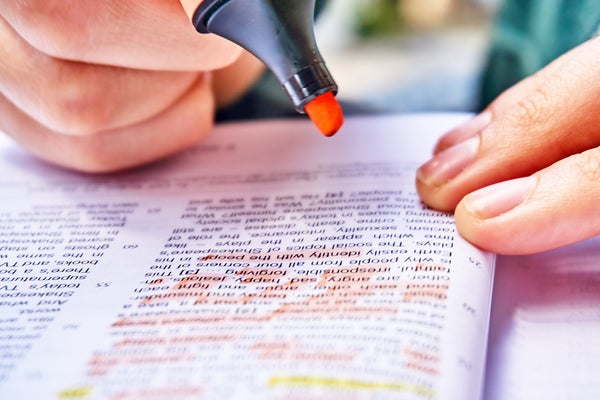
Readers on TikTok and Instagram are making the aesthetics of reading more visible than ever with creative, and often intricate, annotations. Called marginalia, these markups can be elaborate, with notes that nearly fill full pages and that are color-coordinated with the book’s cover. The emergence of such bookish note-taking has sparked a debate between enthusiasts and skeptics: Is the practice of marginalia a bad habit or a beneficial endeavor?
Marginalia have a long history: Leonardo da Vinci famously scribbled thoughts about gravity years before Galileo Galilei published his magnum opus on the subject; the discovery was waiting under our noses in the margins of Leonardo’s Codex Arundel. Famous writers such as Herman Melville and Edgar Allan Poe are somewhat known for their marginalia, making their biographers both overjoyed and overwhelmed. Just last year Ann Patchett, a staple on any modern fiction shelves, told Literary Hub about the joys of reading her own books and annotating patterns she never before noticed. She created a unique edition of Tom Lake for dedicated deep readers, in which she included her own annotations on her own writing style. The Patchett-ception worked: the special edition raised money at an auction for indie bookstores during 2020, and the endeavor inspired the writer to annotate a copy of her beloved classic Bel Canto as well.
Alongside this evolution of margin additions, neuroscientists have been researching the cognitive effects of writing, pencil to paper. For instance, a study of electrical activity in the brain published in Frontiers in Psychology found that handwriting itself helps a person remember and understand more about they’ve read and written. Maryanne Wolf, director of the Center for Dyslexia, Diverse Learners and Social Justice at the University of California, Los Angeles, discussed the importance of annotating with NPR in 2022. In classic former-English-major fashion, she paraphrased Marcel Proust in explaining that deep reading allows us to “go beyond the wisdom of the author to discover our own.” In that vein, marginalia can help the annotator understand the material deeply enough to further develop their own interpretation of the text, she said. In the Journal of Language Learning and Teaching, foreign language professor Demet Yayli of Pamukkale University in Turkey, explained that in writing workshops, especially for genre-fiction writing, deep reading—which includes annotations—is critical in helping students articulate their interpretations and maintain their own “learner autonomy.”
On supporting science journalism
If you're enjoying this article, consider supporting our award-winning journalism by subscribing. By purchasing a subscription you are helping to ensure the future of impactful stories about the discoveries and ideas shaping our world today.
As writer and editor Caitlin Welsh pointed out in a Guardian article covering the recent trend, the kids like annotating. Annotation styles online seem to differ widely from the annotations expected in academia. As long as annotating serves the reader a purpose, any style is fine, experts say. Highlighting every piece of dialogue from your favorite character may seem unreasonable to an outsider, but that might help someone understand why they like that character or how the writer developed the character’s story. Romance readers are known to highlight, dog-ear and annotate their favorite romantic or erotic scenes. (I may be overly romanticizing secondhand books, but there’s nothing more intimate than finding a previous reader’s favorite kissing scene.)
I’ve been reading annotated books my whole adult life; growing up dutifully watching the character of Rory Gilmore and her cringe-worthy obsession with Jess Mariano’s annotation style in Gilmore Girls left me with a deep desire to be well read and thus well respected. Pretending to be the smart person who annotates their books can lead to becoming that person.
If the “book-tokers” or “book-fluencers” want to coordinate their bookmark, highlighter, sticky notes and gel pen to match the cover of their favorite new science-fiction tale, that’s great. Scribbling in the margins isn’t hurting anyone, so let them eat cake even if they smudge the page.