
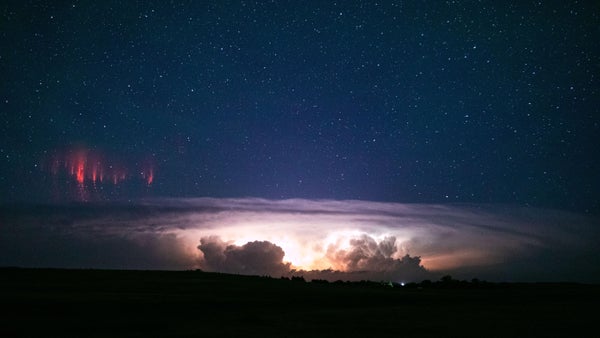
If you’re ever lucky enough to spot the atmospheric drama of a red sprite, look closely, and you may catch a glimpse of green glow that speaks to Earth’s position in the solar system and sheds light on a mysterious layer of our planet’s atmosphere.
That’s according to researchers who examined the source of a strange phenomenon dubbed “mesospheric green emissions from excited oxygen in sprite tops,” or, more colloquially, “mesospheric ghosts.”
The mesosphere is a layer of the atmosphere about 30 to 50 miles above Earth’s surface. That makes it a tricky place for scientists to study, according to Hans Stenbaek-Nielsen, a space scientist at the University of Alaska Fairbanks, who was not involved in the new research. “It’s too high for airplanes, and it’s too low for satellites, so it’s difficult to probe what is going on at that altitude region,” he says.
On supporting science journalism
If you're enjoying this article, consider supporting our award-winning journalism by subscribing. By purchasing a subscription you are helping to ensure the future of impactful stories about the discoveries and ideas shaping our world today.
Sprites and the ghosts that sometimes accompany them provide a window through which scientists can peek inside the mesosphere. Sky watchers only discovered the eerie green glow of mesospheric ghosts in 2019. As their full name suggests, these displays lurk above sprites, which are vibrant red lights that look almost like wildfires in the sky and are caused by differences in electric charge within thunderstorms.
Sprites themselves, although very brief, are much easier to see—and to study—than the green ghosts that accompany about one in every 100 of the red displays, says María Passas Varo, a space scientist at the Institute of Astrophysics of Andalusia in Spain and a co-author of the new research. She and her colleagues have spent more than four years gathering data about some 2,000 sprites, she says, but in only one case has the team snagged sharp observations of the green glow hovering over the sprite.
That event occurred over the Mediterranean Sea on the evening of September 21, 2019, and it is the subject of the new research. Passas Varo and her colleagues examined the ghost using spectroscopy, which splits light according to its wavelength. The light we see as green, for example, has a wavelength of around 510 nanometers, whereas the wavelengths of blue and yellow shades are shorter and longer, respectively.
The study researchers used a spectrograph that is much more finely tuned than the human eye. It was able to distinguish a host of individual wavelengths of light that contributed to the overall green glow.
The result is a sort of barcode of wavelengths detected in the mesospheric ghost. And because scientists know that different atoms and ions emit different wavelengths of light when they glow, Passas Varo and her colleagues could translate their green barcode into a list of chemical substances present in the atmosphere. The scientists expected to find atomic oxygen, which causes the eerie green auroras that paint the polar skies—and they did. But they also spotted emissions from metal in the form of atomic iron and nickel, among other signals, which Passas Varo says she didn’t expect at this altitude.
The atmosphere has access to a clear source of metals—from the constant barrage of microscopic particles of interplanetary dust hitting the planet’s outermost layers. Much of this metal is believed to stay at somewhat higher altitudes than the ghost studied by Passas Varo and her colleagues, however. They suspect that a massive wave through the atmosphere, called a gravity wave, could have pushed the metallic layer low enough to affect the ghost, she notes. That could also explain why mesospheric ghosts are much rarer than the sprites they form above: they may need metals to be present.
The research makes for a valuable glimpse inside the elusive mesosphere, Stenbaek-Nielsen says. “This is exciting, that there are other things up there,” he adds.