
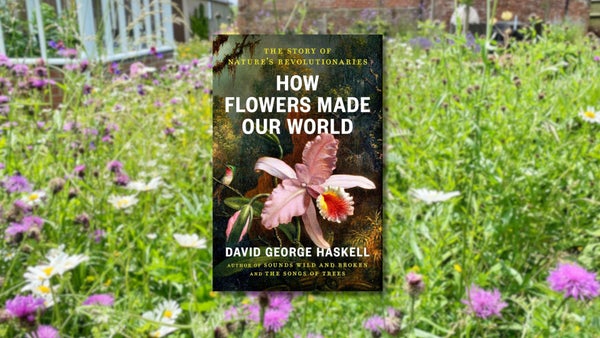
Many weddings, funerals, graduations and gestures of congratulations have one thing in common: flowers. From our perfumes to home decor, modern humans live in a floral world—but we haven’t always. David George Haskell’s new book How Flowers Made Our World: The Story of Nature’s Revolutionaries argues that flowers have an incredibly overlooked history of diversity, community and some truly extraordinary evolutionary paths. The book opens with Haskell cheekily insisting for a bartender to go ahead and add a floral garnish to his cocktail, and that wry indulgence in the fun of flowers and in deeper botanical knowledge is found on every page.
Scientific American spoke with Haskell on how grass is the “green Prometheus,” how old magnolias really are and why we love roses although we’re not even pollinators.
[An edited transcript of the interview follows.]
On supporting science journalism
If you're enjoying this article, consider supporting our award-winning journalism by subscribing. By purchasing a subscription you are helping to ensure the future of impactful stories about the discoveries and ideas shaping our world today.
Your book digs into the science of how flowers, far from being passive objects to enjoy, are active, resilient agents. Take the oldest ones that we have a real record of: magnolias. Can you tell me about how they revolutionized the world “with beauty, bisexuality, and motherhood”?
They’re revolutionary in the sense that they overturned the old order of Earth and built new ecosystems, and they did that through a number of means. Flowers produced a structure that is like an advertising billboard and a sensorium of delight. When a flower matures, the ovary of the flower matures into a fruit, and that fruit encloses the seeds. So it’s a form of botanical motherhood, of intergenerational care that other plants do not have. Then the bisexuality part here, I’m talking about biological bisexuality, hermaphroditism: by combining male and female functions into the same structure, what we call a flower, the plants manage to work much more effectively with pollinators. To this day, 90 percent of flowers are still both male and female within the same structure.
You describe orchids, which evolved after magnolias, as essentially antimagnolias. Can you tell me how exactly?
Magnolias have this beautiful open big cup. Any pollinator who wants to come along can come and get a taste of the pollen and maybe get a little bit of nectar depending on the magnolia species. Orchids are often massively specialized on just one or two species of insect, and they have really, really reduced sexual parts. Even though their petals might be kind of big and crazy, the sexual parts are miniaturized—almost as small as you could possibly have. So the magnolia is a generalist, and the orchids are very, very specialized, sometimes in cooperative ways with their pollinators, and sometimes in sneaky exploitative ways, like pretending to be a female wasp so male wasps try and mate with you.
It’s interesting to think about flowers making decisions to deceive their pollinators. Why do you think this happens in nature, and why do we see it so often in flowers?
For orchids, the first step is often to specialize on a small number of insects because you get more faithful couriers for your pollen that way. Orchids discovered through natural selection that if they made a flower that looked like it had a lot of pollen and nectar but didn’t actually have any, the insects would visit anyway without ever having to be actually rewarded. Once they started that, it seems the next step in evolution was to produce particular aromas that mimic the sex pheromones of individual species of insects. Each step generally involves more and more specialization, which is more efficient, but it also kind of makes you vulnerable, right? If your pollinator goes extinct or the habitat changes so your pollinator isn’t there anymore, you’re kind of stuck.
You have a whole chapter dedicated to another fascinating adaptation you discuss in the book: grasslands and how they rely on controlled burnings. Can you talk more about those?
Remember, grasses are flowering plants, even though their flowers are inconspicuous and wind-pollinated. They’re really important. We evolved to eat grasses and to live in grassy habitats. To bring back native grasslands [as many conservation groups aim to do], the key thing you need to do is bring back fire because grasses for tens of millions of years have coevolved with fire. A grass grows its body by slithering along the ground and sending up temporary leaves to photosynthesize—what we call the blades of grass—that then, later in the season, catch fire. And that seems kind of crazy. Why would you burn yourself? Well, by burning the prairie to the ground, you’ve eliminated all the competition, and next spring you can leap back out.
I participated in some of the restoration of these native grasslands with these nonprofits that involved sowing grasses and some other wildflower seeds as well. To see acres and acres of grassland all catch fire all at once is kind of terrifying and was a lot more acoustically rich than I thought it was going to be. The next spring, that whole young prairie was filled with little green sprouts. The songbirds were coming in to breed there, and the butterflies and some of the wildflowers that live among the grasses were all sprouting up. For tens of millions of years the evolutionary genius of many grasses has been to be the green Prometheus: to bring fire down from the gods and to, in a way, domesticate it.
The concerns around flowers’ gender and sexuality goes back really early in our botanical history. Why were early botanical records considered so scandalous?
People may remember from high school biology that Carl Linnaeus is the person who came up with the classification system that we still use today. Genus and species and orders and classes and so forth—he based that whole classification system on the arrangement of the sexual parts inside flowers. He was totally obsessed with flowers. He later expanded that classification beyond flowers to animals, and he included some really horribly racist stuff about humans—so he left some really pretty horrific legacies as well.
The classification of flowers was considered scandalous because [people] didn’t want to allow students to be looking at the male and female parts of flowers. [They thought] this might corrupt the morals of the students. [Linnaeus] didn’t just talk about male and female; he said there are many “husbands” together with the wife in the same bed, so he really kind of leaned in to the salacious nature of it. I should say also, though, that the classification caught on not just because it was kind of raunchy and kind of seemed edgy at that time [but also because] it’s a fairly easy classification system to learn, right? In an afternoon you can learn to count how many anthers are in a flower, how many are the pollen-producing parts, how many female parts are in there, and learn Linnaeus’s classification system quite rapidly.
A book about botanical history may not sound funny, but I laughed out loud a few times reading this! Can you tell me your favorite flower story that makes you laugh?
Well, the craziest one [comes from] our fascination with aromas. Think about a rose, right? People grow roses all over, and I love rose perfume, and just the smell of rose is really beguiling. We don’t eat roses. We’re not pollinators of roses. Roses evolved their aromas millions of years before humans even existed on this planet, mostly to speak to bumblebees and other insects. And yet we have constructed hundred-million-dollar industries around extracting rose, and people have devoted their whole lives to either creating these rosy aromas or figuring out how to grow them in fields or to extract the aroma through distillation.
We’re attracted to the appearance and the aromas of other humans because those are our friends and our family and our mates. But roses, really? We humans are so ridiculous in that way, devoting ourselves to things that evolved for other purposes. So it’s ridiculous at one level, but at another level, I think it’s really deeply beautiful. Applying a rose perfume to my skin or putting on a shirt that has roses on it or growing roses in my garden—that’s a form of self-expression. To express myself, I hybridize myself. So the self dissolves into the community, which is extraordinarily beautiful. That’s what the world needs more of—less individualism and more community action—and that’s what flowers have been doing all along.