New Issue: Orbital Catastrophe Ahead? Read Now

You need to see the ‘blood moon’ lunar eclipse this week

This near-total eclipse will be visible from the Americas, Africa and Europe—here’s how to see it

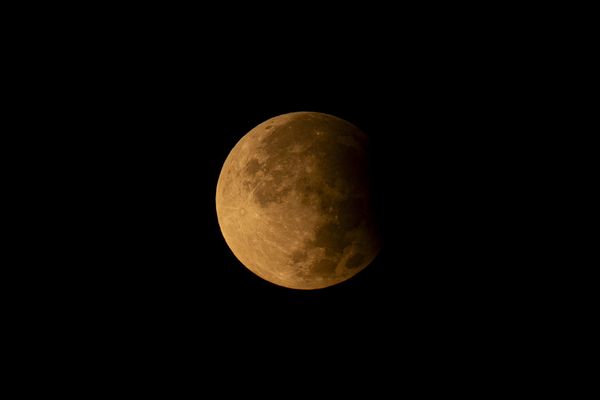
A reddish moon.

A partial lunar eclipse, as seen in Ankara, Türkiye on September 18, 2024.

Anadolu/Getty Images

Join Our Community of Science Lovers!

Sky-gazers who were disappointed not to catch the total solar eclipse this month have a consolation prize. This week people in the Americas, Africa and Europe can expect to see a near-total lunar eclipse in which Earth’s umbra—the shadow cast when the sun is blocked by our planet—will cover 96.3 percent of the moon.

The display will kick off at around 9:23 P.M. EDT on Thursday. But the show will truly begin at around 10:34 P.M. EDT that night. At that point, the moon will start to slip into Earth’s dark umbral shadow.

The moment of greatest eclipse will occur at around 12:13 A.M. EDT on August 28 (which happens to be Scientific American’s 181st birthday). Then our natural satellite is expected to become a “blood moon,” turning a reddish hue. The spectacle will be at least somewhat visible from any place in the U.S. except for certain areas of Alaska, according to NASA.


On supporting science journalism

If you're enjoying this article, consider supporting our award-winning journalism by subscribing. By purchasing a subscription you are helping to ensure the future of impactful stories about the discoveries and ideas shaping our world today.


A map showing the eclipse will be at least partially visible to viewers in the Americas, Africa and Europe.

A map showing where the eclipse will be visible in different phases.

NASA Scientific Visualization Studio

A lunar eclipse occurs when Earth passes directly between the sun and the moon. Because of how light bends and filters around our planet, blue light is scattered away, while red light reaches the moon, hence the “blood moon” monicker.

To see the eclipse, go outside to a safe, dark space at around 10:34 P.M. EDT on Thursday, when the moon will begin to cut into Earth’s umbra. Your eyes will need around 30 minutes to become accustomed to the dark.

This week’s lunar eclipse follows a total lunar eclipse in March and will be the second and last lunar eclipse of the year. But if you miss it, more celestial events are coming in 2027.

Two solar eclipses will take place next year—one on February 6 and the other on August 2. But you might want to make this lunar eclipse count: three lunar eclipses in 2027 will be “penumbral”—meaning the moon will pass through Earth’s penumbra, the fainter part of its shadow, which won’t make quite as spectacular a view. The next total lunar eclipse will take place on New Year’s Eve in 2028—what a way to ring in 2029!

Jackie Flynn Mogensen is a breaking news reporter at Scientific American. Before joining SciAm, she was a science reporter at Mother Jones, where she received a National Academies Eric and Wendy Schmidt Award for Excellence in Science Communications in 2024. Mogensen holds a master’s degree in environmental communication and a bachelor’s degree in earth sciences from Stanford University. She is based in New York City.

More by Jackie Flynn Mogensen

Subscribe to Support Independent Journalism

Great science journalism requires human expertise, time, effort and creativity. And it costs money. That’s why I and the journalists here at Scientific American hope you’ll join our community.

When you subscribe, you are supporting staff and freelance journalists who are passionate about telling science stories that are true, important and compelling. Our editors and reporters are often experts in their fields, which means they understand the nuances of big discoveries and can untangle the breakthroughs from the hype. With a subscription, you are also supporting rigorous fact-checking to ensure the words we publish are precise and accurate. And you’re supporting original illustrations, graphics and photos that bring you closer to an advanced laboratory, an ice sheet in Antarctica or a space mission in orbit. You’re helping us craft other types of high-quality journalism as well: Our newsletters are carefully written, edited and curated by staffers you have or will come to know and love. Our Science Quickly podcast is based on original reporting, collaboration with editors and scientists and exacting production.

Subscriptions keep this engine running so we can continue to deliver thoughtful, rigorous and independent science journalism to you. In an era of viral misinformation, this work is crucial. If you value what we do, I hope you’ll consider joining us as a subscriber

Thank you,

Jeanna Bryner, Editor in Chief, Scientific American

Subscribe