New Issue: Orbital Catastrophe Ahead? Read Now

With Melissa, 2025 Becomes Only the Second Season with More Than Two Category 5 Hurricanes

This is only the second time we’ve had more than two Category 5 storms in a single Atlantic hurricane season

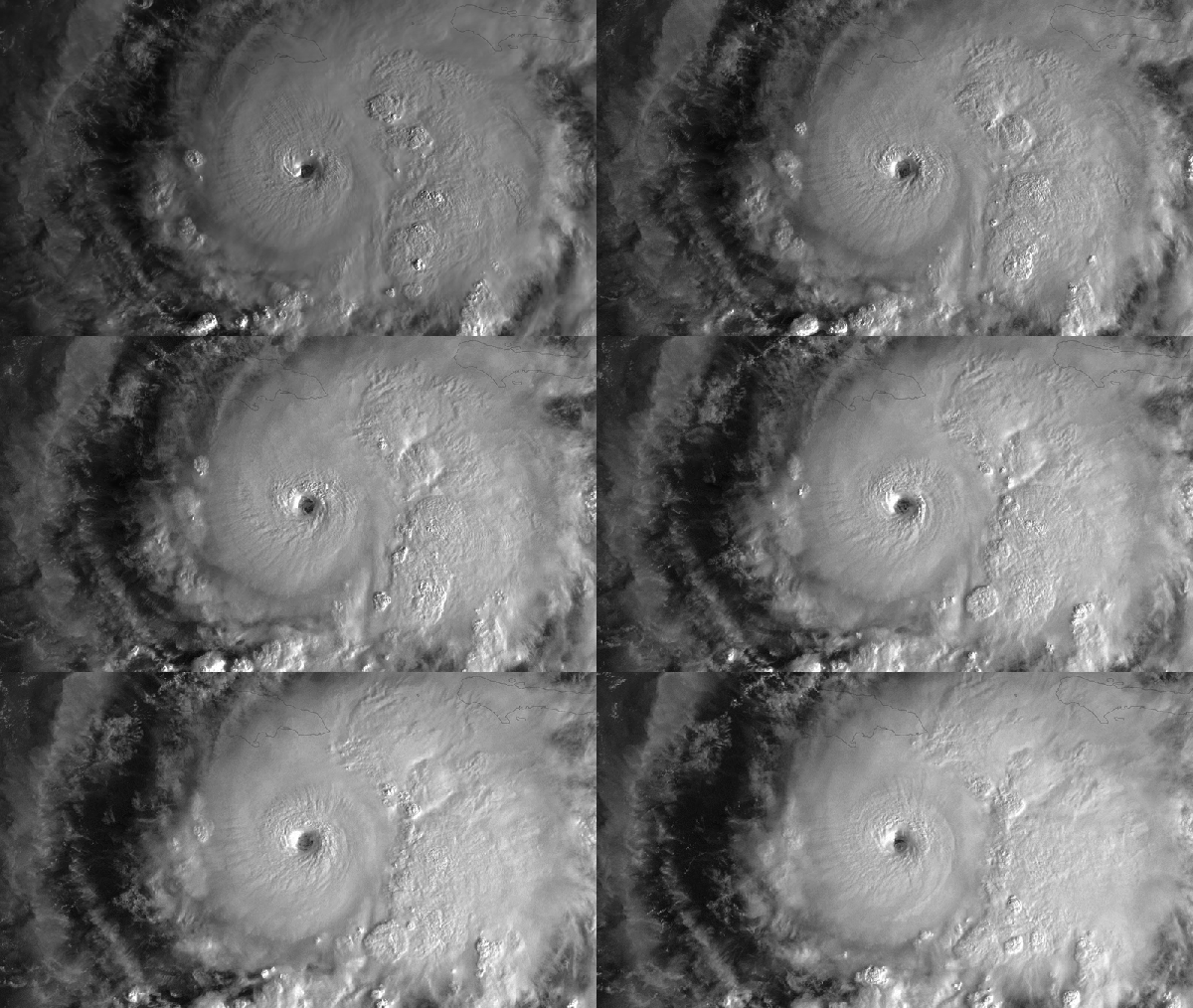
The swirling storm clouds of Hurricane Melissa

Hurricane Melissa swirls in the Caribbean Sea, as seen by the GOES-19 weather satellite operated by the National Oceanic and Atmospheric Administration.

Cooperative Institute for Research in the Atmosphere, Colorado State University/National Oceanic and Atmospheric Administration

Join Our Community of Science Lovers!

As it bears down on Jamaica, Hurricane Melissa has become the third Category 5 storm of the 2025 Atlantic season—just the second season on record to ever see more than two Category 5 hurricanes.

The only other Atlantic season to achieve this feat was the blockbuster one of 2005, which featured four Category 5 storms: Emily, Katrina, Rita and Wilma.

Hurricanes are categorized on the Saffir-Simpson scale based on their wind speeds: a storm becomes a Category 1 when its winds reach 74 miles per hour and a Category 5 when they reach 157 mph.


On supporting science journalism

If you're enjoying this article, consider supporting our award-winning journalism by subscribing. By purchasing a subscription you are helping to ensure the future of impactful stories about the discoveries and ideas shaping our world today.


Category 5 storms are rare—Melissa is only the 45th Category 5 in the Atlantic Ocean on record since 1851. These storms require a perfect alignment of prodigious available energy and conducive atmospheric conditions to reach and sustain such powerful wind speeds.

READ MORE: Hurricane Science Has a Lot of Jargon—Here’s What It All Means

Melissa was able to reach its 185-mph maximum wind speed by taking advantage of exceptionally warm waters in the Caribbean Sea. It underwent extreme rapid intensification, strengthening from a 70-mph tropical storm last Saturday morning to a 140-mph Category 4 hurricane on Sunday—twice the rate of the official threshold of rapid intensification. (The storm strengthened further later on Sunday and again on Monday.) That level of strengthening “is on the fringes of what’s ever been observed in the Atlantic basin,” wrote meteorologist Michael Lowry on his blog. On Tuesday morning, Melissa had a central pressure of 892 millibars, tying for the third most intense Atlantic hurricane on record and only the seventh to drop below 900 mb. Only five other known Atlantic storms have reached 185-mph winds.

With rising ocean temperatures, more storms are expected to undergo such rapid intensification and to intensify at faster rates. In a changing climate, hurricanes are also becoming stronger overall—one study found that climate change amplified the winds of every hurricane in 2024. That trend means more storms will reach the higher categories than they used to. A 2020 study, for instance, found that the proportion of tropical cyclones that reach Category 3 or higher has already grown in recent decades.

There have been seven Category 5 storms in the past three years and 13 in the past decade, wrote weather writer Dennis Mersereau on Bluesky.

Editor’s Note (10/28/25): This article was edited after posting to update Hurricane Melissa's wind speed.

Andrea Thompson is senior editor for Earth and environment at Scientific American, covering the environment, energy and Earth sciences. She has been covering these topics for nearly two decades. Prior to joining Scientific American, she was a senior writer covering climate science at Climate Central and a reporter and editor at Live Science, where she primarily covered earth science and the environment. She has moderated panels, including as part of the United Nations Sustainable Development Media Zone, and appeared in radio and television interviews on major networks. She holds a graduate degree in science, health and environmental reporting from New York University, as well as a B.S. and an M.S. in atmospheric chemistry from the Georgia Institute of Technology. Follow Thompson on Bluesky @andreatweather.bsky.social

More by Andrea Thompson

Subscribe to Support Independent Journalism

Great science journalism requires human expertise, time, effort and creativity. And it costs money. That’s why I and the journalists here at Scientific American hope you’ll join our community.

When you subscribe, you are supporting staff and freelance journalists who are passionate about telling science stories that are true, important and compelling. Our editors and reporters are often experts in their fields, which means they understand the nuances of big discoveries and can untangle the breakthroughs from the hype. With a subscription, you are also supporting rigorous fact-checking to ensure the words we publish are precise and accurate. And you’re supporting original illustrations, graphics and photos that bring you closer to an advanced laboratory, an ice sheet in Antarctica or a space mission in orbit. You’re helping us craft other types of high-quality journalism as well: Our newsletters are carefully written, edited and curated by staffers you have or will come to know and love. Our Science Quickly podcast is based on original reporting, collaboration with editors and scientists and exacting production.

Subscriptions keep this engine running so we can continue to deliver thoughtful, rigorous and independent science journalism to you. In an era of viral misinformation, this work is crucial. If you value what we do, I hope you’ll consider joining us as a subscriber

Thank you,

Jeanna Bryner, Editor in Chief, Scientific American

Subscribe