
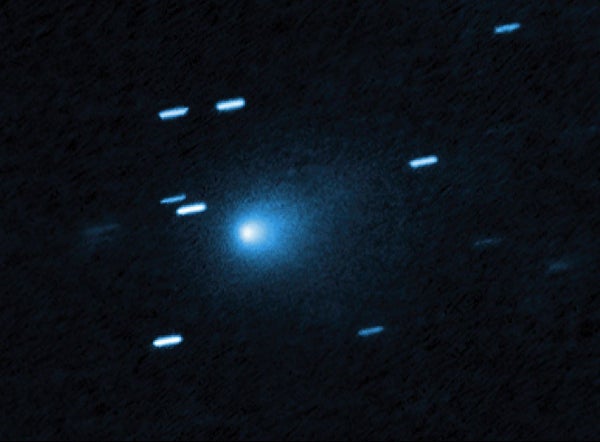
The latest interstellar visitor to be discovered in our solar system was born somewhere in the universe that was nothing like our home and, according to a new study, a time long before the solar system even formed—in the infancy of the cosmos.
Spotted in 2025, 3I/ATLAS is the third interstellar comet that astronomers have identified flying through our solar system, after 1I/ʻOumuamua and 2I/Borisov. Since then researchers have used the space-based James Webb Space Telescope (JWST) and the ground-based Atacama Large Millimeter/submillimeter Array (ALMA) in Chile to study the gas spouting out from 3I/ATLAS as the sun’s heat has burned up its icy insides. Chemical isotopes contained in the gas reveal details of the comet’s murky history—and a new study published in Nature (after it was posted online as a preprint in March) helps further color in that origin story.
Using carbon isotopes in the comet to estimate its age, the authors believe it may be even more ancient than earlier estimates had suggested—as old as 12 billion years. That’s far older than our own solar system, which is 4.5 billion years old, and just less than two billion years younger than the universe itself.
On supporting science journalism
If you're enjoying this article, consider supporting our award-winning journalism by subscribing. By purchasing a subscription you are helping to ensure the future of impactful stories about the discoveries and ideas shaping our world today.
The study also shows that 3I/ATLAS came from a much colder region of its own solar system than any of the comets we see in our own. The comet contains far more heavy hydrogen—in the form of an isotope called deuterium, which has one neutron and one proton—than any local space rock, a quality that tends to point to colder environs. The finding jibes with other recent research, and astronomers are increasingly speculating that our solar system might be the oddball—and that the comets we’ve been studying for centuries have been unlike most in the universe.
It’s thanks to cutting-edge telescopes like ALMA and JWST that we’ve spotted these first three interstellar objects. And with the Vera C. Rubin Observatory in Chile now beginning a decade-long sky survey, more such discoveries are likely to follow, says Cyrielle Opitom, an astronomer at the University of Edinburgh in Scotland and a co-author of the new study. “We hope they will be as exciting as 3I/ATLAS,” she says. These vagrant rocks could soon tell us far more about what lies at the universe’s outer reaches—and perhaps how weird we really are.