
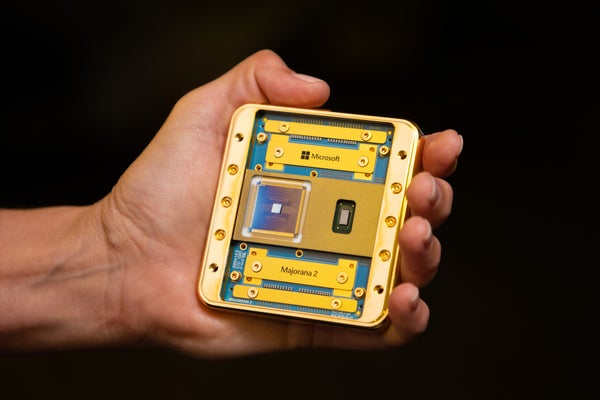
Microsoft claimed today that it has improved its quantum technology by an extraordinary factor. Outside experts say it doesn’t even work and never has.
The company has named its latest quantum chip Majorana 2, for the theoretical quasiparticle it aims to use as the basis for a new “topological” approach to quantum computing. Chilled to ultracold temperatures in superconducting wires, electrons may be coaxed to act collectively—as so-called Majorana quasiparticles—in a manner that theoretically makes them more resistant to the physical “noise” that causes computational errors in other quantum systems.
Similar to braiding weak fibers together to make a strong rope, Microsoft’s approach seeks to create topological quantum bits, or qubits, by manipulating multiple Majorana quasiparticles on one device. In principle, this quantum computing method could scale up better than others, with Microsoft claiming it could someday squeeze millions of qubits onto a single chip. That could give the company a significant advantage in the race to build a quantum device that outpaces any machine in existence at certain problems.
On supporting science journalism
If you're enjoying this article, consider supporting our award-winning journalism by subscribing. By purchasing a subscription you are helping to ensure the future of impactful stories about the discoveries and ideas shaping our world today.
“This is a very exciting era that we’re in,” said Jason Zander, executive vice president leading Microsoft’s Quantum team, during a press briefing before the public announcement. “We’re at the start of a new chapter.”
But the company has a mixed track record when it comes to such claims. In 2021 Microsoft retracted a high-profile Nature paper after outside experts pointed out that the study’s data could have come from material imperfections rather than a topological qubit. Physicists have raised similar concerns about several publications since, as well as about last year’s announcement of the Majorana 1 chip based on the disputed technology.
The latest claim, made in a new preprint manuscript that has not been peer-reviewed, builds on these controversial results. The team has replaced the Majorana 1 chip’s aluminum superconductor with one made of lead. “People generally want to try to stay away from putting lead into anything,” said the team’s Chetan Nayak in the press briefing. “It sounds like a crazy idea, actually.” Material adjustments including this one, the Microsoft team claims, add to the longevity of the hypothetical qubit—which is now reported at 20 seconds to a minute—by improving its error-averting “topological gap.”
A Microsoft blog post accompanying the announcement noted that due to this “rapid progress” the company is accelerating its technological roadmap, and now aims to demonstrate “scalable, practical quantum computing” by 2029.
Henry Legg, a physicist at the University of St. Andrews in Scotland, points out that the data shown in the preprint apparently come from a handful of purported instances on a single device. “You can see something amazing in one device and never see it again because it’s just some random artifact,” he says. “What you need is many devices, and that’s not what they’re showing in this paper.”
The new result simply isn’t up to the physics community’s standards, he says. “If this was from any other group or Ph.D. student, it would never make it through peer review,” Legg says. In fact, the multitrillion-dollar company’s last preprint of this kind has remained unpublished since last summer, which physicist Sergey Frolov cites as evidence that top journals have likely rejected it.
“This new preprint is not based on a research track record that can be considered a solid foundation,” says Frolov, a quantum researcher at the University of Pittsburgh. “When Microsoft is mentioned these days, physicists and quantum computing specialists just chuckle or raise their eyebrows.”
Meanwhile, the company maintains that it has demonstrated what many scientists say it has not. “Bell Labs didn’t have to prove there was an electron to invent the transistor,” said Zander more than once during the briefing. “We did have to prove that Majorana and that theory was actually real.”