
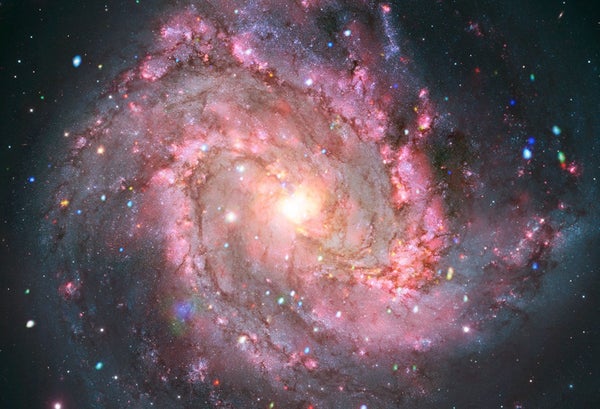
A set of supernovae are behaving in weird ways, more than a decade’s worth of data from NASA’s Chandra X-ray Observatory reveals. Instead of slowly fading, as expected, these exploded stars have dramatically varied in brightness over the course of 14 years.
Typically, when a massive star explodes in a supernova, it leaves behind a cloud of superheated gas and debris. Over time, these stellar fireworks tend to fade, but Chandra observations of the galaxy Messier 83 (M83) from 2000 through 2014 suggests that’s not always the case. There supernova remnants that researchers had expected to have faded x-ray emissions actually showed surprising variety in the brightness of their x-rays.
The findings were published in the Astrophysical Journal this month.
On supporting science journalism
If you're enjoying this article, consider supporting our award-winning journalism by subscribing. By purchasing a subscription you are helping to ensure the future of impactful stories about the discoveries and ideas shaping our world today.
M83 is around 15 million light-years away from Earth. Also called the Southern Pinwheel, this spiral galaxy is a hotbed of star formation. “We knew that individual X-ray sources could vary dramatically,” said Andrea Prestwich, an astronomer at the Catholic University of America and the study’s lead author, in a statement. “But finding that so many supernova remnants were behaving this way was a real surprise. Something unusual is going on in these objects. Pinpointing the cause remains a challenge, as M83’s distance limits the detail we can observe.”
At least one of the odd remnants has an explanation—the debris from SN 1957D, a supernova first seen almost 70 years ago, appears to be colliding with material surrounding it, leading to the increased x-ray emissions. But the cause of the other changing emissions is unclear.
One possible explanation, the researchers say, is a population of survivor stars that seems to have outlived their partner stars. If this is confirmed, then each x-ray source would have started as a pair of stars orbiting each other. In this scenario, when the more massive star exploded, its partner star did not. That would create what is called a high-mass x-ray binary, or HMXB, which could explain the variation in the Chandra readings. HMXBs aren’t new, but they haven’t historically been linked to very many supernova remnants.
Another potential cause of the varying x-ray emissions is that a black hole or neutron star, which is sometimes left after a star dies, is pulling in some of the material that was originally expelled outward in a sort of cosmic recycling.
“This could be an example of cosmic recycling, where debris from the explosion falls back onto the very object the supernova created,” said study co-author and Wesleyan University astronomy professor Roy Kilgard in the same statement. “And it’s quite possible that both explanations are at play—different sources in our sample may have different origins.”
M83 isn’t the only galaxy where scientists have recently spotted these variable supernova remnants; a follow-up study also revealed them in Messier 51 (M51), or the Whirlpool Galaxy.

A composite image of the galaxy M51 combines data from NASA’s Chandra X-ray Observatory (purple) with optical data (red, green and blue) taken with ground-based telescopes by a team of astrophotographers.
NASA/CXC/SAO (Chandra x-ray data); C.Björk/T.Bähnck/S. Donoso/J. Gentillon/A. and D. Grelin/S. Guberski/R. Hall/T. Heuberger/J. Jacks/P. Kent/Br. Meyers/W. Ostling/N. Puig/T. Schaeffer/F. Schöfbänker/M. Vasilev (Astrobin/optical ground-based data)