
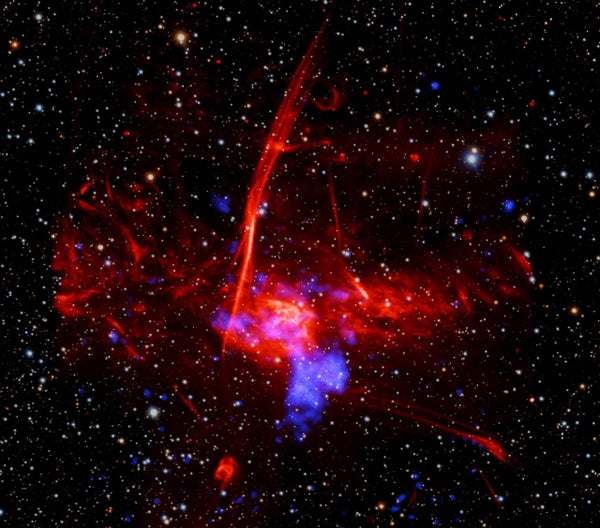
NASA’s Chandra X-Ray Observatory has captured a dramatic scene about 26,000 light-years away from Earth. Scientists suspect it could be a supernova remnant, the violent shock wave and cloud of debris sent hustling through space after a massive star dies. Scientists estimate the possible supernova remnant is expanding at a rate of two million miles per hour and is at least 1,700 years old.
Supernovas are a key part of the galaxy’s ecosystem—when they explode, they release elements that are key to the birth of new stars and planets. If confirmed to be a supernova remnant, it would be one of the closest remnants ever found to the supermassive black hole in the central region of the Milky Way.
In the new composite image seen above, the galaxy runs left to right. The long filaments that are mostly perpendicular to the galaxy are energetic particles traveling along magnetic fields. Another image layered with James Webb Space Telescope data shows a close-up of the potential remnant, located in Sagittarius C, an active star-forming region near the center of the Milky Way.
On supporting science journalism
If you're enjoying this article, consider supporting our award-winning journalism by subscribing. By purchasing a subscription you are helping to ensure the future of impactful stories about the discoveries and ideas shaping our world today.

A close-up image of Sagittarius C that adds NASA’s James Webb Space Telescope data to the x-ray and radio data.
NASA
Scientists think the object may be the remains of a supernova because x-ray data suggests there is a “bright blob” inside Sagittarius C. That blob matches many of the known characteristics of a rapidly expanding supernova remnant, according to a recent study in the Astrophysical Journal. The data come from NASA’s Chandra, as well as the European Space Agency’s XMM-Newton mission, South Africa’s MeerKAT telescope and the Pan-STARRS telescopes in Hawaii.
The possible remnant is inside what is known as the HII region of Sagittarius C. This type of region is a special bubble of gas that forms when radiation from hot, young stars strips the electrons from hydrogen atoms, making clouds of ionized hydrogen.
This isn’t the first time data have suggested a supernova remnant exists in Sagittarius C. Older data from NASA’s now-retired Stratospheric Observatory for Infrared Astronomy (SOFIA) mission hinted at the presence of an expanding shell of gas around Sagittarius C, and the new study strengthens the case. Scientists typically expect to see elevated levels of specific elements around supernova remnants, however, which is not the case here. Still, that may be because the debris from the explosion has already mixed with the surrounding gas.
The bright blob could also stem from a collection of massive stars in the region, but the study authors argue this is less likely because it’s far brighter than nearby stellar clusters.