New Issue: Orbital Catastrophe Ahead? Read Now

NASA Recruits Mars Perseverance Rover to Monitor Sun’s Activity

Mars is passing behind the sun, giving NASA's Perseverance rover a view of the star’s far side

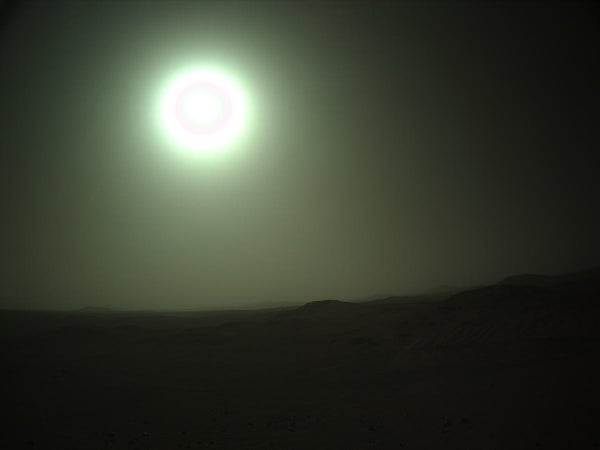
NASA's Mars Perseverance rover looks at the sun on November 25.

NASA/JPL-CalTech

Join Our Community of Science Lovers!

NASA has drafted its Mars rover Perseverance to help monitor the sun’s activity. Every day for the next two months, the rover will image the sun with its Mastcam-Z cameras, capturing crucial information about sunspots and other large features that can give clues to solar activity.

Mars is currently passing behind the sun, giving the rover a view of the star’s far side—a perspective we can’t see from Earth. Perseverance’s Mastcam-Z, which consists of zoomable cameras attached to its mast, isn’t designed for solar monitoring; the rover points the system at the sun once a day to measure the dust in the Martian air, critical information for weather forecasting on the Red Planet. But it is sensitive enough to see large sunspots.

The sun as imaged by NASA's Mars Perseverance rover on November 25.

NASA/JPL-Caltech/ASU


On supporting science journalism

If you're enjoying this article, consider supporting our award-winning journalism by subscribing. By purchasing a subscription you are helping to ensure the future of impactful stories about the discoveries and ideas shaping our world today.


This is not the first time NASA has recruited Perseverance as a solar observatory—the agency also used the rover to image sunspots in 2024.

Sunspots are temporary dark areas on the sun that occur when intense magnetic fields block out heat from the interior of the sun. Concentrated in active regions, they can last days or months and typically coincide with other phenomena such as solar flares and coronal mass ejections. If these energetic explosions are pointed toward Earth, they can cause auroras and even disruptions to satellite and radio systems.

Subscribe to Support Independent Journalism

Great science journalism requires human expertise, time, effort and creativity. And it costs money. That’s why I and the journalists here at Scientific American hope you’ll join our community.

When you subscribe, you are supporting staff and freelance journalists who are passionate about telling science stories that are true, important and compelling. Our editors and reporters are often experts in their fields, which means they understand the nuances of big discoveries and can untangle the breakthroughs from the hype. With a subscription, you are also supporting rigorous fact-checking to ensure the words we publish are precise and accurate. And you’re supporting original illustrations, graphics and photos that bring you closer to an advanced laboratory, an ice sheet in Antarctica or a space mission in orbit. You’re helping us craft other types of high-quality journalism as well: Our newsletters are carefully written, edited and curated by staffers you have or will come to know and love. Our Science Quickly podcast is based on original reporting, collaboration with editors and scientists and exacting production.

Subscriptions keep this engine running so we can continue to deliver thoughtful, rigorous and independent science journalism to you. In an era of viral misinformation, this work is crucial. If you value what we do, I hope you’ll consider joining us as a subscriber

Thank you,

Jeanna Bryner, Editor in Chief, Scientific American

Subscribe