New Issue: Orbital Catastrophe Ahead? Read Now

NASA sets a date for redo of key Artemis II test

NASA will attempt a second “wet dress rehearsal” and simulated launch of its upcoming moon mission on Thursday

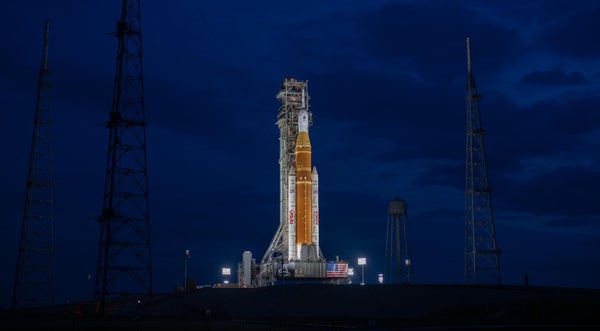
Lights illuminate NASA’s Artemis II SLS (Space Launch System) rocket and Orion spacecraft at Launch Complex 39B at NASA’s Kennedy Space Center in Florida on January 18, 2026.

NASA/Brandon Hancock

Join Our Community of Science Lovers!

NASA has set a date for the do-over of a key readiness test for its Artemis II mission to the moon. During this “wet dress rehearsal,” the agency will attempt to pump liquid fuel into the Space Launch System (SLS) rocket and simulate a countdown to liftoff on February 19 at 8:30 P.M. EST.

The test is critical for Artermis II to move forward for launch; the first attempt, performed on February 2, exposed problems with both the SLS and the Orion capsule, which is designed to house Artemis II’s four-person crew on a journey around the moon and back. Liquid hydrogen fuel leaked from the rocket, and one of the capsule’s valves malfunctioned. Notably, similar fuel leaks plagued the mission’s predecessor, Artemis I, delaying its launch for months.

In announcing the new wet dress rehearsal date, NASA said that engineers have replaced a filter in ground support equipment that they think reduced the flow of liquid hydrogen into the rocket and that this has potentially resolved the leaking issue.


On supporting science journalism

If you're enjoying this article, consider supporting our award-winning journalism by subscribing. By purchasing a subscription you are helping to ensure the future of impactful stories about the discoveries and ideas shaping our world today.


Unlike Artemis I, which was uncrewed, Artemis II will loft four people—NASA’s Reid Wiseman, Christina Koch, and Victor Glover and Canadian Space Agency astronaut Jeremy Hansen—into a record-breaking flyby around the moon.* For 10 days, the crew members will observe the moon’s little-studied farside and will perform other experiments onboard before they splash down in the Pacific Ocean off San Diego.

*Editor’s Note (2/17/26): This sentence was edited after posting to correct the description of Artemis II’s planned lunar flyby.

Subscribe to Support Independent Journalism

Great science journalism requires human expertise, time, effort and creativity. And it costs money. That’s why I and the journalists here at Scientific American hope you’ll join our community.

When you subscribe, you are supporting staff and freelance journalists who are passionate about telling science stories that are true, important and compelling. Our editors and reporters are often experts in their fields, which means they understand the nuances of big discoveries and can untangle the breakthroughs from the hype. With a subscription, you are also supporting rigorous fact-checking to ensure the words we publish are precise and accurate. And you’re supporting original illustrations, graphics and photos that bring you closer to an advanced laboratory, an ice sheet in Antarctica or a space mission in orbit. You’re helping us craft other types of high-quality journalism as well: Our newsletters are carefully written, edited and curated by staffers you have or will come to know and love. Our Science Quickly podcast is based on original reporting, collaboration with editors and scientists and exacting production.

Subscriptions keep this engine running so we can continue to deliver thoughtful, rigorous and independent science journalism to you. In an era of viral misinformation, this work is crucial. If you value what we do, I hope you’ll consider joining us as a subscriber

Thank you,

Jeanna Bryner, Editor in Chief, Scientific American

Subscribe