
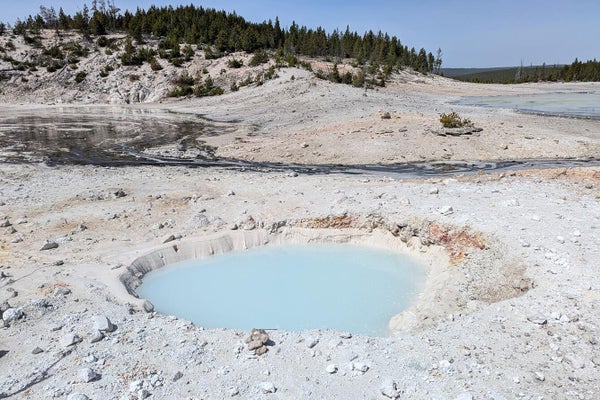
There’s a new milky blue pool in Yellowstone National Park.
Yellowstone geologists discovered the baby hydrothermal feature in April while doing routine work at Norris Geyser Basin, the park’s oldest geothermal area, according to the Yellowstone Volcano Observatory. High-resolution satellite imagery later revealed that the pool didn’t exist prior to December 19, 2024. By January 6, a depression had formed in the ground. By February 13, it had become a pool of water.
The feature is now about 13 feet across and filled with 109-degree-Fahrenheit water. It sits west of a feature called Tree Island in the basin, about 650 feet from the boardwalks and trails where visitors amble through the basin’s other ponds and pools. The water in the pool gets its otherworldly milky texture from dissolved silica, the mineral best known for making up much of the structure of glass. According to the National Park Service, the water at Norris Geyser Basin has more dissolved silica than anywhere else in the park.
On supporting science journalism
If you're enjoying this article, consider supporting our award-winning journalism by subscribing. By purchasing a subscription you are helping to ensure the future of impactful stories about the discoveries and ideas shaping our world today.
Some changes to Yellowstone’s hydrothermal features have come quickly, such as the eruption at Biscuit Basin that spewed water, mud and minerals over tourists on July 23, 2024. A spatter of small rocks around the new pool indicated that there had been some sort of outburst near Tree Island. But a look at the seismic monitoring data from Norris Geyser Basin found no evidence of an eruption between December 2024 and February 2025. Next, the researchers looked at acoustic, or sound, data from the same period. They found a few weak rumbles and pops on December 25, 2024, and January 15 and February 11, 2025.
These subtle noises suggest that the new pool was born last Christmas and that a series of little hydrothermal explosions that weren’t strong enough to shake the ground initiated the structure.
Norris Geyser Basin is perhaps best known for Steamboat Geyser, which shoots water up to about 330 feet in the air on an unpredictable schedule. It’s also the most dynamic basin in the park, famous for sudden shifts in water temperature, mercurous eruption schedules and the frequent birth of new hydrothermal features.