
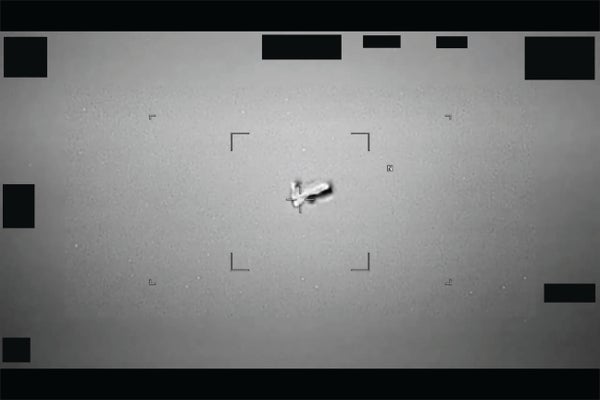
The Pentagon is starting to release files related to unidentified anomalous phenomena (UAP), or unidentified flying objects (UFOs). The government said the effort is aimed at increasing transparency, but experts tell Scientific American that the files are “nothing unexpected.”
The collection is being created as part of an interagency effort that includes the Pentagon, the Department of Energy, NASA, the Office of the Director of National Intelligence and the White House, as well as the FBI and other U.S. intelligence agencies. It includes photographs, videos and documents gathered from across federal agencies. Some of the photographs are similar to previously released images that show blurry dots seen from U.S. military aircraft, while others, taken by Apollo astronauts, show unidentified spots above the moon’s surface.
The release comes after President Donald Trump directed the Pentagon and other federal agencies to identify and publish governmental files related to “alien and extraterrestrial life, unidentified aerial phenomena, and unidentified flying objects” via a social media post in February. Previously, in 2021, the Pentagon published a report investigating UAP that found no evidence linking such phenomena to aliens or extraterrestrial activity.
On supporting science journalism
If you're enjoying this article, consider supporting our award-winning journalism by subscribing. By purchasing a subscription you are helping to ensure the future of impactful stories about the discoveries and ideas shaping our world today.
“These files, hidden behind classifications, have long fueled justified speculation—and it’s time the American people see it for themselves,” said Secretary of Defense Pete Hegseth in a statement posted to social media on Friday. “This release of declassified documents demonstrates the Trump Administration’s earnest commitment to unprecedented transparency.”
Physicist and former director of the Pentagon’s All-Domain Anomaly Resolution Office Sean Kirkpatrick says the files are likely to fuel speculation rather than quell it.
“There’s nothing unexpected in their release. And without any analysis or context, [it] will only serve to fuel more speculation, conspiracy and armchair pseudoscience, particularly from the playhouse politics theater company,” he says.
Independent researcher and UAP skeptic Mick West says that while the release includes new videos and pilot reports, there is “nothing really interesting” to be found so far. “More dots, more parallax,” he says.
Others were more heartened by the documents, as the Disclosure Foundation, which is dedicated to pushing government for more transparency on UAP's, called the release a "meaningful step towards transparency."
Some of the files include debriefs with Apollo-era astronauts. In one of these documents, Buzz Aldrin recounts seeing what might have been a piece of a Saturn V launch vehicle, the NASA rocket that helped loft the Apollo missions into space.
NASA’s current administrator Jared Isaacman praised the release. “At NASA, our job is to bring the brightest minds and most advanced scientific instruments to bear, follow the data, and share what we learn,” he said in the same social media statement. “We will remain candid about what we know to be true, what we have yet to understand, and all that remains to be discovered.”
NASA has conducted its own research into UAP for decades. And in 2023 the agency released an independent scientific report that found no evidence that any UAP sightings or other reports were in any way connected to extraterrestrial activity.
Editor’s Note (5/8/26): This is a developing story and may be updated.