New Issue: Orbital Catastrophe Ahead? Read Now

See the Pentagon’s new UFO image release

The Pentagon has started releasing files related to unidentified anomalous phenomena (UAP), also called UFOs. Here are the images released so far

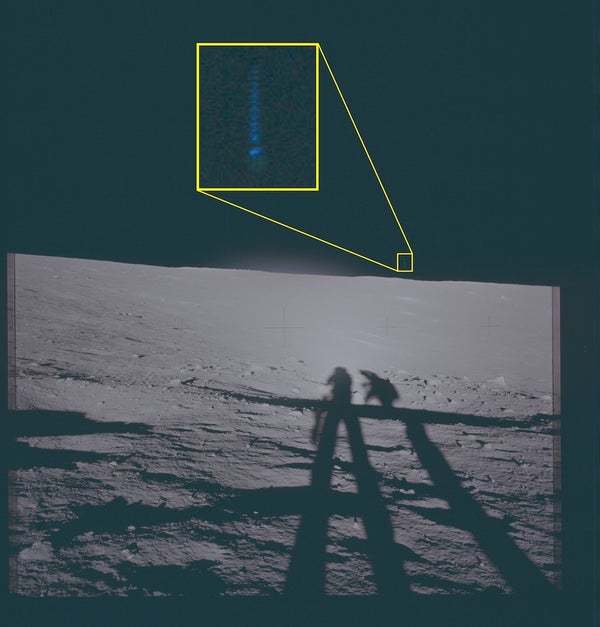
This archival photograph depicts the lunar surface as viewed from the landing site of Apollo 12. This image features a highlighted area of interest slightly to the right of the vertical axis of the frame, above the horizon, in which unidentified phenomena are visible.

NASA

Join Our Community of Science Lovers!

On Friday the Pentagon released what appears to be the first batch of government files related to unidentified flying objects (UFOs), or unidentified anomalous phenomena (UAP), since President Donald Trump directed officials to do so via a social media post earlier this year. The files include FBI reports into unexplained sightings, as well as NASA debriefs with astronauts who saw things on the moon they couldn’t identify—some of which were captured in images.

Scientific American’s Adam Kovac reports that experts in the field are not surprised by any of the released files and say that, rather than quelling speculation, the declassification could fuel it.

Here are some of the images included in the file release, as well as the information about what the photographs might show that the Pentagon has provided.


On supporting science journalism

If you're enjoying this article, consider supporting our award-winning journalism by subscribing. By purchasing a subscription you are helping to ensure the future of impactful stories about the discoveries and ideas shaping our world today.


Still from a video that a U.S. military operator reported as featuring UAP flying across their screen.

DOW

This still image was taken from a video captured in May 2022 by a U.S. military operator flying over the Middle East that showed a UAP flying across their screen.

Infrared still image (black hot) captured of unidentified object below helicopter over western U.S. in September 2025.

FBI

A newly released, black-hot infrared still image shows an unidentified object below a helicopter above the western U.S. in September 2025.

U.S. Indo-Pacific Command reported a UAP that resembles a football-shaped body near Japan.

A UAP image captured in 2024.

DOW

In 2024 personnel of the U.S. Indo-Pacific Command reported seeing a UAP that resembled a football-shaped body near Japan.

The monochrome image displays a uniform, grainy texture with a central crosshair reticle. A small, dark and slightly irregular object is visible just below and to the right of the center of the reticle.

FBI

In late 2025 a U.S. military operator reported a small, dark and slightly irregularly shaped object visible on their screen. This monochrome image shows the object just below and to the right of the center of the reticle.
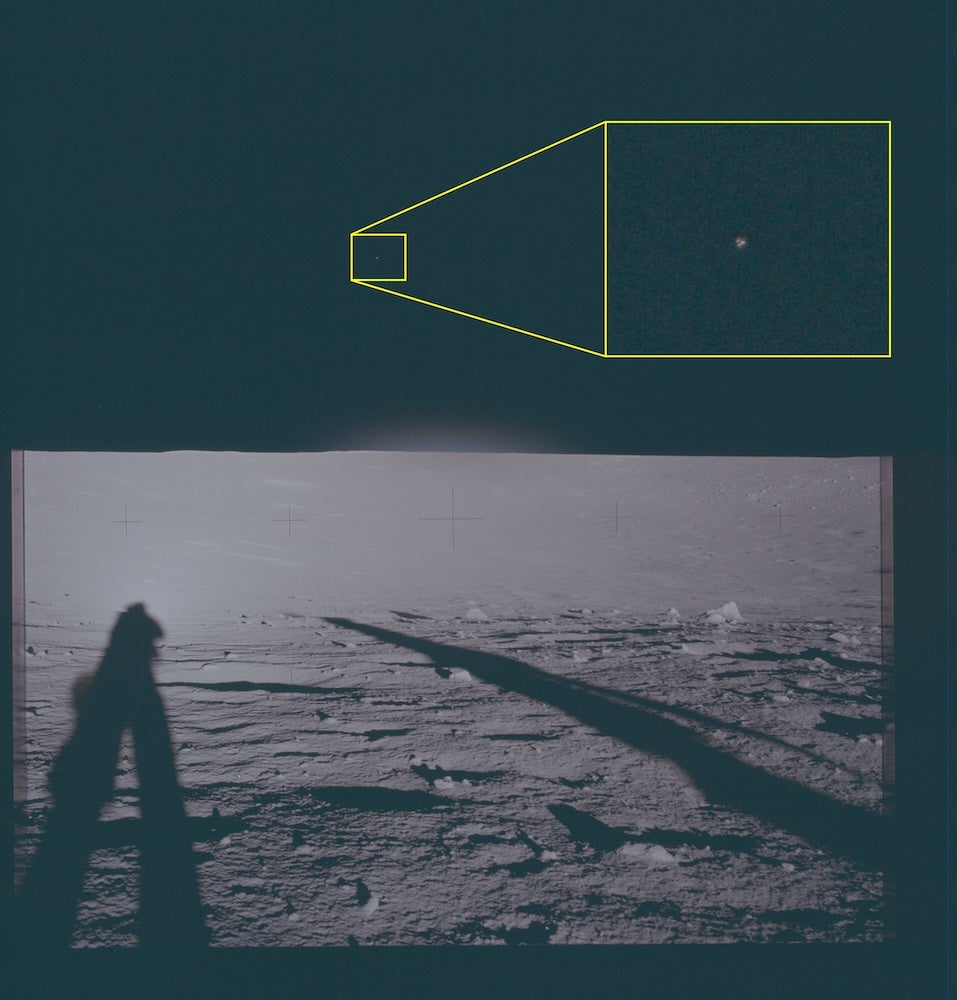
This archival photograph depicts the lunar surface as viewed from the landing site of Apollo 12. This image features a highlighted area of interest slightly to the left of the vertical axis of the frame, above the horizon, in which unidentified phenomena are visible.

NASA

In this archival image, you can see the lunar surface as viewed from the landing site of Apollo 12, the sixth crewed flight for the U.S. Apollo Program and the second to land on the moon on November 19, 1969. The UAP can be seen in the highlighted area slightly to the left of the vertical axis of the frame, above the horizon.

This archival photograph depicts the lunar surface as viewed from the landing site of Apollo 12. This image features a highlighted area of interest slightly to the right of the vertical axis of the frame, above the horizon, in which unidentified phenomena are visible.

NASA

Another archival photograph taken during the Apollo 12 mission depicts the lunar surface with an unidentified phenomenon in the highlighted box.

This archival photograph depicts the lunar surface as viewed from the landing site of Apollo 12. This image features two highlighted areas of interest, labeled “Area 1” and “Area 2,” slightly to the right of the vertical axis of the frame, above the horizon, in which unidentified phenomena are visible.

NASA

This archival photograph of the site of the Apollo 12 landing features two highlighted areas of interest showing unidentified phenomena. Labeled “Area 1” and “Area 2,” they are slightly to the right of the vertical axis of the frame.

This archival photograph depicts the lunar surface as viewed from the landing site of Apollo 12. This image features a highlighted area of interest near the right edge of the frame, above the horizon, in which unidentified phenomena are visible.

NASA

Another Apollo 12 archival image also shows a view from the mission’s landing site in the southeastern region of Oceanus Procellarum, or Ocean of Storms. A highlighted UAP can be seen near the right edge of the frame, above the horizon.

NASA photograph from the Apollo 17 mission taken on December 1972. The image contains three “dots” in a triangular formation in the lower right quadrant of the lunar sky that is clearly visible upon magnification of the image.

NASA

A previously released NASA photograph from the Apollo 17 mission that was taken in December 1972 shows three “dots” in a triangular formation in the lower right quadrant of the lunar sky. They are more visible in the inset magnification of the area.

Infrared still image (black hot) captured of unidentified object over the western U.S. in December 2025.

DOW

A black-hot infrared still image captured an unidentified object—a dark dot—over the western U.S. in December 2025. Parts of the image have been redacted.

Jeanna Bryner is editor in chief of Scientific American. Previously she was editor in chief of Live Science and, prior to that, an editor at Scholastic's Science World magazine. Bryner has an English degree from Salisbury University, a master’s degree in biogeochemistry and environmental sciences from the University of Maryland and a graduate science journalism degree from New York University. She has worked as a biologist in Florida, where she monitored wetlands and did field surveys for endangered species, including the gorgeous Florida Scrub Jay. She also received an ocean sciences journalism fellowship from the Woods Hole Oceanographic Institution. She is a firm believer that science is for everyone and that just about everything can be viewed through the lens of science.

More by Jeanna Bryner

Subscribe to Support Independent Journalism

Great science journalism requires human expertise, time, effort and creativity. And it costs money. That’s why I and the journalists here at Scientific American hope you’ll join our community.

When you subscribe, you are supporting staff and freelance journalists who are passionate about telling science stories that are true, important and compelling. Our editors and reporters are often experts in their fields, which means they understand the nuances of big discoveries and can untangle the breakthroughs from the hype. With a subscription, you are also supporting rigorous fact-checking to ensure the words we publish are precise and accurate. And you’re supporting original illustrations, graphics and photos that bring you closer to an advanced laboratory, an ice sheet in Antarctica or a space mission in orbit. You’re helping us craft other types of high-quality journalism as well: Our newsletters are carefully written, edited and curated by staffers you have or will come to know and love. Our Science Quickly podcast is based on original reporting, collaboration with editors and scientists and exacting production.

Subscriptions keep this engine running so we can continue to deliver thoughtful, rigorous and independent science journalism to you. In an era of viral misinformation, this work is crucial. If you value what we do, I hope you’ll consider joining us as a subscriber

Thank you,

Jeanna Bryner, Editor in Chief, Scientific American

Subscribe