
ARTIFICIAL UNCERTAINTY
In the opening paragraph of “Our Robotic Future,” Ben Guarino presents three potential future scenarios in which robots perform particular tasks. I found this section chilling. I would hate to be the elderly person who is helped out of bed in the morning and dressed by a machine. The child whose room is straightened by a cleaning bot might benefit by learning to do so themself. And if mechanical hands assemble our products from start to finish, who will have earned the money to buy them? I believe the Luddites had a point.
JIM LOVE GREAT FALLS, MONT.
On supporting science journalism
If you're enjoying this article, consider supporting our award-winning journalism by subscribing. By purchasing a subscription you are helping to ensure the future of impactful stories about the discoveries and ideas shaping our world today.
An as yet unremedied challenge in the world’s competitively charged arena of robotics powered cerebrally by artificial intelligence is Moravec’s paradox. It presciently came on the scene in the 1980s.
The paradox contended that technologists would be much slower to design robots’ sensorimotor skills than their reasoning skills. This despite the ultimate desire being to develop sensorimotor competencies and intelligence competencies along lines equally adept for their intended purposes.
It’s no secret that such machines’ improvements in the sensorimotor skills required to nimbly navigate unpredictably diverse spatial conditions—a nimbleness our species acquired evolutionarily—have been vastly slower to impress than AI’s dash to intelligence. Guarino’s article seems to confirm that’s still the case.
The philosophical questions associated with thinking, understanding, creating and engaging in ingenious thought experiments that result in incremental change or even wholesale paradigm shifts might, deceptively, seem harder. Yet dexterity in bodily motions has posed the thornier trial for robotics developers globally.
KEITH TIDMAN BETHESDA, MD.
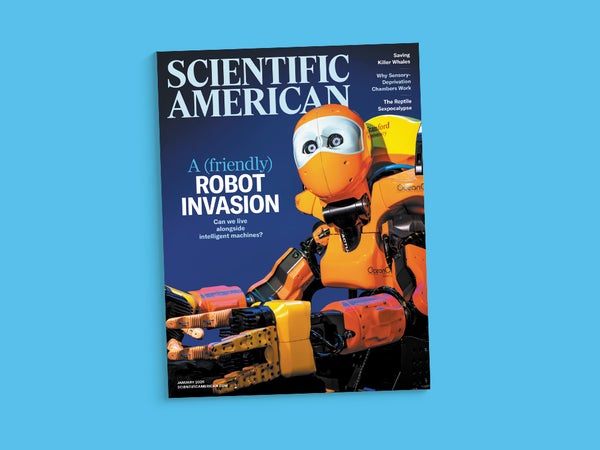
In describing the same machine that is pictured on the front cover of the January issue, Guarino’s article says, “The OceanOne robot’s anthropomorphic face is designed to reassure human divers underwater.”
“Reassure”? To me, the face looks like it comes from a horror movie scene. Imagine exploring a reef in a dimly lit depth, looking over your shoulder and suddenly seeing that face and those eyes looking at you from a couple of feet away.
PERRY HARLEN MOUNT MAUNGANUI, NEW ZEALAND
BATS VS. BIRDS
In “Fine-Feathered Snack” [Advances], Meghan Bartels describes the successful capture of a songbird by a greater noctule bat (Nyctalus lasiopterus) in Spain, confirming suspicions that these large bats will eat birds. The finding is interesting, but I think that bats generally come off worse when they have encounters with birds.
In 2018 Royal Society Open Science published a study describing the severe decline in numbers of greater noctules in a Spanish park. An invasive population of parakeets was killing the bats to gain access to cavities in trees for roosting.
Many species of birds, most especially raptors and corvids, prey on bats, which are vulnerable to ambush as they leave their roosts. The bird of prey Falco rufigularis has even earned the name Bat Falcon.
The most macabre account of bird predation concerns a little songbird called the Great Tit (Parus major). Tits belong to the same family as American chickadees. Great Tits are tough and resourceful and are known to kill other small birds. There had been reports from Sweden and Poland of tits feeding on dead bats, but it was not known whether this was mere scavenging.
In the February 2010 issue of Biology Letters, researchers in Germany and Hungary published a report that described Great Tits pillaging a pipistrelle bat roost in a cave in Hungary during winters. There was some light in the cave from the large entrance, and the birds might have located the hibernating bats by listening for their calls. The birds would sometimes haul their still-living prey out to a nearby tree and kill them with pecks to the head or other parts of the body as they ate the brain, organs or flesh.
This was hard work for birds weighing around 20 grams and more accustomed to feeding on invertebrates, nuts and berries. When the researchers provisioned the tits with sunflower seeds and bacon, the birds usually left the bats alone. As your article states, “behavioral plasticity” can be key to survival.
CHRIS WARMAN NORTH YORKSHIRE, ENGLAND
GRIEF AND CLOSURE
“Mourning Becomes Electric,” by David Berreby [December 2025], describes how some grieving people have found it helpful to interact with “digital ghosts” of their departed loved ones created by AI. Personally, the best source of closure that I have found comes from stories heard from old acquaintances, especially at end-of-life ceremonies.
“CURTIS” MENOMONIE, WIS.
DOG TALK
In “Discerning Dogs” [Advances; December 2025], Anirban Mukhopadhyay reports on how a relatively small number of dogs that understand an unusually large vocabulary might even be able to categorize words: in a study, such dogs could distinguish between “throw” and “pull” toys.
I wonder whether there might be an olfactory dimension to the categories. For example, “pull” toys might have a stronger scent of human skin from our palms and fingers, relative to “throw” toys, which might be an important factor for how a dog knows which toy belongs to which category.
JACQUELINE COOLIDGE CHEVY CHASE, MD.
ERRATA
In the March 2026 Letters column, Scott Cline’s letter should have said that Abderrazak El Albani’s idea is supported by recent discoveries from other researchers.
“Relativity Revealed,” by Victoria Helm, Thomas Juffmann and Peter Schattschneider [March], should have said that Hendrik Lorentz was working in the 1920s when he believed the Lorentz contraction would be visible.
In “The True Worth of America’s Public Lands,” by Kyle Manley [March], the key in the box “Up for Grabs” should have indicated that the Bureau of Land Management is responsible for the federal lands shown in brown and that the U.S. Forest Service is responsible for those shown in green. The corrected illustration can be seen at www.scientificamerican.com/article/why-privatizing-public-land-wont-solve-the-housing-crisis