
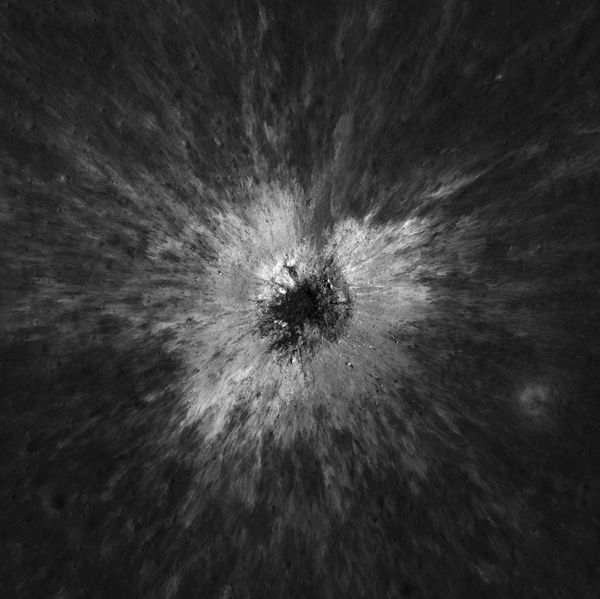
The moon has no shortage of craters. But a newly discovered pit discovered by NASA scientists has proven to be the cosmic equivalent of a needle in a haystack.
Each month for the past 17 years, the Lunar Reconnaissance Orbiter (LRO) has surveyed the entire moon, producing vast amounts of images and data that reveal how the lunar surface changes over time.
Robert Wagner, an image processing specialist at the private space company Intuitive Machines, was assigned to look at LRO data. When he compared images of the eastern edge of the moon that were taken in May 2024 with photographs of the area from the month prior, he was stunned to see a brand-new crater, 222 meters (728 feet) across and 43 meters (141 feet) deep.
On supporting science journalism
If you're enjoying this article, consider supporting our award-winning journalism by subscribing. By purchasing a subscription you are helping to ensure the future of impactful stories about the discoveries and ideas shaping our world today.
By moon standards, that’s big—and so rare that it’s estimated that an impact of that size only occurs once every 132 years. In fact, as Wagner and his colleagues describe in a recent Science Advances paper, it’s the largest newly formed crater ever discovered in our solar system.
“I just stopped, dropped everything, and started looking into what that spot was,” Wagner said in a statement.
The impact area has been dubbed McGetchin Crater, after former Lunar Science Institute director Tom McGetchin, who died in 1979.
Unlike Earth, the moon has relatively little atmosphere and no liquid water or major plate tectonic system. That means the surface changes relatively little over time—unless it gets hit from something outside. That makes it a great place to study impacts from asteroids, comets and meteorites, not to mention human-made objects, because the areas that have been hit tend to be much better preserved than they would be on the solar system’s other planets and moons.
Scientists used a heat-sensing instrument onboard the LRO to probe the region of the new crater in more detail. They found that while the middle of the crater glows red, the area around it is 16 degrees F cooler than the surrounding area at night. Those finding were published in a separate paper in the same journal.
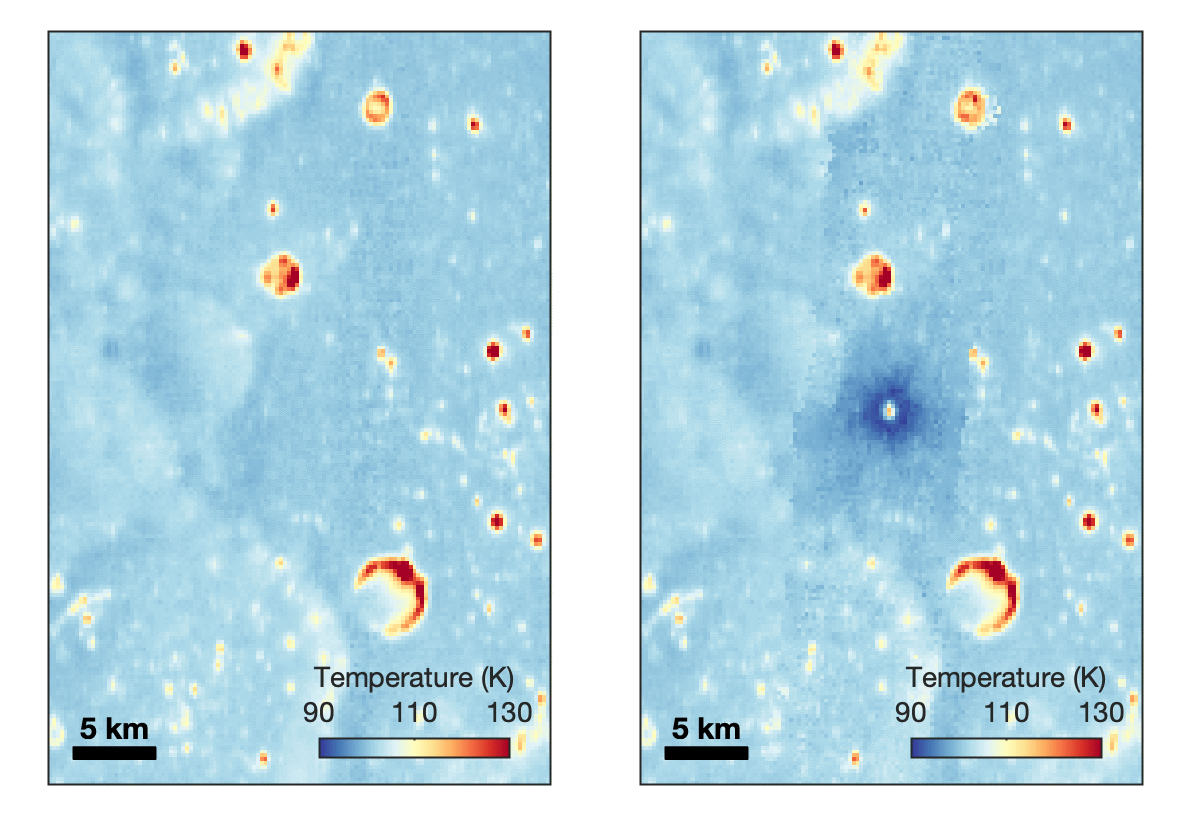
An animated image set shows an area on the eastern limb of the moon before and after McGetchin Crater formed there sometime between April 11 and May 22, 2024.
NASA Goddard/UCLA/JHU APL
The scientists surmised that this occurs because lunar dirt, called regolith, that piled up around the crater as a result of the impact is less dense and therefore less able to retain heat.
The knowledge of how lunar craters form and evolve could prove useful as humans plot their return to the lunar surface for the first time in more than half a century. In particular, plans to develop long-term moon bases could benefit from the information. The data collected from studying the crater could help scientists develop technology that would better allow astronauts to brave and traverse the hostile environment.