New Issue: Orbital Catastrophe Ahead? Read Now

Scientists may have just solved one of the strangest mysteries of Greenland’s ice sheet

Below the surface, Greenland’s ice appears to be churning up, a process one scientist described as akin to a “boiling pot of pasta”

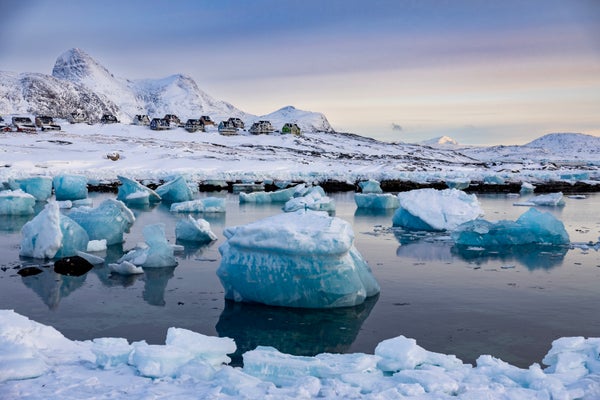
Icebergs and ice sheets float in the water off Nuuk, Greenland

ODD ANDERSEN/Getty Images

Join Our Community of Science Lovers!

Hidden underneath the surface of Greenland’s ice, there are strange, vast structures known as “plumes.” But for years, scientists didn’t know how these curious forms came to be—until now. A new study published in the journal Cryosphere reveals that the structures may have been caused by thermal convection in a process similar to the churning of the hot rock in Earth’s mantle.

Convection is caused by temperature differences within a material. Hot material rises, and cool material falls—driving a cycling, or convection. The same phenomenon appears to occur in ice, too, indicating that parts of the ice sheet may be softer than scientists realized. That’s important for one crucial reason: we know that Greenland’s ice sheet is rapidly melting. And as the climate warms, scientists are racing to understand how exactly it will melt and how fast.

Three images of “plumes” that appear under the ice’s surface that are rendered as squiggles in the ice’s layers

Example plume features in northern Greenland.


On supporting science journalism

If you're enjoying this article, consider supporting our award-winning journalism by subscribing. By purchasing a subscription you are helping to ensure the future of impactful stories about the discoveries and ideas shaping our world today.


“We typically think of ice as a solid material, so the discovery that parts of the Greenland ice sheet actually undergo thermal convection, resembling a boiling pot of pasta, is as wild as it is fascinating,” said Andreas Born, a professor of Earth science at the University of Bergen in Norway, in a statement.

Although the findings do not necessarily mean that the ice sheet will melt faster, they could offer clues as to how it may melt. And that knowledge is critical—the sheet is more than 650,000 square miles in size; by one estimate, if all of it melts, it will raise the planet’s sea levels by a whopping 24 feet.

“Our discovery could be key to reducing uncertainties in models of future ice sheet mass balance and sea-level rise,” Born said in the same statement.

Jackie Flynn Mogensen is a breaking news reporter at Scientific American. Before joining SciAm, she was a science reporter at Mother Jones, where she received a National Academies Eric and Wendy Schmidt Award for Excellence in Science Communications in 2024. Mogensen holds a master’s degree in environmental communication and a bachelor’s degree in earth sciences from Stanford University. She is based in New York City.

More by Jackie Flynn Mogensen

Subscribe to Support Independent Journalism

Great science journalism requires human expertise, time, effort and creativity. And it costs money. That’s why I and the journalists here at Scientific American hope you’ll join our community.

When you subscribe, you are supporting staff and freelance journalists who are passionate about telling science stories that are true, important and compelling. Our editors and reporters are often experts in their fields, which means they understand the nuances of big discoveries and can untangle the breakthroughs from the hype. With a subscription, you are also supporting rigorous fact-checking to ensure the words we publish are precise and accurate. And you’re supporting original illustrations, graphics and photos that bring you closer to an advanced laboratory, an ice sheet in Antarctica or a space mission in orbit. You’re helping us craft other types of high-quality journalism as well: Our newsletters are carefully written, edited and curated by staffers you have or will come to know and love. Our Science Quickly podcast is based on original reporting, collaboration with editors and scientists and exacting production.

Subscriptions keep this engine running so we can continue to deliver thoughtful, rigorous and independent science journalism to you. In an era of viral misinformation, this work is crucial. If you value what we do, I hope you’ll consider joining us as a subscriber

Thank you,

Jeanna Bryner, Editor in Chief, Scientific American

Subscribe