
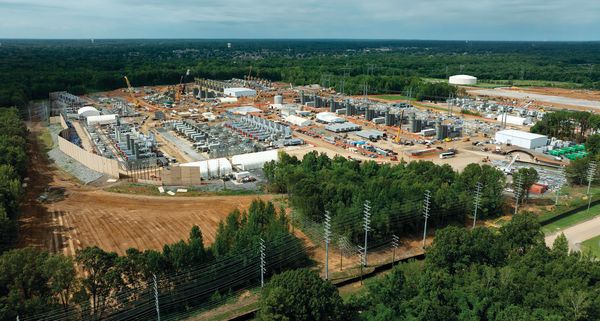
Taylor Logsdon was 20 when she and her high school sweetheart moved up their wedding so she could buy a $79,000 house in Colonial Hills, a mixed-income neighborhood of winding, tree-lined streets in Southaven, Miss. At the time, state law would not let her do so alone before she turned 21; she was told marriage would make it possible. About 11 years later that house sits near what could become one of the largest power plants in the state, a thicket of gas turbines assembled to feed SpaceXAI’s artificial-intelligence ambitions.
Beyond Logsdon’s neighborhood, the power plant is mostly hidden. Along the road, black privacy fabric wraps the tall chain-link fence surrounding the Southaven site. Past a thin line of trees, metal stacks rise above the fence, and exhaust shimmers in the heat. A $7-million sound wall does little to muffle the noise, which drills through the walls of nearby homes: a constant drone like a plane taking off and never leaving.
Reporter Austyn Gaffney talks through her reporting fieldwork in Tennessee and Mississippi for the story.
On supporting science journalism
If you're enjoying this article, consider supporting our award-winning journalism by subscribing. By purchasing a subscription you are helping to ensure the future of impactful stories about the discoveries and ideas shaping our world today.
The turbines are there because SpaceXAI needs an enormous amount of electricity for Colossus 2, one of the country’s densest concentrations of computing power, where the company is training Grok, its chatbot. The data center sits just north of the Tennessee state line, in Memphis’s Whitehaven neighborhood; the main power site sits across the border, in Southaven. The gas burns in Mississippi; the electricity crosses to Tennessee. The grid couldn’t deliver enough electricity on SpaceXAI’s timeline, so the company brought generation onsite with portable gas turbines rather than waiting for a conventional power plant or utility upgrade. The turbines were installed under Mississippi’s determination that portable equipment could run for up to a year without air permits. In April the NAACP sued, calling the operation an unpermitted power plant—a fleet that state records later showed had grown to dozens of machines. By July the plant had a capacity of about 1,775 megawatts, rivaling the state’s largest power plants—enough to electrify more than 1.4 million homes or a city more than 60 times Southaven’s size.
Across the country, AI companies are building hyperscale data centers, and power has become the constraint. Data centers now use around 4 to 5 percent of U.S. electricity, and the Electric Power Research Institute projects that share could reach 9 to 17 percent by 2030. “Companies are making a decision that it’s in their best interest to go as fast as possible because every day that they’re not online, they would be losing potential revenue,” says Costa Samaras, an engineering professor and director of the Scott Institute for Energy Innovation at Carnegie Mellon University. Cleanview, an energy-data firm tracking the industry, estimates that AI data centers can generate $10 million to $12 million in annual revenue per megawatt. Bringing a large facility online even a few years early can mean tens of billions of additional dollars.
By June the Southaven dispute had expanded far beyond the city. Elon Musk’s SpaceX, which acquired xAI earlier this year and folded it into an AI arm called SpaceXAI, raised $75 billion in an initial public offering, pushing Musk’s estimated net worth briefly above $1 trillion. A few days later the Department of Justice moved to intervene on xAI’s side and asked the court to dismiss the NAACP suit, arguing that shutting down the power source for Colossus 2 would threaten AI innovation and national security. In a sworn declaration, the Pentagon’s chief digital and artificial-intelligence officer told the court that Grok is one of only four proprietary frontier AI models currently capable of supporting national-security applications. The Pentagon was also a customer: the previous summer it had awarded xAI a contract worth up to $200 million, and the company launched Grok for Government the same day.
In Colonial Hills, the stakes are measured more simply: by who gets the power and who breathes the exhaust.
I met Logsdon in her driveway, where she sat in a deck chair as the brass bell of an ice cream truck occasionally cut through the plant’s drone. Her husband earns $21 an hour as a landscaper. Their mortgage is about $500 a month. She doesn’t believe they could afford to move.
The noise is especially hard on the couple’s kids, all 12 or under, who say it keeps them up at night. Before the turbines arrived, their son, Dallas, was obsessed with xAI’s founder. “We actually were kind of Elon fans,” Logsdon told me. Dallas received a weekly science magazine that featured Musk, and he told his mom he wanted to grow up to be like him. “Elon probably doesn’t know [this plant] was built between two neighborhoods,” she said, “he’s so high up.”

Taylor Logsdon says the turbine noise keeps her children up at night. She later helped to form a neighborhood coalition focused on noise and air pollution.
Kevin Wurm
Low-frequency noise from the Southaven turbine plant could be four to 16 times as loud as the background noise typical of a quiet suburban neighborhood, depending on the distance from the plant, according to a March report by acoustics firm Roland, Woolworth & Associates. The noise has drawn its own lawsuit: residents, including Logsdon, filed a class action alleging lost sleep and falling property values.
Logsdon said she is not anti-AI or anti-Musk, but she helped to form the Southaven Safe and Sound Coalition to advocate for her community, especially over the less visible effects of air emissions. She installed three air monitors—two outside her front door and a third atop her camper, the Four Winds Express—to learn what her kids and older neighbors might be breathing. A preliminary analysis of readings taken over four months found that fine-particulate-matter (PM2.5) concentrations around her house exceeded the Environmental Protection Agency’s daily health-protection standard about a third of the time. (The monitors could not determine how much of the pollution came from the power plant.) At least 10 schools, three daycares, two libraries, 11 parks and 27 churches sit within two miles of the plant, according to the coalition.
Dozens of gas turbines in one place can produce very high levels of nitrogen oxides, according to Daniel Cohan, a professor of civil and environmental engineering at Rice University. Those pollutants can irritate the lungs, worsen asthma, and form ground-level ozone, the main ingredient in smog, which builds quickly in the heat of a Mid-South summer.
The NAACP’s lawsuit hinges on whether scores of portable machines operating together constitute a single stationary source, which the plaintiffs argue should trigger the Clean Air Act’s permitting requirements. The Mississippi Department of Environmental Quality, or MDEQ, allowed xAI to operate the turbines without air permits so long as each was removed within 12 months. xAI later received a permit for 41 permanent turbines at the same site, with a total capacity of around 1,200 megawatts. The state’s public hearing on that permit drew more than 300 people, and every speaker opposed it. According to local news reports, no one from the permit board attended, and no one from xAI spoke. At least 27 of those permanent turbines were under construction as of July, according to MDEQ.
In Colonial Hills, the stakes are simpler: who gets the power and who breathes the exhaust.
In January the EPA said temporary turbines that exceed federal emissions thresholds may still require permits. MDEQ had said it would evaluate enforcement if a portable unit remained after the 12-month deadline. On July 30, just before the first units were due to reach that limit, a Mississippi commission acting through MDEQ signed an agreement with xAI affiliate MZX Tech, the SpaceX subsidiary that owns the site, allowing 13 turbines to keep operating through the end of the year, citing delays in construction of the permanent plant. The agreement also set a rolling timetable for the rest of the temporary fleet to be retired as SpaceXAI brings its permitted permanent turbines online.
Portable turbines can be installed quickly, but unlike combined-cycle plants, which can be about 1.5 times as efficient, they do not use their waste heat to generate additional power. “By going with this quick and dirty approach there, [the company] is burning more gas, releasing more pollution and contributing to climate change far more than it needs to be,” Cohan says.
SpaceXAI did not respond to repeated requests for comment.
The strategy had already been tested across the state line. In Memphis, xAI was relying on temporary gas turbines at Colossus 1 by 2024. The site sits in South Memphis, where the surrounding neighborhoods are predominantly Black and ringed by industry that long predates xAI. After public pushback, xAI applied for a permit for 15 permanent turbines in early 2025, but four months later two flyovers by the Southern Environmental Law Center, or SELC, found 35 turbines operating there. After the center threatened to sue, the Shelby County Health Department approved the 15-turbine permit. The dozens of temporary turbines at Colossus 1 disappeared around the same time similar machines began appearing in Mississippi, according to an SELC attorney. In an April letter to the EPA, Senator Sheldon Whitehouse, ranking member of the Senate Committee on Environment and Public Works, quoted an xAI senior manager who described the plan as copy and paste from Colossus 1.

SpaceXAI’s gas turbines rise at the end of a residential street in Southaven, Miss.
Kevin Wurm
In May the NAACP and its Mississippi State Conference sought a preliminary injunction, arguing that 33 unpermitted gas turbines at Southaven could emit 2,508 tons of smog-forming nitrogen oxides every year. A revised motion filed the next month put that scale in local terms, estimating that the site’s emissions could amount to about 26 times those of the TVA Allen gas plant. Abre’ Conner, who leads the NAACP’s environmental and climate justice work, says the organization wanted to make sure other technology companies did not see xAI’s approach as an option.
But the fleet kept growing. In January, xAI said it was running 27 turbines for Colossus 2. MDEQ counted 46 turbines at the Southaven site in May, 60 in June and 69 by July—more than double the number the company had publicly acknowledged at the beginning of the year. Forty-two had been added in 2026, late enough under the agreement’s rolling timetable to remain into 2027; the newest could stay through July of that year.
Before settling on Memphis, xAI reportedly considered eight locations around the country. Musk has said the company was told that building a data center from scratch could take up to two years, so it searched instead for a vacant factory that checked all its boxes. It found one in South Memphis: a former Electrolux plant in an industrial park already threaded with power infrastructure.
The turbines supply warehouse-scale buildings filled with racks of servers built around graphics processing units, or GPUs, the chips first popularized by video games and now prized for training and running AI models. Colossus 1 uses more than 220,000 Nvidia GPUs; Colossus 2 is estimated to use more than twice that amount. Together, Musk has called the facilities the world’s biggest AI supercomputer. Under heavy load, each GPU can draw several hundred watts and generate heat that must be removed. Data centers are increasingly shrink-wrapped around the hardware of their moment; in some cases, building anew can be more efficient than retrofitting for a changeover in chips, cooling systems and power demands.
Colossus is best known for training and running Grok, but the facilities are also becoming a business built on selling computing power. In May, SpaceX disclosed a deal under which Anthropic would pay $1.25 billion a month for capacity across Colossus 1 and Colossus 2, according to the company’s IPO filing. The agreement covers approximately 325,000 GPUs and could total more than $40 billion through May 2029. Grok’s training has moved to Colossus 2, and the company bought an 810,000-square-foot warehouse in Southaven for a third data center, Macrohardrr. In late July, Musk announced another: Minihard in Memphis, with the same GPU capacity as Macrohardrr.
The White House, meanwhile, was pushing AI companies to shoulder their own power needs. In March it rolled out a voluntary Ratepayer Protection Pledge asking AI companies to “build, bring, or buy” the power needed for their data centers and cover related grid-upgrade costs. xAI was one of the signatories. The pledge has no enforcement mechanism, but it encourages the same build-your-own pathway now being challenged in Southaven.
Some Southaven aldermen would talk about SpaceXAI, but several ultimately directed me toward Mayor Darren Musselwhite. He was harder to find. One alderman offered to buy me lunch if I tracked him down. A resident told me the mayor’s nickname was Rapunzel because he was always locked away in his tower. After repeated calls and e-mails and two visits to that tower—Southaven City Hall—Musselwhite did not respond.
A picture began to emerge from my conversations of a project that had become hard for local officials to resist even as trust in SpaceXAI wore thin. Mississippi governor Tate Reeves has called the company’s more than $20-billion Southaven expansion the largest private investment in the state’s history. In a letter included with the DOJ’s court papers, he warned that an injunction could disrupt the state’s economy. Southaven’s mayor said in January that the buildout could bring more than 100 jobs and about $60 million in additional revenue for the city, the county and the school system. The city’s share, he estimated, would exceed $20 million in 2028—nearly a quarter of its main operating budget. “It’s hard for any community to just say no and turn it down,” alderman-at-large George Payne said on his way to work as an engineer at the local news station. Speaking more broadly about AI, he added, “I’m scared to death of it, as [are] many other people. But I don’t think it’s going to go away. You can’t stop now.”

Krystal Polk’s parents built this house on land her great-great-grandparents bought; SpaceXAI’s power plant now sits across the road.
Kevin Wurm
A few days before the project was revealed, William Jerome, another alderman, signed a nondisclosure agreement—his first—that prevented him from discussing the project publicly before the company announced it. Jerome says the city has nothing to hide, but he would advise other communities to build data centers far from residential areas and to check their local laws before inviting companies in. “I would tell cities to check their zoning because xAI has not done anything illegal,” he says. “For one year they don’t have to get a permit. So are they unpermitted? Yeah, but they’re not illegal.”
Jerome and Payne both say they plan to hold SpaceXAI to its promise to build a quieter, permanent facility to house the turbines. “Now that’s what they [the company] are telling us,” Payne says. “Do I believe with 100 percent certainty? I hope so.”
In Memphis, officials have already been learning the limits of nonbinding promises. At a city council meeting, Sarah Houston, executive director of Protect Our Aquifer, a local water advocacy group, described a recycled-water facility xAI had promised to build. Local officials never secured a binding agreement, and construction paused with the project only partly finished. Houston said completing it would cost another $100 million, less than three days’ worth of payments under Anthropic’s contract for capacity at Colossus 1 and 2.
“We learned at the same time as everyone else” that the project was paused, Doug McGowen, president and CEO of Memphis Light, Gas and Water, told the council. He said xAI had restructured, with an entirely new engineering team in place. SpaceXAI’s president told him and Memphis mayor Paul Young that construction could restart in the first quarter of 2027.
Tannera George Gibson, the city attorney, dismissed Houston’s presentation as “cute” and said the city needed to rely on lawyers, not advocates, for information. Pressed further, Gibson acknowledged that Memphis was leaning on “goodwill and corporate partnership.” Council member Jeff Warren said that the public wanted more accountability. “xAI has had the opportunity to develop these facilities in ways that don’t use water and put water back in cleaner than they take it out, and they haven’t chosen to do it, because they’re in a race against time,” he said.
Local resistance has spread almost as quickly as the data centers themselves. KeShaun Pearson, president of Memphis Community Against Pollution, has spent months traveling through Tennessee, Georgia, Mississippi and Arkansas, trying to turn scattered fights over power and pollution into a Mid-South coalition.
I met him at a barbershop in a strip mall near Memphis’s Frank C. Pidgeon Industrial Center as pink light began to streak the summer sky. He had flown from Atlanta that morning after attending a DeKalb County Board of Commissioners meeting that extended the community’s data center moratorium through September 30.
At least 15 states have considered restrictions or pauses on new data centers, according to the National Conference of State Legislatures, but about half of those proposals have failed. Maine lawmakers passed an 18-month moratorium in spring 2026, but Governor Janet Mills vetoed it. In July, Kathy Hochul, governor of New York State, signed an executive order making hers the first state to impose a statewide pause for new large data centers. Local governments, including DeKalb County, have often been quicker to impose temporary pauses of their own.

Polk says SpaceXAI never came to the door before building nearby. After company representatives questioned family members near the property, she and her children began carrying tax records to prove it is theirs.
Kevin Wurm
Pearson grew up near the industrial park in South Memphis with severe allergies. In a letter opposing the permit for gas turbines at Colossus 1, the Asthma and Allergy Foundation of America warned that the project could add health risks in a region already overburdened with asthma and other respiratory problems. A report published in 2026 showed that Shelby County, which includes Memphis, had received an F from the American Lung Association for its high-ozone days for three years running, from 2022 to 2024. DeSoto County, home to Southaven, also received an F for high-ozone days. Now 37, Pearson said communities like his continue to be treated as “the path of least resistance”—as if their lives do not matter—and “strategically targeted for pollution projects.”
Together we drove toward the industrial park. The unfinished recycled-water facility was marked by two large storage tanks. Across from it sprawled a rail yard and the TVA Allen Combined Cycle Gas Plant, an older answer to the question of who controls power here. Congress created the Tennessee Valley Authority in 1933 to bring electricity and flood control to a struggling region, an experiment in public power that Memphis voted to join the following year. The city became TVA’s largest customer; the relationship has repeatedly frayed over waste, water and power costs. Beyond the plant stood the Nucor steel mill, a cornfield and the Mississippi River.
In the heart of the industrial park sat Colossus 1. “It’s so easy for me to see just how our federal government is being leveraged against us,” Pearson said, referring to the DOJ’s effort to intervene in the Southaven case.
After enormous public pushback against SpaceXAI, Memphis created a community-benefits ordinance. Under it, 25 percent of property-tax revenue from the company’s facilities, up to $100 million, will go toward public-benefit projects in zip codes within a five-mile radius of two of its sites, with 1 percent set aside for environmental work. The ordinance cut against the way Memphis usually courts industry: companies typically negotiate deals that can reduce their property taxes by as much as 75 percent for a set term, but xAI, by Young’s account, asked for no such break. Pearson, however, wants more than money. He wants a moratorium.
In August the Memphis City Council gave initial approval to a temporary pause on new data centers. But for now, the momentum in Southaven is running the other way. The temporary turbines have a negotiated exit schedule, but SpaceXAI has permission to replace them with a permanent power plant. Environmental groups are challenging that permit, and the legal fight over the temporary fleet is still unresolved.
Back in Southaven, Krystal Polk, 52, owns a home close to the fence line, facing the gas plant. Her great-great-grandparents purchased the land, and her parents built the house at a time when few Black families in the area owned property, Polk says. Intruders once wrote “KKK” in the gravel outside the one-story ranch house.
Still, Polk’s family found peace there, watching big owls swoop down and falling asleep to the rustle of two acres of trees. Her three kids grew up spending weekends there while the family lived at another house in town during the workweek. She hosted gatherings there for dozens of relatives. But this year, on the Fourth of July, she canceled a family get-together because the plant was too loud and the prospect of air pollution was too unsettling. “I feel like we are invisible,” she told me from a couch in her living room, her blue dress brushing the floor. “A whole community is saying the same thing, and they’re not listening to them. They have children and babies over there, and elderly, and it’s very heartbreaking.”
Industry is not new to Polk’s family. Warehouses had moved in around the property. Years earlier, TVA representatives visited the house several times to make sure the family knew the utility was building a gas plant nearby and to hear any concerns. Polk said she remembered them as being friendly and respectful.
TVA had come to the door before it began building; xAI never did. Polk said company representatives have instead repeatedly stopped members of her family near the property, asking why they were there or what they were doing—especially when she invited advocates or reporters onto her lawn. “I have to remind them that this is mine,” she said. “I’m not on your property. This is my property.” She and her kids now carry tax records to prove it. “We will be someone’s study eventually,” Polk said. “It’s probably not this year, but as the years go on, we will be the casualties from all of this.”
Editor’s Note (9/17/26): This article was edited after posting to correct the amount of additional revenue Southaven’s mayor estimated the city would receive in 2028. He estimated more than $20 million, not $20 billion.