
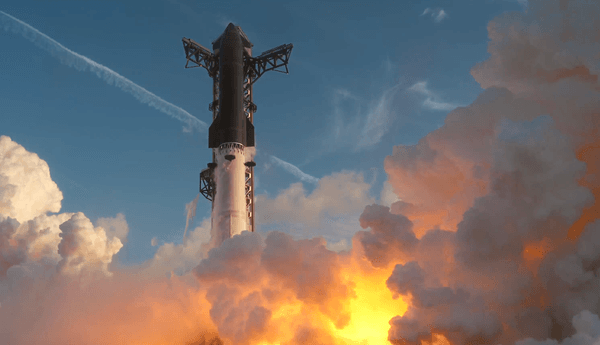
SpaceX’s Starship is on a mission to prove itself. The largest rocket ever built lifted off from the company’s Starbase facility in South Texas on Monday at 8:49 A.M. EDT, soaring toward space atop its giant Super Heavy booster. This test flight—the 14th fully integrated launch—was more than just another Starship shakedown: it marked the first time the enormous spacecraft has propelled itself into orbit around Earth.
The first orbital flight puts Starship over its biggest hurdle yet in SpaceX’s race to make the vehicle its new workhorse for space launches, replacing the wildly successful Falcon 9. Yet issues along the way—the flight was meant to last hours longer than it did—served as a potent reminder of just how audacious SpaceX’s hopes for Starship really are—and how far the company must go to build a robust, reliable orbital transportation system.
Flight 14’s vehicle is the third-generation version of Starship, standing about 124 meters (407 feet) tall when stacked with its Super Heavy booster. That first stage, Booster 21, powered the vehicle upward using 33 Raptor 3 engines. After stage separation, Booster 21 performed a controlled return and splashdown in the Gulf of Mexico.
On supporting science journalism
If you're enjoying this article, consider supporting our award-winning journalism by subscribing. By purchasing a subscription you are helping to ensure the future of impactful stories about the discoveries and ideas shaping our world today.
Meanwhile, Starship accelerated toward orbit. About 25 minutes after liftoff, it reignited one of its three sea-level Raptor engines to raise and circularize its trajectory. (The ship also carries three vacuum-rated Raptor engines for in-space maneuvers.) Incredibly, SpaceX seemed unsure as to whether to push ahead to orbit, calling off that part of the test for a brief moment before deciding to go for orbit minutes later.
At that point, Starship became an orbital spacecraft. The vehicle reached an altitude of roughly 275 kilometers. Along the way, it deployed 26 Starlink V3 satellites—the first operational payloads to be carried to orbit by Starship. Three of those satellites also beamed back imagery of Starship’s heat shield, which must remain intact to ensure the spacecraft doesn’t break apart and burn up during reentry.
SpaceX had originally planned a 10-hour mission that would see Starship orbit the globe at least six times, but a little over an hour and a half into the flight, SpaceX made the call to bring Starship back to Earth early. Starship performed a deorbit burn at approximately 11 A.M. EDT and re-entered Earth’s atmosphere at around 11:40 A.M. The ship performed a controlled splashdown in the Pacific Ocean at 11:58 A.M.
A test of SpaceX’s grand vision
Starship occupies an unusual place in the history of rocketry. Unlike all previous launch systems, it’s designed to be fully reusable: both the Super Heavy booster and the Starship spacecraft would be recovered and flown repeatedly in normal operations.
Intended to carry both crew and cargo, Starship is the linchpin of SpaceX’s grand vision of launching a million data center satellites into orbit and separately sending astronauts to the moon and, eventually, to Mars.
That radical vision has depended on a chain of technological achievements: entering orbit, deploying payloads, surviving reentry, making pinpoint landings and achieving smooth recoveries—and then repeating the sequence flawlessly, again and again, to reach the frequency of flights necessary to make Starship’s economics work.
Today’s flight did not prove all of those things—and nor was it supposed to. Neither the Starship or booster attempted a tower catch (that may happen during the next test flight, according to SpaceX), and Flight 14 didn’t demonstrate any of the daunting orbital propellant transfers required for missions to the moon or Mars.
For more than three years, Starship’s development has been defined by a series of spectacular successes and failures, accruing incremental progress in between. The fourth flight, in 2024, demonstrated controlled splashdowns of both stages. Flight 5 saw the first-ever tower catch—a dramatic recovery of a Super Heavy booster using the launch tower’s mechanical arms. Later launches introduced major vehicle upgrades, including the current third-generation Starship. Flights 12 and 13 successfully tested this new generation, although the booster on Flight 13 was lost during landing.
A major failure during Flight 14 wouldn’t have doomed SpaceX’s plans for Starship—but it would have complicated them. The company uses a “test to failure” philosophy, pushing its systems to their limits to identify problems. Flight 14 didn’t deliver on all its aims—it was supposed to orbit Earth at least six times—but the fact that it deployed its payload and got in and out of orbit safely nonetheless could minimize any tinkering before the next test.
To the moon and beyond
Of all Starship’s promises, the most notable may be the vehicle’s role in NASA’s Artemis program to return astronauts to the moon. The space agency has selected a version of Starship as one of two potential Human Landing Systems (HLS) for Artemis. Under the current plan, SpaceX is developing Starship HLS for Artemis III—a low-Earth orbit test mission in 2027—and for a crewed lunar landing, the Artemis IV mission, in 2028.
That version of Starship must be refueled in Earth orbit via a succession of tanker flights by other Starships before heading to the moon. The Starship would then depart Earth orbit, travel to lunar orbit and rendezvous with astronauts there for a down-and-back foray to the moon’s surface. NASA’s inspector general has said this will require more than 10 tanker flights, with the first refueling beginning more than 200 days before the crewed mission.
That is a wildly ambitious plan. And it means the largely successful nature of today’s orbital test is not merely be good news for SpaceX. It could also reduce one of the fundamental uncertainties hanging over NASA’s lunar plans, adding credibility to the space agency’s controversial Artemis architecture.
NASA’s inspector general also concluded earlier this year that Starship HLS is behind schedule for future Artemis missions, warning that further technical problems could spiral into greater delays for the entire program. This no doubt contributed to NASA’s decision to shift an actual crewed landing from Artemis III to Artemis IV, and it reinforces the space agency’s choice to also pursue Blue Origin’s Blue Moon vehicle as another Human Landing System, creating some redundancy in the lunar architecture.
But after Blue Moon’s ride to space, Blue Origin’s New Glenn rocket, suffered a catastrophic explosion on the launch pad during preflight testing in late May of this year, the status of this second option for Artemis lunar missions is also in question.
This makes it hard to understate NASA’s reliance on Starship—and hence on a successful Flight 14—for keeping Artemis on schedule.
Editor’s Note (9/28/26): This is a developing story and will be updated.