
When the solar system began to form, everything was chaos. A slew of rocky material was smashing together in a maelstrom that would eventually become the baby protoplanets, comets and asteroids that make up our cosmic neighborhood.
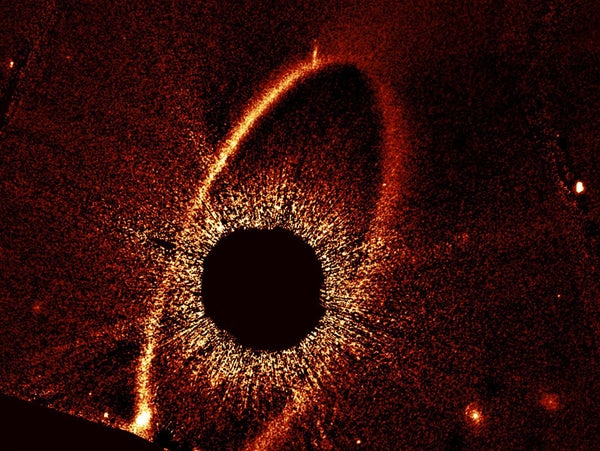
And now NASA’s Hubble Space Telescope has captured a similar violent clash occurring around another star some 25 light-years away. The star, Fomalhaut, stands out as one of the brightest in the night sky and is known to be shrouded in bands of dust and debris.
Back in 2008 astronomers examining Fomalhaut discovered a potential planet orbiting the star—subsequent observations, however, showed that the orb was fading, leading some to question whether it was a planet or the debris left over from a collision between two smaller objects. By 2014 it had disappeared. And in a new study published in Science, astronomers describe how, in 2023, they found a different point of light that resembles the previously discovered object.
On supporting science journalism
If you're enjoying this article, consider supporting our award-winning journalism by subscribing. By purchasing a subscription you are helping to ensure the future of impactful stories about the discoveries and ideas shaping our world today.
Its sudden appearance—and the proposed planet’s disappearance—suggests both are the remnants of violent collisions between two massive objects. The observations cut against older hypotheses about such crashes, according to Paul Kalas, an astronomer at the University of California, Berkeley, and a co-author of the new study.
“Previous theory suggested that there should be one collision every 100,000 years, or longer. Here, in 20 years, we’ve seen two,” Kalas said in a statement. “If you had a movie of the last 3,000 years, and it was sped up so that every year was a fraction of a second, imagine how many flashes you’d see over that time. Fomalhaut’s planetary system would be sparkling with these collisions.”
In the future, Kalas and his colleagues hope to use the James Webb Space Telescope to glean the composition of the dust left over from the crash, including any evidence it contains water ice. These and other observations of Fomalhaut and its surrounding debris could offer new clues to how planetary systems like our own coalesce and evolve.