
This article is part of a special report on the total solar eclipse that will be visible from parts of the U.S., Mexico and Canada on April 8, 2024.
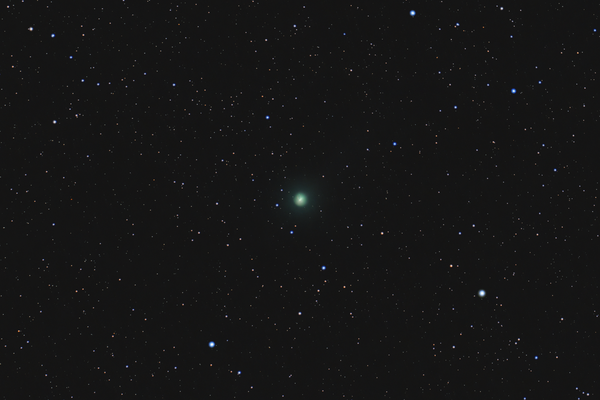
On April 8 a swath of Mexico, the U. S. and Canada will be treated to a stunning total solar eclipse, the second such eclipse to be widely visible in the U.S. in less than a decade. But this time a comet may photobomb the display.
The dirty ice ball, officially known as Comet 12P/Pons-Brooks, was discovered in 1812. The comet takes a little more than 71 years to orbit the sun in a path that sends it zipping out past Neptune’s orbit and then diving back through the inner solar system. During Comet 12P’s current pass, professional and amateur astronomers have observed a series of outbursts from the hurtling ice ball that appeared to give it horns, earning it nicknames such as “Millennium Falcon” and “Devil Comet.”
On supporting science journalism
If you're enjoying this article, consider supporting our award-winning journalism by subscribing. By purchasing a subscription you are helping to ensure the future of impactful stories about the discoveries and ideas shaping our world today.
“This is one of the brightest comets in history,” says Rosita Kokotanekova, a planetary scientist at the Institute of Astronomy and National Astronomical Observatory at the Bulgarian Academy of Sciences.
And Comet 12P will make its closest approach to the sun on April 21—less than two weeks after the total solar eclipse. The timing means that the comet will appear about 25 degrees away from the sun during totality. (Your clenched fist held at arm’s length can be used to measure about 10 degrees across in the sky.)

Credit: Katie Peek; Source: NASA (eclipse track data)
Just how visible Comet 12P may be during totality is still uncertain. Although the sun will be blocked at that time, the sky won’t reach true nighttime hues—it will be more like twilight—and our home star’s outer atmosphere, or corona, will be shining as well. Based on the current observations, during totality, the comet may be just barely visible to the naked eye, or sky watchers may need binoculars to spot it.
“I don’t want people to get disappointed if they don’t see the comet,” Kokotanekova says. “If people expect to see something extremely bright on a fully dark sky, I think that unless we’re very luck with an outburst, it will be more challenging than that.”
But if the comet cooperates, it could appear much brighter. That’s because Comet 12P is known for its dramatic outbursts, during which the ice ball loses a substantial amount of material, both ice that sublimates into gas and dust shed into the surrounding space. This causes the comet to appear brighter by increasing the size of the fuzzy halo around it.
“It has had some spectacular outbursts,” Kokotanekova says of Comet 12P. Scientists aren’t yet sure what causes them, she adds—some researchers have theorized that cracks are opening in the comet’s icy body or that cliffs on its potentially jagged surface are collapsing. “It’s a very unknown territory,” she says. “That’s why we’re interested in every comet that does this.”
Whatever the cause of 12P’s outbursts, a well-timed one could turn Comet 12P’s appearance at totality from subtle to stunning. That said, our limited records from the comet’s previous close approaches to the sun suggest that its outbursts may subside as it hurtles closer to our star—another puzzle for scientists to tackle in the coming months.
Although total solar eclipses and bright comets are each relatively rare phenomena, Comet 12P wouldn’t be the first to make an appearance during totality. A historian reported discovering a different comet during a total solar eclipse over what is now Turkey in C.E. 418, for example. And since the late 1800s observers have often spotted “sungrazing” comets—which pass within about 850,000 miles of the star—during eclipses. Particularly notable, in 1997 Comet Hale-Bopp made its closest approach to Earth just two weeks after a total solar eclipse. We’ll just need to wait a little longer to see how Comet 12P/Pons-Brooks will compare.