
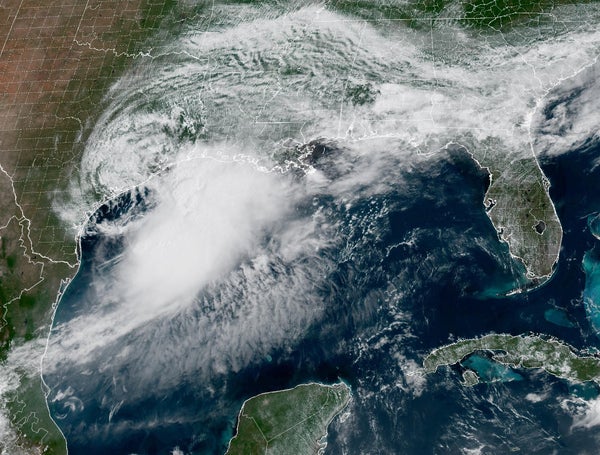
The first named storm of the Atlantic season is here—and it has formed from the dregs of the third named storm of the eastern Pacific hurricane season.
Tropical Storm Arthur, which has formed off the coast of Texas, was born in part from the remnants of Tropical Storm Christina, which had a brief and erratic existence in the eastern Pacific. Those remnants migrated over Central America, emerging over the Gulf of Mexico, where they combined with another atmospheric disturbance to make Arthur.
“Arthur’s genesis, like most genesis events in the western Gulf, was messy, but I think a westward-moving tropical wave was probably the primary seed for this system, with a boost from Christina’s remnants,” says Phil Klotzbach, an atmospheric scientist at Colorado State University, who studies hurricanes.
On supporting science journalism
If you're enjoying this article, consider supporting our award-winning journalism by subscribing. By purchasing a subscription you are helping to ensure the future of impactful stories about the discoveries and ideas shaping our world today.
Arthur and Christina aren’t technically considered the same storm, but there have been previous events where storms have survived crossing over Central America somewhat intact, if weakened. Usually, however, these crossings progress from the opposite direction as this one. Some 21 previous storms are recognized as crossing from the Atlantic to the Pacific, or vice versa. Of these, only five crossed from the Pacific to the Atlantic. The most recent crossings were those of Tropical Storm Bonnie and Tropical Storm Julia in 2022, and both were from the Atlantic to the Pacific, Klotzbach says.
In 2000 the National Hurricane Center (NHC) determined that storms that made the crossings and retained at least tropical storm strength would keep their original name.
As for why the Pacific is on its third storm and the Atlantic is only on its first: this is not unusual because the beginning of the Pacific season is in mid-May versus the Atlantic season’s June 1 start date. And this year’s El Niño will likely amplify Pacific storms, whereas the phenomenon tends to quash development in the Atlantic.