
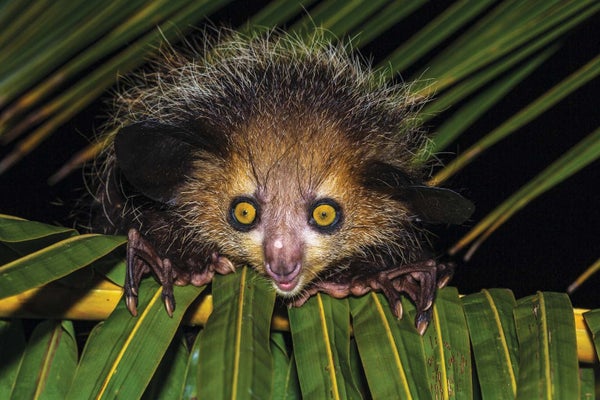
A long-fingered lemur has been caught on camera picking its nose—and eating the slimy goods.
The culprit was Kali, an aye-aye at the Duke Lemur Center who now has the dubious honor of being the first of her species ever recorded nose picking, researchers say. What’s more, Kali earned this distinction with an aye-aye’s bizarrely long middle finger; when fully inserted in her nose, it reached all the way into her throat. “I was really impressed,” says Anne-Claire Fabre, an evolutionary biologist at the University of Bern and the curator of mammals at the Natural History Museum of Bern in Switzerland. She and her colleagues reported the findings in the Journal of Zoology.
Fabre was studying lemur grasp when she happened to catch Kali “digging for gold.” She and her team subsequently searched in the research literature for other examples of primate nose pickers and found that at least 11 other species besides aye-ayes are guilty of the habit. Others include chimpanzees, gorillas, capuchin monkeys and, yes, humans. Surveys have found nose picking to be extremely common in our species, with almost entire samples of teens and adults admitting to the habit privately.
On supporting science journalism
If you're enjoying this article, consider supporting our award-winning journalism by subscribing. By purchasing a subscription you are helping to ensure the future of impactful stories about the discoveries and ideas shaping our world today.
But the champion nose picker has got to be the aye-aye. These lemurs’ middle fingers are more than three inches long and very spindly. Aye-ayes use the weird digits to tap on logs extremely rapidly, reaching at least seven raps per second while listening with their batlike ears for the sound of voids in the wood—tunnels gnawed by insects. Then they mentally map these tunnels, bite holes at intersections and plunge their middle fingers in to pull out grubs, says North Carolina State University biologist Adam Hartstone-Rose, who was not involved in the new research. While fingers in the animal kingdom almost always have hinge joints that bend forward and back, Hartstone-Rose says, the aye-aye’s middle finger joint is a ball-and-socket, allowing it to rotate and turn almost like a human shoulder.
Some researchers have speculated that nose picking might offer immune system advantages or some other benefit, although Fabre says no firm science backs that up. But primates, in general, are pickers, Hartstone-Rose says: they pull parasites off one another, pick at scabs, put Q-tips in their ears against medical advice, and generally use their dexterity to groom themselves and others.
“I think the finger evolved to do this amazing ‘fishing’ behavior” in logs, Hartstone-Rose says, “and just because it has that anatomy and that sensitivity, it basically freed it to be able to do this other disgusting thing.”