
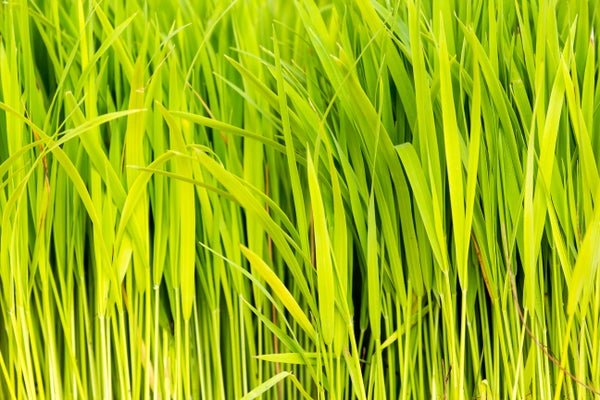
Picture a clump of grass—a spray of flat green blades that converge into sturdy tubes near the ground. These tubes are formed by the curled lower portion of the grass leaf, called the sheath, which represents something of an evolutionary triumph. It allows grass to grow from the base (instead of the stem, like most other flowering plants) by protecting new growth and holding mature blades upright so they can compete for sunlight. This growth strategy helps to explain why lawns survive mowing and how grasslands dominate more than a quarter of Earth’s land area: by tolerating grazing and wildfires better than stem-growing competitors.
Scientists have long debated the evolutionary origins of the sheath, which is found in all grasses, including corn, wheat and bamboo. Now a new study in Science illustrates how the novel structure of the grass leaf arose from the same genetic pattern that governs other plants’ leaf development. “It’s not that we got new things bolted on and added,” says the study’s lead author Annis Richardson, a developmental geneticist at the University of Edinburgh. “The connections were tweaked.”
Richardson and her colleagues started by taking 3-D images of corn seedlings as they matured, then re-creating the plant’s development using a computer model. The researchers honed their model further by comparing it with experimental observations, such as where certain genes activate in plants and how genetic mutations affect leaf shape. Then they turned to the sheath.
On supporting science journalism
If you're enjoying this article, consider supporting our award-winning journalism by subscribing. By purchasing a subscription you are helping to ensure the future of impactful stories about the discoveries and ideas shaping our world today.
In the 1800s botanists proposed that the sheath part of a grass leaf represented the evolutionary equivalent of the petiole, the stalk that connects a typical plant’s leaf to its stem. Later, many scientists concluded based on vein patterns that beyond just the sheath, the entire grass leaf—or most of it—actually corresponded to this stalk. Richardson and her team tested both hypotheses in their model and found that the older idea, linking only the sheath to the petiole, offered the simplest evolutionary path and required only subtle changes in a common genetic blueprint.
Aman Husbands, a developmental biologist at the University of Pennsylvania who was not involved in the study, says the researchers tied together clues about the sheath from other leaf studies and “put it all together into a model that actually explains it and really settles it.”
An improved understanding of what controls leaf shape could help scientists engineer better crops, Richardson says. Identifying the sheath’s origin also sheds light on grass evolution. Although grass’s unique structure had enormous consequences for Earth’s landscapes and inhabitants—including humans, who get more than half their calories from domesticated grass grains—she adds, “we now understand that that leaf shape wasn’t that hard to develop.”