
This article is part of a special report on the total solar eclipse that will be visible from parts of the U.S., Mexico and Canada on April 8, 2024.
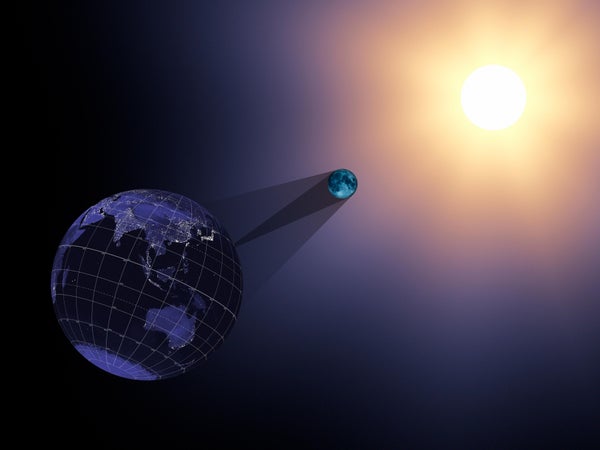
At first blush, the circumstances required for a total solar eclipse sound technical but mundane: the sun, moon and Earth line up, in that order. Sure, it happens just once every 18 months or so, and only a thin strip of Earth experiences the marvel of totality during each eclipse, but how hard can it be for one to occur?
Astronomically hard, it turns out: the conditions required for Earthlings to experience a total solar eclipse like the one about to occur across a swath of North America have been developing for billions of years, and the phenomenon relies on the unique relationship between Earth and our moon.
On supporting science journalism
If you're enjoying this article, consider supporting our award-winning journalism by subscribing. By purchasing a subscription you are helping to ensure the future of impactful stories about the discoveries and ideas shaping our world today.
“People always associate eclipses with the sun, but of course you’re really looking at the moon,” says Parvathy Prem, a planetary scientist at Johns Hopkins University’s Applied Physics Laboratory. “In some sense, you’re touching the shadow of the moon,” she says. The spectacle is “a reminder that the Earth and the moon are connected.”
Total solar eclipses get their drama from a tidy set of coincidences. Most prominently, the sun, which is about 400 times larger than the moon, is located about 400 times farther away from Earth. The result is an illusion in which both sun and moon appear to be about the same size in our sky, allowing the moon to block out the sun’s visible disk while revealing the fiery white corona of its outer atmosphere. No other rocky planet in our solar system has the right proportions to experience total solar eclipses as Earth does: Mercury and Venus lack moons entirely, while Mars’s two satellites are runty captured asteroids capable of only partial eclipses.
Our moon is also unusually large—it is bigger than 98 percent of its peers in our solar system and smaller only than a few moons of the gas giants Jupiter and Saturn. Earth’s companion is surprising in both its heftiness and proportional size compared with its planet. “The moon is a really unusually big satellite; it’s very rare,” says Jun Korenaga, a geophysicist at Yale University.
Our moon is so bulky because of the collision that formed it. Scientists believe a hunk of rock about the size of Mars slammed into the young proto-Earth about 4.5 billion years ago. When the dust settled, modern Earth and its lunar companion remained. It was a real Goldilocks situation: a smaller impact might have created a smaller moon, and a larger impact might have destroyed Earth and the moon entirely. (Another dose of cosmic chance: the impact left the moon’s orbit tilted five degrees from that of Earth. If the moon’s orbital plane matched our own, Earth would experience a total solar eclipse every new moon.)
With this literally Earth-shattering impact, a dance between our planet and its moon began that has lasted billions of years. Shortly after the collision, the two bodies were close together, but they have since drifted apart, a result of the moon’s gravity tugging at Earth’s oceans and causing tides. This watery bulge peaks just a tad before the moon is overhead, thanks to Earth’s rotation and friction between the seafloor and the ebbing and flowing ocean. In order to conserve angular momentum and energy in response to this destabilization, Earth’s rotation slows down an infinitesimal amount, and the moon gradually drifts away from Earth.* Scientists think that the distance grew quickly until about two billion years ago, Korenaga says. Today the moon saunters away from Earth at a rate of just about 1.5 inches each year.
For decades, scientists have tracked the distance between Earth and the moon with five instruments called lunar ranging retroreflectors that were placed on the lunar surface during the Apollo program and the then Soviet Union’s uncrewed rover program, Lunokhod. By shooting laser beams up at these reflectors and precisely measuring the time it takes for the laser’s photons to return to Earth, scientists have been able to regularly calculate the changing distance between the laser and the reflector with stunning accuracy.
“That really changed the way we measure things,” says Vishnu Viswanathan, a planetary scientist at NASA’s Goddard Space Flight Center in Maryland, of the technology. “You can imagine measuring, like, 380,000 kilometers to an accuracy of a few millimeters—that’s just mind-boggling.”
Also mind-boggling is that humans may be changing the speed of the moon’s retreat. Because the phenomenon is mediated by the oceans, the speed of the moon’s retreat increases and decreases depending on how much water is sloshing around Earth’s surface. Human activity is hastening glacial melt, and more water in the oceans could theoretically speed up the moon’s retreat. Viswanathan says scientists are now looking for these signatures in retroreflector data.
As the Earth-moon distance changes, so does the experience of a total solar eclipse. Billions of years ago, when the moon was much closer, eclipses may not have been able to offer a glimpse of the sun’s wispy corona.
And in the opposite direction, jump 620 million years into Earth’s future and the moon will have drifted far enough away that Earth will see only annular solar eclipses. Today these “ring of fire” spectacles occur during eclipses when the moon is in the more distant part of its orbit around Earth and cannot fully block the sun’s disk. But far in the future, Earth will likely only catch partial eclipses, just like those seen by rovers on the surface of Mars courtesy of its puny moons.
Right now, with a total solar eclipse just weeks away, is a cosmically brilliant time to be alive. “It always strikes me as really remarkable that we’re around at the time when the moon is just the right distance from us for us to have solar eclipses,” Prem says. “It really is an amazing coincidence.”
*Editor’s Note (3/12/24): This sentence was edited after posting to correct the description of how the moon’s pull on Earth’s oceans affects our planet’s rotation.