
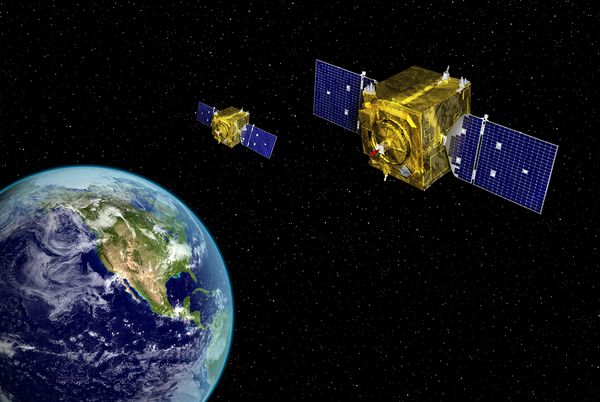
When the U.S. announced that it has placed weapons in space on September 14, it came as a surprise to absolutely nobody familiar with the subject.
“My initial impression was that it was about time to announce it since it was the worst-kept secret in the world,” says Doug Loverro, who was deputy assistant secretary of defense for space policy during the second Obama administration.
Military use of space isn’t new. Armed forces of the U.S. and other spacefaring countries have relied on satellites for surveillance and navigation for more than half a century—in the 1960s the U.S. and the Soviet Union even blew up nuclear bombs in space. The GPS (Global Positioning System), weather and communications satellites upon which so much of our modern lives on Earth now depend all have militaristic roots. And as this dependency has grown, so, too, have countries’ concerns about defending their assets in space. Gradually, Earth orbit has become not just a place for a god’s-eye overview of our planet but also a hotly contested war-fighting domain.
On supporting science journalism
If you're enjoying this article, consider supporting our award-winning journalism by subscribing. By purchasing a subscription you are helping to ensure the future of impactful stories about the discoveries and ideas shaping our world today.
This admission from the U.S., says Jonathan McDowell, an astrophysicist who tracks rocket launches and in-space activity, is just the next step in that process.
“It’s not out of nowhere,” he says. “The U.S. remains the country that is the most dependent on space assets for its operations, and to that extent, it remains the country that has the most to lose from space conflict.”
Loverro believes the announcement wasn’t much more than an acknowledgment of what people could already see for themselves by looking up. While their actual missions may remain secret, most classified military satellites can be easily tracked and cataloged from the ground. “If we don’t tell them what it is, they’re going to hypothesize what it is—so let’s just be clear,” he says.
Even so, no other nation has ever publicly acknowledged its possession of space weapons. The U.S.’s decision to do so now presumably signals to potential adversaries with thinly veiled space weapons of their own—namely China and Russia—that a new era of accountability for orbital saber-rattling is at hand. But two burning questions remain: What are these space weapons, exactly? And what might they mean for our future down here?
The answers probably aren’t what you’d think.
The Orbital Arsenal
Space weapons can come in four broad categories, most experts say: nuclear bombs, directed-energy weapons, kinetic antisatellite weapons and platforms for disrupting or disabling satellites’ activity without actually destroying them. For the latter category, the most effective results would probably come from a platform getting close to an adversarial spacecraft via what’s known as rendezvous and proximity operations (RPOs).
Nuclear weapons in space are banned by the 1967 United Nations Outer Space Treaty, and the consensus is that they would be Very Bad for everyone. Blowing up a nuclear bomb in space would first destroy or disable any nearby satellites, and then the damage would spread as electronics-frying energetic particles from the explosion contaminated huge swaths of orbit. If that wasn’t bad enough, the dead satellites would start crashing into things, creating cascades of high-speed debris that could destroy most remaining satellites in a catastrophic domino effect called Kessler syndrome.
Back on Earth, we’d likely see beautiful flashes of color in the sky—followed by severe economic shocks and military conflict erupting around the globe as crucial space-based services went dark. Though the U.S. has accused Russia of seeking to loft nuclear weapons into orbit, detonating a warhead in space is highly unlikely right now, says Jeffrey Lewis, an expert on nuclear security at Stanford University.
“The only reason you would do that is if you are looking at the entire space landscape and you’re thinking to yourself, ‘I’d like to be able to hit delete,’” Lewis says.
Kinetic antisatellite weapons are things like missiles or other spacecraft that smash into and shatter satellites. The linebackers of orbit, these weapons may be effective but aren’t necessarily the most strategic. The resulting shrapnel, while less than that of a nuclear explosion, would still pose grave hazards, going against the U.S. military’s long-standing (but informal) policy of avoiding debris-generating activity in space. So that’s out.
Directed-energy weapons—think big lasers—could take down satellites, too. In some respects, these would be a military planner’s dream: they could be built and operated on the ground or carried into space, and their precision-targeted beams could move at the speed of light to intercept and disable spacecraft while creating minimal debris. Loverro, who oversaw U.S. space war fighting from 2013 to 2017, says this is probably the tool he’d reach for if he were choosing a space weapon.
But laser weapons “probably aren’t technically mature enough” yet, McDowell says, and their use would be a very aggressive show of force at this point.
That leaves the wide-ranging category of interfering with satellites through RPOs and other subtle means. One of the most obvious scenarios, McDowell says, entails a space-based platform using an RPO to approach a target and disrupt its communications or sensing; that’s why he thinks that the U.S. weapons announced earlier this month are probably satellites that will “go up next to other satellites and shout real loud in their ear.”
Called a communication jammer, such a device is a form of electronic weapon that emits electromagnetic “noise” to swamp signals between ground stations and other satellites. This type of interference can effectively render a targeted spacecraft defunct, blocking critical military navigation and intel. Russia is suspected of jamming several satellite systems across Europe in the wake of its 2022 invasion of Ukraine.
McDowell has identified 17 small U.S. satellites as likely jammers; all of them were launched as secretive payloads over the past four years. These satellites are in geostationary Earth orbit, so high up that they move at the same rate as the planet’s rotation, making each an effectively stationary sentinel that continuously monitors a target region of the globe below. But at least some jammers now in orbit, he suspects, are explicit RPO platforms that are not meant to stay in one place at all.
And disrupting signals isn’t the only aggressive act in the RPO toolbox.
Playground Games
Remember the childhood trick in which some playground prankster would put their finger really close to your face and tease, “I’m not touching you”? RPOs are a lot like that, Lewis says.
But when the “pranksters” are global superpowers vying for space superiority, the “playground” is Earth orbit and the “finger” is a satellite moving at tens of thousands of miles per hour and bristling with advanced, highly classified technology—the stakes get a lot higher.
The first RPOs occurred near the dawn of the space age as milestones in human spaceflight. Back during NASA’s Gemini missions of the 1960s, U.S. astronauts navigated one spaceship close enough to dock at another. These were dry runs for similar maneuvers that were essential for the subsequent lunar landings of the Apollo program. NASA’s space shuttles also used RPOs to capture and service satellites. RPOs are routine at the International Space Station and will be crucial for the orbital refueling that NASA’s Artemis program demands for returning U.S. astronauts to the moon. But the frontier for this capability, many experts say, lies in RPOs by small, agile robotic satellites.
“It is so hard to rendezvous, which is why it doesn’t happen a lot,” Lewis says. “And yet we are now entering an era where it can happen a lot more, and that gets to why this is such a structural change.”
Conducting an RPO is far more difficult than parallel parking a car or flying an airplane in formation. In orbit, satellites aren’t really flying—they’re falling at very high speeds. Approaching one without zooming away in a split second requires maneuvering into its orbital plane and matching its speed. With that accomplished, an RPO satellite can do any number of things, including inspecting the target, shielding it from attacks, jamming its communications or blocking its optics. Augmented with a robotic arm, an RPO satellite could grab another spacecraft to refuel it or adjust its orbit—or even to push it out of orbit entirely.
The technology to accomplish all this is getting better and cheaper, and government and commercial ventures are experimenting with all kinds of RPOs.
In 2022 China successfully used an RPO maneuver to remove a defunct satellite from orbit, and it has since shown possible capabilities for in-orbit satellite repair. This is great news for keeping space clear of junk and extending satellites’ lifetimes—unless China turns that ability to get close to an uncooperative satellite into a military strategy.
As it becomes increasingly difficult to hide where and how satellites are moving in space, a maneuver that gets too close for comfort to another satellite without revealing its aims can be a powerful—and scary—tool, says Mallory Stewart, chief executive officer of the Council on Strategic Risks and former assistant secretary of the former Bureau of Arms Control, Deterrence, and Stability at the U.S. Department of State.
“We’ve been watching with alarm an amazing increase in capacities, especially for China, to conduct these RPOs really close—intricate, exquisite capacity,” Stewart says. “The challenge is: What if a Chinese satellite gets close and leaves, and we don’t even know what happened?”
For China and other nations, it must be said, the same concerns over U.S. capabilities hold true as well. China and the U.S. alike have developed and deployed robotic space planes, for example, that are custom-built for RPOs.
These aren’t the only worrisome RPO advancements. For the past decade, Russia has been launching “nesting doll” spacecraft that shoot out a smaller satellite to stalk targets in long-range RPOs; some experts believe these smaller satellites contain kinetic weapons that could destroy those targets. Radar tracking has revealed China’s space plane performing similar feats with small objects in recent years. In one such incident, the space plane concluded a release-and-recapture sequence just a day before the U.S.’s space weapons revelation.
The U.S., of course, hasn’t been sitting idle. This summer the company True Anomaly, which works closely with the U.S. military, accomplished a test mission in which one satellite chased and imaged another that was actively trying to elude pursuit.
Think again about kids wagging their fingers in each other’s faces on a playground. Even if the activity is ostensibly harmless, if it happens enough, there’s bound to be a tantrum. That’s what experts are worried about when it comes to RPOs.
Without universal “rules of the road” for just how close is too close, provocative RPOs could quickly become flashpoints for conflict, whether on the ground or in orbit. And as spacefaring powers try to advance their technology as quickly (and often as quietly) as possible, a satellite testing its capabilities or coming to inspect another spacecraft may inadvertently cross these ill-defined thresholds, triggering global warfare. (Then again, RPOs can also enhance situational awareness, discouraging or defusing hostilities via spacecraft serving as an on-orbit “neighborhood watch.”)
“Space security is threatened by our enmity, and this is going to be a really important tool—maybe the most important tool—in competition, and [RPOs] do have the potential to get out of control,” Lewis says.
Weapons of War or Keepers of Peace?
What keeps Rahul Rughani up at night isn’t the danger RPOs pose or the threat of space conflict; it’s that all this fighting might keep us from using the technology for good.
“I’m worried that other bad actors are going to use RPO technology to disrupt existing spacecraft,” he says. “And if that happens, there could be a stifling of progression in technology development on RPO, and that would be very bad for the industry as a whole.”
Rughani is chief systems engineer at Arkisys, one of many companies that are trying to use RPOs for things like satellite servicing, debris removal and on-orbit manufacturing. As much as RPOs could be the first step to apocalyptic space war, they could also be the key to creating a vibrant 21st-century space ecosystem.
“The irony of it all is that if we’re gonna move into the space economy, we’re gonna need that RPO capacity,” Stewart says. “So we can’t say, across the board, that these are inherently nefarious.”
And just as RPOs seem to be spurring a new phase of space warfare, the possibilities for their beneficial, peaceful use are proliferating, too. Over the past two years, the space company Astroscale successfully conducted an RPO with a massive piece of space debris, getting as close as 15 meters (49 feet) to the object to inspect it. The company plans to actually remove debris beginning in 2027. This summer the start-up Kall Morris (KMI Space) debuted an orbital “tow truck” at the International Space Station that could service and move other satellites.
With approximately 18,000 active satellites now circling Earth and proposals underway for millions more, a major transformation is already occurring over our heads. As this revolution unfolds, the debris-clearing, satellite-rescuing capabilities of RPOs could ensure the sky doesn’t fall, keeping the orbital environment safe and accessible for all.
At least, that’s the utopian vision many experts now hope for. Whether RPOs catalyze or crush this dream hinges on how we define and regulate their use: as weapons of war or keepers of orbital peace.