New Issue: Orbital Catastrophe Ahead? Read Now

How a bomb cyclone is bringing blizzard conditions to the Northeast

Blizzards can bring a ton of snow, but here’s what else they feature

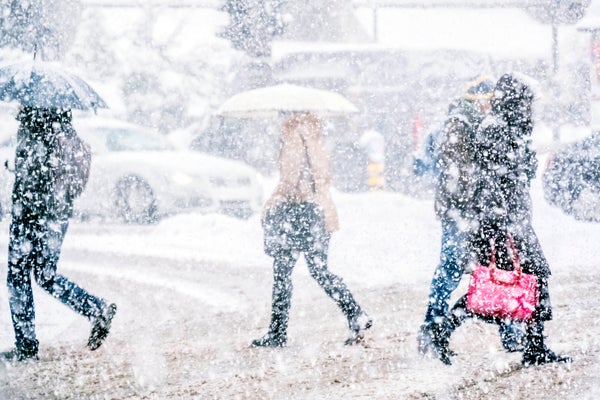
People walking across a road as heavy snow falls

gremlin/Getty Images

Join Our Community of Science Lovers!

A winter bomb cyclone is expected to bring blizzard conditions across parts of the East Coast from Maryland up through southeastern New England from Sunday night into Monday morning. But what exactly is a blizzard?

A blizzard doesn’t always mean “a lot of snow,” though it can certainly bring heavy snowfalls, as this storm is expected to do along parts of the East Coast. Rather the National Weather Service defines a blizzard as a snowstorm with winds that are regularly at or above 35 miles per hour and “considerable falling” or blowing snow for at least three hours. This weekend’s storm could dump one to two feet of snow in the worst-hit areas, and snowfall rates could reach two to three inches per hour. Wind gusts could reach 40 to 70 mph along the coast from New Jersey through New England.

Blizzard conditions can reduce visibility to less than 0.25 mile, which makes travel especially hazardous. New York City has put a travel ban on its roads starting at 9 P.M. on Sunday night.


On supporting science journalism

If you're enjoying this article, consider supporting our award-winning journalism by subscribing. By purchasing a subscription you are helping to ensure the future of impactful stories about the discoveries and ideas shaping our world today.


This storm’s winds and heavy, wet snow could also cause power outages by weighing down power lines and tree branches.

Blizzard conditions can develop along the northwest side of a very intense storm, as is the case with this system. This is because the major difference between the low pressure at the storm’s center and an area of higher pressure to the west creates very intense winds. This storm will likely become a bomb cyclone—what a storm is called when it undergoes “bombogenesis,” defined by a large decrease in pressure in 24 hours.

Andrea Thompson is senior editor for Earth and environment at Scientific American, covering the environment, energy and Earth sciences. She has been covering these topics for nearly two decades. Prior to joining Scientific American, she was a senior writer covering climate science at Climate Central and a reporter and editor at Live Science, where she primarily covered earth science and the environment. She has moderated panels, including as part of the United Nations Sustainable Development Media Zone, and appeared in radio and television interviews on major networks. She holds a graduate degree in science, health and environmental reporting from New York University, as well as a B.S. and an M.S. in atmospheric chemistry from the Georgia Institute of Technology. Follow Thompson on Bluesky @andreatweather.bsky.social

More by Andrea Thompson

Subscribe to Support Independent Journalism

Great science journalism requires human expertise, time, effort and creativity. And it costs money. That’s why I and the journalists here at Scientific American hope you’ll join our community.

When you subscribe, you are supporting staff and freelance journalists who are passionate about telling science stories that are true, important and compelling. Our editors and reporters are often experts in their fields, which means they understand the nuances of big discoveries and can untangle the breakthroughs from the hype. With a subscription, you are also supporting rigorous fact-checking to ensure the words we publish are precise and accurate. And you’re supporting original illustrations, graphics and photos that bring you closer to an advanced laboratory, an ice sheet in Antarctica or a space mission in orbit. You’re helping us craft other types of high-quality journalism as well: Our newsletters are carefully written, edited and curated by staffers you have or will come to know and love. Our Science Quickly podcast is based on original reporting, collaboration with editors and scientists and exacting production.

Subscriptions keep this engine running so we can continue to deliver thoughtful, rigorous and independent science journalism to you. In an era of viral misinformation, this work is crucial. If you value what we do, I hope you’ll consider joining us as a subscriber

Thank you,

Jeanna Bryner, Editor in Chief, Scientific American

Subscribe