
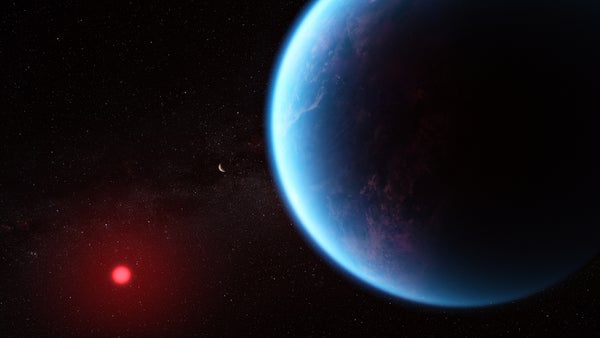
Scientists and extraterrestrial enthusiasts are abuzz after a team of researchers studying the atmosphere of an exoplanet called K2-18 b with NASA’s James Webb Space Telescope (JWST) just announced that they detected high levels of either the chemical dimethyl sulfide or a very similar compound—billing it as a hint of alien life. Although most people have never heard of dimethyl sulfide, it’s all around us here on Earth. But what is this compound, and is it really a sign of life beyond Earth?
What Is Dimethyl Sulfide?
In chemical terms, dimethyl sulfide comprises one atom of sulfur bonded to two methyl groups, each of which contains one carbon atom and three hydrogen atoms. The result is a small molecule with an outsize ability to offend the human nose. “Any of these sulfur things are going to be super stinky—that garlic, rotten egg smell,” says Eleanor Browne, a chemist at the University of Colorado Boulder.
On supporting science journalism
If you're enjoying this article, consider supporting our award-winning journalism by subscribing. By purchasing a subscription you are helping to ensure the future of impactful stories about the discoveries and ideas shaping our world today.
Earth’s dimethyl sulfide is constantly being produced by tiny plankton in the oceans. From there, it rises into the atmosphere, where it makes up about one out of every billion molecules. Once aloft, each individual molecule of dimethyl sulfide lasts only hours or, at most, about a day before it is destroyed in reactions that are triggered by exposure to sunlight and various atmospheric compounds.
That process is scientifically important here on the surface, Browne says, because those reactions eventually create tiny particles called aerosols that seed clouds, making dimethyl sulfide an important compound to understand for climate models and other atmospheric science.
From Earth to K2-18 b
Because microbes produce all of the detectable dimethyl sulfide in Earth’s atmosphere, and because it breaks down so quickly, scientists have long held that the compound could be a so-called biosignature—a fingerprint of life that is detectable from a distance—on other planets far from our own. “On Earth, it’s considered really a clean, unambiguous biosignature,” says Nora Hänni, a chemist at the University of Bern in Switzerland.
Enter JWST, a piece of technology with an unprecedented ability to sniff out atmospheric chemicals on planets that pass between their stars and the telescope. Scientists arranged for JWST to study K2-18 b, which had been discovered orbiting a small, cool star about 124 light-years from Earth in 2015. The exoplanet’s size appears to be between that of Earth and Neptune and belongs to a range that scientists have never seen up close.
In 2023 researchers led by Nikku Madhusudhan, an astrophysicist at the University of Cambridge, announced the first signs of dimethyl sulfide in K2-18 b’s atmosphere. At that time, other scientists were unable to corroborate the detection. But on Wednesday Madhusudhan and his team announced that a second JWST instrument had detected either the compound or a similar potential biosignature, dimethyl disulfide, with more confidence than the previous observations and at much higher levels than those in Earth’s atmosphere. The new results were published on April 17 in the Astrophysical Journal Letters.
“You need thousands of times of Earth’s concentrations to be able to explain the data,” he said during a presentation broadcast on YouTube on April 17.
Taking the “Bio” Out of Biosignature?
From the new JWST observations—and the calculation that K2-18 b lies at a distance from its star that could permit liquid water to remain on its surface—Madhusudhan concluded that the most logical explanation is that the planet is covered in an ocean of warm water that is “teeming with life,” he said during the presentation on Thursday.
But both Hänni and Browne conducted recent research that showed it would be a stretch to rely on dimethyl sulfide as a conclusive sign of life. Browne and her colleagues produced it and similar compounds in a laboratory simulation of Earth’s early atmosphere—without including living organisms. Hänni and her team detected the molecule on a frozen comet called 67P/Churyumov-Gerasimenko, which the European Space Agency explored up close with its Rosetta mission.
Both researchers emphasize that scientists don’t know nearly enough about K2-18 b to determine whether any dimethyl sulfide found in its atmosphere was produced by living organisms—or by abiotic happenstance of the kind that led to their own observations. Researchers don’t even know whether the compound would disappear as rapidly as it does in Earth’s nitrogen-rich atmosphere, given that the alien world’s atmosphere is dominated by carbon dioxide instead.
“Chemistry and the planets and all of those processes are so diverse,” Browne says. “There’s always going to be a way to make something abiotically.”
And if life is producing the dimethyl sulfide, that same life should be producing other compounds as well, says Chris Lintott, an astronomer at the University of Oxford. “[Dimethyl sulfide] should exist in a chemical network. If it’s produced by biology, it should break down, and the raw materials—such as H2S [hydrogen sulfide]—used to make it should be visible in the spectrum, too. They aren’t.”
Overall, he argues that local context will always determine what makes something a biosignature. “Looking for what’s biological on Earth isn’t a good guide to what might be biological elsewhere,” he says.