
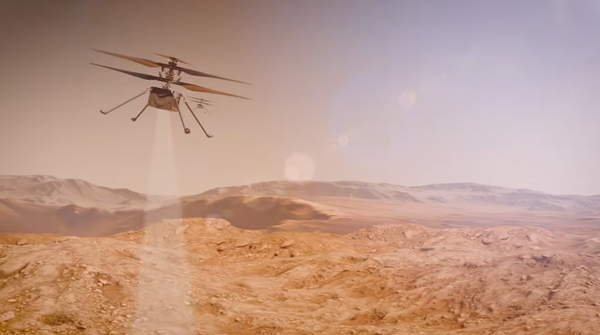
NASA wants to send an ambitious fleet of helicopters to soar through Martian skies—but scientists fear the endeavor could crater existing Red Planet research missions.
In March NASA unveiled SkyFall, a flashy proposal for packing three identical helicopters into a first-of-its-kind nuclear-propelled spacecraft to be launched to Mars in late 2028. But the announcement caught many planetary scientists unaware. They say it’s unclear how SkyFall would support their decades-long endeavor to search for signs of ancient habitability and life on Mars by bringing samples from that world back to Earth for intensive study. This Mars Sample Return project was well underway, with specimens cached on Mars ready for retrieval, but is now in limbo because of budget cuts. Scientists worry that SkyFall, with its still unclear price tag, could distract from efforts to revive that program while also cannibalizing funds from other ongoing Mars missions within the agency’s cash-strapped science division.
“We’re in this tough spot of, when someone offers you something, it’s hard to say, ‘No thank you, I don’t want it,’” says Phil Christensen, a planetary scientist at Arizona State University. “You say, ‘Sure, we can do great science with that.’”
On supporting science journalism
If you're enjoying this article, consider supporting our award-winning journalism by subscribing. By purchasing a subscription you are helping to ensure the future of impactful stories about the discoveries and ideas shaping our world today.
SkyFall is meant to fly on the first-ever spacecraft powered by nuclear fission, a vehicle called Space Reactor-1 Freedom that would be a pathfinder for larger, more capable nuclear propulsion projects. The spacecraft would release SkyFall near Mars, with the fleet contained within a capsule that would descend through the atmosphere on parachutes. The capsule would then deploy the three helicopters in midair, another new feat for the agency. NASA is still working to select a landing site that strikes a balance between low risks and high scientific rewards, according to details that the space agency shared with Scientific American.
NASA’s previous Mars helicopter, Ingenuity, launched in the belly of the Perseverance rover, which reached the Red Planet in 2021. The little chopper blew past NASA’s modest goals for the project, covering more than 10 miles during more than 70 flights over the course of nearly 1,000 Martian days before it became too damaged to fly. Ingenuity carried only a basic camera, and its work was limited to reconnaissance for Perseverance.
SkyFall’s helicopters will be a bit larger than Ingenuity, with enough lift to carry not just a camera but also basic weather equipment and ground-penetrating radar—instruments that would gather observations primarily during each vehicle’s short flights. NASA personnel are still determining how many flights each helicopter should make, per the space agency’s statement to Scientific American.
Assuming NASA can pull off the necessary technological advances to get SkyFall flying on the Red Planet, the helicopters will likely deliver new discoveries about Mars and may even inform future human visits. But the mission’s goals outlined by the space agency—tasks such as scouting unexplored terrain, detecting stores of subsurface ice and monitoring atmospheric dust—are a far cry from the preexisting priority of Mars Sample Return and the associated search for alien life. Some Mars scientists say SkyFall also won’t meaningfully inform other big-picture research questions, such as digging into the planet’s history or understanding how its surface and atmosphere interact.
SkyFall is “a demonstration mission; it’s not really a science mission,” says Vicky Hamilton, a planetary scientist at the Southwest Research Institute. “It’ll do some science,” she adds, but “it’s not what we’d intended.” Worse yet, SkyFall could be actively detrimental to Mars science. “The chances are quite high that more than one currently operating mission at Mars will be terminated and their funds redirected to supporting SkyFall,” Hamilton wrote in a co-authored memo from the NASA-advising Mars Exploration Program Analysis Group, of which she is the most recent past president.
Any SkyFall-sparked disruption would come at an already fraught time: Besides Mars Sample Return being in limbo, NASA is also down a Mars orbiter: the space agency’s Mars Atmosphere and Volatile Evolution (MAVEN) mission ended after it lost contact with Earth last December. That leaves NASA’s Mars fleet at two aging orbiters—Mars Odyssey, which arrived in 2001, and the Mars Reconnaissance Orbiter, which arrived in 2006—as well as the Curiosity and Perseverance rovers, which landed in 2012 and 2021, respectively.
And the future won’t bring any real reinforcements: NASA has an instrument on the European Space Agency’s Rosalind Franklin rover. And there’s SkyFall, a proposed “Mars Telecommunications Network” and a newly announced weather payload that is also targeting launch in 2028 via a public-private partnership. None of these are the type of meaty science mission that Mars researchers have become accustomed to.
“I hope SkyFall doesn’t become ‘Well, okay, that’s your Mars mission for the decade’—that would be too bad,” Christensen says.
Three months after SkyFall’s announcement, NASA still has not explained where the money for the project would come from or how much it might cost. “SkyFall is a new effort, and cost estimates are currently in development,” a NASA spokesperson told Scientific American, pointing to the agency’s budget information hub, which, as of the time of publication, does not include any documents that reference the SkyFall project.
“This has been a very opaque process,” says Jack Kiraly, director of government relations at the Planetary Society, a nonprofit organization that advocates for space exploration. Kiraly says that although he’s personally excited about SkyFall, the agency owes the public more transparency about its plans.
As a federal agency, NASA receives an annual budget from Congress each year, and legislators are currently hashing out appropriations for the next fiscal year, which begins on October 1. But although that legislation can sometimes highlight specific programs—the draft currently under consideration in the House of Representatives explicitly notes support for SkyFall—Congress typically trusts the agencies to decide finer details of how to disburse their allotted funds among various projects, Kiraly notes.
But rather than relying on funds for advancing technology or human exploration, SkyFall will probably draw funds from NASA’s science division’s Mars Exploration Program, he says, specifically, its budget line for future missions. The White House has requested $110 million for that budget line for the coming fiscal year, out of $248 million overall for NASA’s Mars research efforts.
A crash program to build and launch such an ambitious mission by 2028 isn’t compatible with those numbers, Kiraly says. “It’s going to need a lot of money up front,” he says. “That puts a lot of pressure on the rest of the portfolio.”
Hamilton puts it more bluntly. SkyFall, she fears, “is basically going to eat the entire Mars Exploration Program budget for the foreseeable future.”