
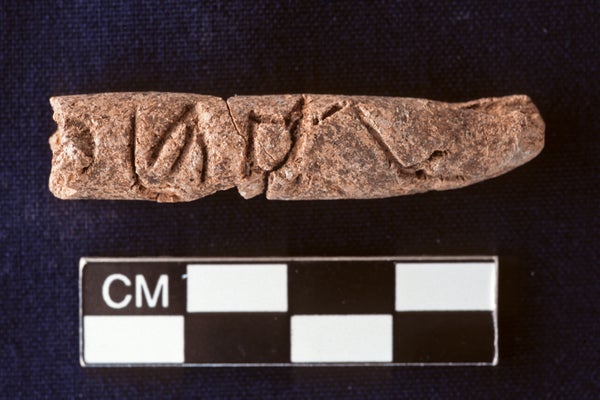
Researchers may have deciphered the oldest known scrap of alphabetic writing yet discovered, and it may be a nearly 4,500-year-old gift tag.
A clay cylinder found in a tomb holding six skeletons in northern Syria bears the word “silanu,” which may be a name, says Glenn Schwartz, an archaeologist at Johns Hopkins University. Schwartz discovered the finger-sized cylinder, along with three others bearing similar etchings, in a tomb at Tell Umm el-Marra, an ancient city that sits between modern-day Aleppo and the Euphrates River.
Alphabets break words into single vowels and consonants and typically require only 20 to 40 characters. That makes alphabetic systems more streamlined and easier to learn than the writing systems that came before—Egyptian hieroglyphs and Mesopotamian cuneiform. Those systems used hundreds of symbols that mainly represented words and syllables rather than individual sounds. Scientists previously thought that the first alphabet was created around 1900 B.C.E. by people speaking a Semitic language on the Sinai Peninsula in what is now Egypt. That alphabet, called Proto-Sinaitic, is based on hieroglyphic symbols repurposed as letters. The new finding suggests instead that people in farther-flung reaches of the Near East experimented with hieroglyph-derived letters much earlier.
On supporting science journalism
If you're enjoying this article, consider supporting our award-winning journalism by subscribing. By purchasing a subscription you are helping to ensure the future of impactful stories about the discoveries and ideas shaping our world today.
“It changes the entire narrative of how the alphabet was introduced,” Schwartz says. Small holes drilled into the cylinders could have been used to string them on thread. As such, the clay structures could have served as labels for goods; Silanu might have been either the recipient or sender of some of the jars of food and beverage placed in the tomb to accompany its occupants into the afterlife, Schwartz says.* The tomb likely belonged to a wealthy and powerful family in the city.
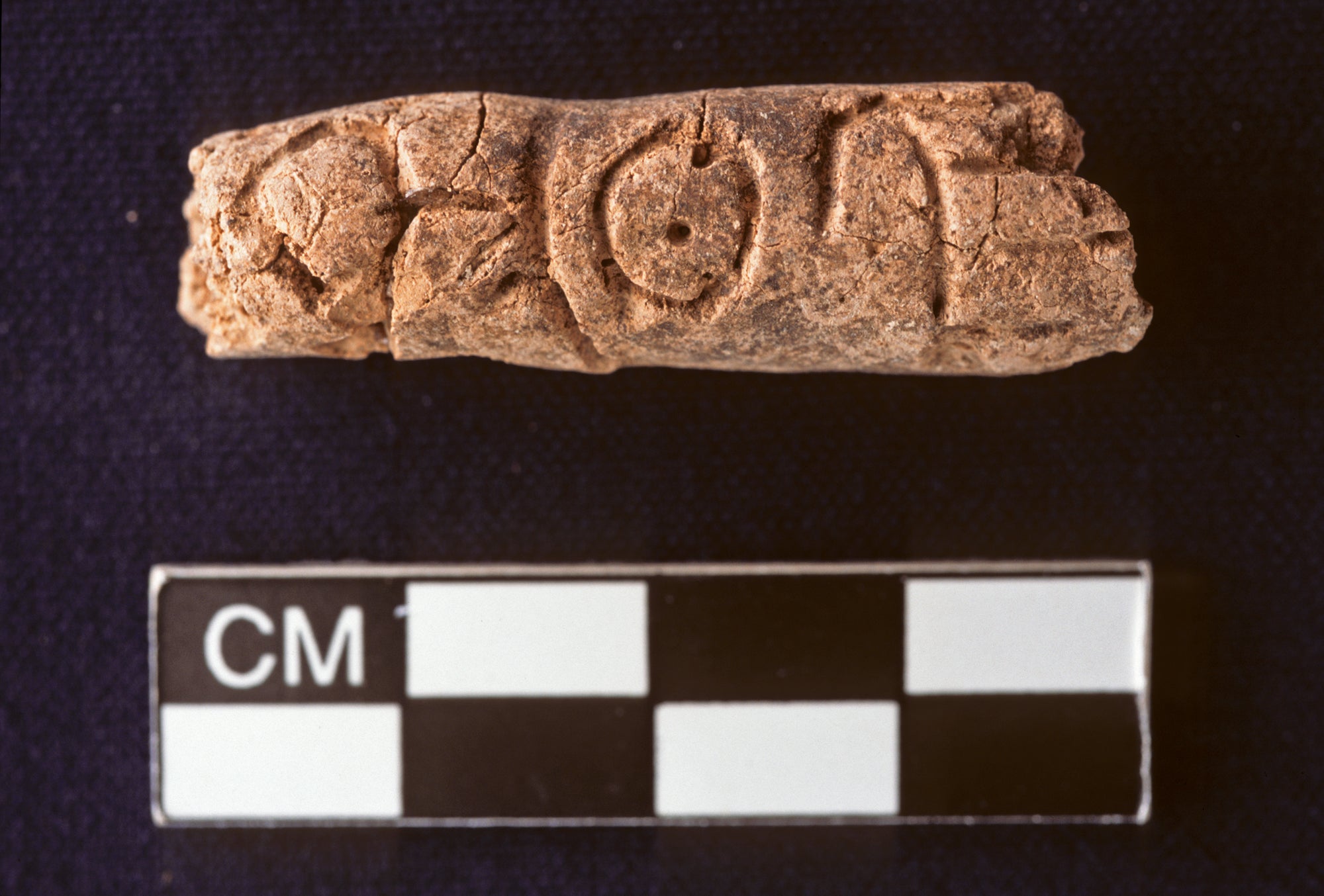
This finger-sized clay cylinder found in a tomb at Umm el-Marra may hold letters from the earliest known alphabet.
Glenn Schwartz, Johns Hopkins University (CC BY 4.0)
Archaeologists first found the cylinders in 2004, and radiocarbon analysis indicated the clay dated back to about 2400 B.C.E. In 2021 Schwartz described the cylinders in an Italian journal called Pasiphae. The research didn’t get much attention, in part because Schwartz was cautious in pushing his interpretation of the inscriptions as alphabetic letters. “I probably was too timid,” he says.
He presented a more confident interpretation this week at the annual meeting of the American Society of Overseas Research, held in Boston. Some researchers, who had access to only a few snapshots of the cylinders prior to the talk, said they were looking forward to more evidence that the inscriptions represent an alphabet rather than another type of writing system. “When you only have a few very short inscriptions, it can be difficult to tell how many signs the system has,” says Philippa Steele, a senior researcher in classics at the University of Cambridge. With so few signs to work from, she says, it’s hard to be sure that the new etchings really match up with known Proto-Sinaitic writing rather than resemble it by coincidence. “I think we have to hope for more finds,” she says.
Others are convinced. “It’s an alphabet,” says Silvia Ferrara, a professor in early languages at the University of Bologna in Italy, who was not involved in the work. “It’s easy-peasy. I’m used to much tougher things.”
“The morphology of the letters on the cylinder seals parallels quite nicely that of the existing corpus of early alphabetic writing,” adds Christopher Rollston, a professor of biblical and Near Eastern languages and civilizations at George Washington University, who was not involved in the new research but did study under Schwartz as a graduate student.
While the developers of the first alphabet were once thought to be living within Egyptian society, Egyptians and Syrians had extensive trade networks, Ferrara says, and many populations around the Middle East were likely familiar with the Egyptian writing system.
“It’s not that surprising,” she says, “knowing how far and wide these things traveled.”
*Editor’s Note (12/2/24): This sentence was updated after posting to correct a misspelling of “Silanu.”