
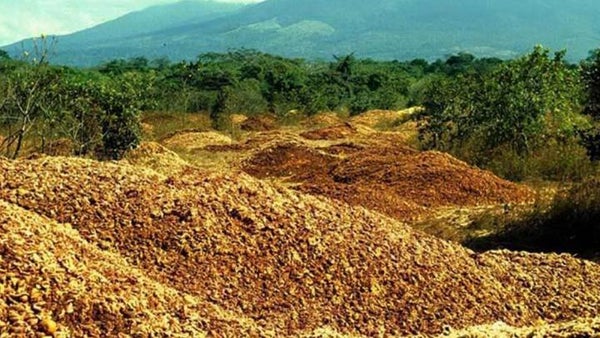

In the fight to conserve tropical rainforests, here's a tool you don't often hear about: orange peels. Specifically, 12,000 tons of them, dumped on the land. "You don't usually associate waste disposal with biodiversity benefits, something that's good for the environment."
Tim Treuer is an ecologist at Princeton University, and he’s talking about a unique conservation story. It started in the early 1990s, when an orange juice producer called Del Oro set up shop near the Guanacaste Conservation Area in Costa Rica, a region that contains several national parks and a wildlife refuge.
Del Oro needed somewhere to dump their orange peels, and the company also owned forested land abutting the parkland that it had no intention of cultivating. So a deal was struck: if Del Oro donated its forested land, it could dump orange peel waste on degraded pastureland within the conservation area.
On supporting science journalism
If you're enjoying this article, consider supporting our award-winning journalism by subscribing. By purchasing a subscription you are helping to ensure the future of impactful stories about the discoveries and ideas shaping our world today.
A thousand dump trucks' worth of orange peels were scattered on the land in 1998. "And within about six months the orange peels had been converted from orange peels into this thick black loamy soil. Kind of passing through this gross stage in between of kind of sludgy stuff filled with fly larvae."
The result of that influx of nutrient-rich organic material? "I couldn't even find the site the first time I saw it." He couldn't find it because, over 16 years, the orange-peel waste had sent the land on a journey to become vine-choked jungle. Jungle with three times the diversity of tree species of the adjacent control plot, richer soil and a much denser canopy. In other words, the experiment was a success. The results appear in the journal Restoration Ecology. [Timothy L. H. Treuer et al., Low-cost agricultural waste accelerates tropical forest regeneration]
Treuer says perhaps this lesson could be applied elsewhere. "It's a shame where we live in a world with nutrient-limited degraded ecosystems and also nutrient-rich waste streams. We'd like to see those things come together a little bit. That's not license for any agricultural company to just start dumping their waste products on protected areas, but it does mean that land managers, restorationists, people involved with industrial-scale agricultural operations should start thinking about ways to do thoughtful experimentation to see if in their particular system they can have similar win-win-win results."
That's actually "win-win-win"—a win for the company, a win for the protected area, and because the jungle packs away CO2, a win for the planet, too.
—Christopher Intagliata
[The above text is a transcript of this podcast.]

