

Rachel Feltman: Happy Monday, listeners, Happy Pride and Happy Knicks in Five! For Scientific American’s Science Quickly, I’m Rachel Feltman. You’re listening to our weekly science news roundup.
Let’s start with an update on Ebola. Earlier this month, a study published in the Lancet estimated that the outbreak currently surging in the Democratic Republic of the Congo (DRC) and Uganda could become the largest on record. As of June 18, the official case count was 894, with a death toll of 204. The outbreak, which was first declared in May, is caused by a species called the Bundibugyo virus. This virus is more rare than other species in its family that cause Ebola, and currently available treatments and vaccines are not expected to have much effect. Moderna is already working on a targeted vaccine, but even at breakneck speed, the development process is expected to take months. In a Disease Outbreak News bulletin published on June 13, the World Health Organization said that countries sharing land borders with DRC and Uganda were at high risk, but that risk of transmission was low for the rest of the African continent and the world at large.
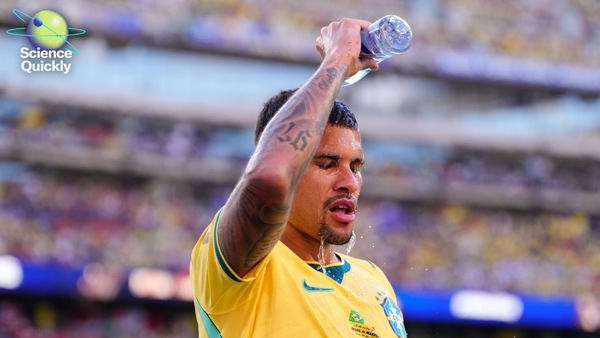
Speaking of the world at large, and on a somewhat lighter note, the FIFA Men’s World Cup is now in full swing. Now, as we explained in our June 8 episode, public health authorities are keeping close tabs on disease transmission as players and spectators flock to packed stadiums and visit far-flung cities. But there’s a potential health crisis related to these games that won’t show up in wastewater testing: heat-related illness. And frankly, that’s something we all have to worry about, even if we're not lucky enough to be watching a World Cup game in person. So let’s have a quick chat about that with Andrea Thompson, SciAm’s senior desk editor for life science.
On supporting science journalism
If you're enjoying this article, consider supporting our award-winning journalism by subscribing. By purchasing a subscription you are helping to ensure the future of impactful stories about the discoveries and ideas shaping our world today.
Thanks for joining us, Andrea.
Andrea Thompson: Thanks for having me
Feltman: So the World Cup is generally a summer thing. So why does it feel like we're hearing more about heat this year?
Thompson: So some of that is because of where we’re having it. It’s across North America, so a large chunk of the games are in places that get pretty hot in June and July, but in general, we have been seeing extreme heat increase everywhere in the world in the summer. So any World Cup is going to contend with this more, but they’re also happening in some places that tend to be on the hotter side in the summer.
Feltman: Right. The World Cup in Qatar was actually held in the winter for that reason, if I’m remembering correctly.
Thompson: Yes, they had to move it because it would’ve been just impossible to have it in the summer with the heat there.
Feltman: Yeah. So is this impacting gameplay at all?
Thompson: So some locations have just luckily have not had super hot weather. A few locations, Atlanta, Houston and Dallas, have climate-controlled stadiums, so it’s not really an issue what’s happening outside. But also, FIFA has instituted hydration breaks.
So because of the potential for heat, extreme heat, or so they said, at the midpoint of each half, they are having a three-minute hydration break for players to make sure that they drink water and do other things to cool their body temperature down for a little bit.
Feltman: And what about the fans? You know, what are these venues doing to protect spectators? And what can spectators do to protect themselves?
Thompson: Right. So acclimatization is a really big factor in heat stress and heat illness. Someone who’s from the Southeast, from Florida, is a lot more used to humid heat than someone from Seattle.
And then even things like, you know: What time of day is the match? Is your seat going to be in sunlight? ’Cause that raises the temperature quite a bit. Making sure you drink water. Originally, there was a ban on bringing water bottles into the stadium, but that was reversed. There are things you can do to keep cool like, having a hand fan to fan yourself. Now, if you’re getting into really extreme heat temperatures, that’s when you really need to think about being very cautious, maybe taking breaks in the shade.
But that barrier will also lower depending on certain personal factors. Certain medications can make you more susceptible to heat illness, certain conditions, especially heart conditions. Very young children cannot regulate their body temperature as well as adults. So if you’re a parent bringing your child, you can’t gauge your child’s comfort based on your own comfort because they can’t regulate their body temperature as well.
Feltman: Well, we’ve already had a few really, like, blockbuster days in terms of heat. So how are things looking in terms of what kind of summer we’re in for?
Thompson: Yes, so, right now, for June, it’s basically all of the western part of the country, and the northern part is trending more toward likely having warmer-than-average temperatures. The Southeast is sort of a toss-up. But even within, you know, an outlook like that, you can have an acute heat wave in any place, which also makes it a little hard to plan.
Thanks, Andrea. Listeners, you can find more stories on the science behind this year’s World Cup on our website. We’ll have a link to our World Cup landing page in today’s show notes.
We’ll wrap up with something seasonally appropriate: research on how fatherhood changes the brain. Now if you’re thinking, “Oh, crap, is Father’s Day coming up already?” I’m sorry to tell you that it was, in fact, yesterday. But if you’ve got a father figure you want to celebrate, I’m sure they’ll agree that late is better than never.
Here to tell us what science says about “daddy brain” is Tanya Lewis, senior desk editor for health and medicine at Scientific American.
Thanks for being here, Tanya.
Tanya Lewis: Yeah. Thank you so much for having me.
Feltman: So you recently wrote about the science of fatherhood and how it changes the brain. I would love to hear a little bit more, but first I do wanna acknowledge for our listeners that we’re gonna be using the words mother and father a lot in a very generalized way because most of the research we’re talking about focused on women who identified as mothers who were the birthing parents and men who identified as fathers who were nonbirthing parents. But just wanna make clear that we understand there are many ways to exist as a human and many ways to make a family. So Tanya, could you tell us a little bit about this piece that you wrote?
Lewis: Yeah. So I’m really fascinated by this topic because I recently became a parent last year. And so I am very intimately familiar with the changes that occur in a parent's brain, and you and I maybe know, sort of, what the mother's experience is, but fathers are often kind of left out of these conversations about what happens to the brain of a parent.
I actually spoke with Devika Bhushan, and she's a pediatrician and public health physician. And she has been very interested in this topic for a long time, starting from her days as a pediatrician, where she would see, oftentimes, dads, you know, really struggling with the stresses of early parenthood.
There really aren’t any sort of validated assessment tools for things like depression in fathers the way there are in mothers, and in fact, postpartum depression looks pretty different in dads than in moms. It’s more like irritability or substance use and this tendency to kind of shut down, as opposed to just an overwhelming sense of sadness.
Feltman: So what do we know about what kind of changes are happening in the brain of a new dad?
Lewis: Yeah. So, for example, the cortex, parts of the outer layer of the brain that are involved in higher-level cognition and planning and motor control and things like that become kind of pruned. So the gray matter shrinks in a lot of areas. But it’s not like your brain is less effective; it’s actually becoming more specialized for the tasks of caregiving. So we see this in fathers as well as mothers.
We also see that there’s more connectivity in brain areas that are more related to emotion and emotional processing. And there was a study in 2014, they compared, you know, caregiving mothers in heterosexual relationships with fathers who were primary caregivers. And they found that there were changes in these two different brain networks. One is this network called the mentalizing network, which is really this sort of theory-of-mind network where you’re putting yourself in the baby’s shoes.
And then there’s this other network which is a deeper subcortical network including things like the amygdala, which is involved in emotion and, like, fear processing. And they saw that men and/or fathers had more activation in the mentalizing network—so, like, trying to anticipate, you know, what the baby is experiencing—whereas mothers had more activation in that sort of emotional regulation network. So we’re seeing these different specializations happening across different parents.
Feltman: That’s really cool. Do we know anything about when these changes start in dads?
Lewis: Yeah. If you compare mothers who are gestational carriers versus nongestational parents, you see some of these changes earlier, like prenatally. But after birth, what’s remarkable is that a lot of these changes happen in both parents. And we know that, for example, dads’ testosterone levels drop, and actually their levels of a hormone called prolactin, which is involved in lactation and is actually present in fathers as well, and that increases in men as well. Interestingly enough, postpartum depression in fathers peaks later than it does in mothers. Studies show that it’s actually at its peak around three to six months after birth. In those early days after birth, a lot of the primary caregiving responsibilities like feeding the baby historically or traditionally may have fallen on mothers. But then when mothers go back to work, as many women do, then we see additional stress placed on the nonbirthing parent, typically the father.
So, we probably need better tools for screening things like depression in fathers specifically, because that affects the mental health of everyone in the family and is very impactful on the development of the child as well.
Feltman: Listeners, if you're struggling and you need someone to talk to, either about parenthood or anything else, remember that you can call or text the number 988 from within the U.S. to talk to a counselor at any time. That’s 988. You can also go to 988lifeline.org to chat online. And if you are outside of the U.S., you can go to findahelpline.com to get info on similar programs in more than 150 countries around the world. That's findahelpline.com
That’s all for today’s episode. We’ll be taking a break from the news episode format next week to highlight some fantastic books in celebration of SciAm’s Summer Reading Challenge, and then we’re planning a special Monday roundtable episode to dive into the latest on GLP-1s for the week after that. But I promise we’ll get back to a more regular roundup schedule starting on July 13.
As for our next episode, it’s one that I found super interesting during the interview, so you should definitely tune in. We’ll be getting into the surprisingly controversial science behind safe sun exposure.
Science Quickly is produced by me, Rachel Feltman, along with Fonda Mwangi, Sushmita Pathak and Jeff DelViscio. This episode was edited by Alex Sugiura. Marielle Issa and Aaron Shattuck fact-check our show. Our theme music was composed by Dominic Smith. Subscribe to Scientific American for more up-to-date and in-depth science news.
For Scientific American, this is Rachel Feltman. Have a great week!
