

Rachel Feltman: For Scientific American’s Science Quickly, I’m Rachel Feltman. This week we’re diving into what we like to call a Friday Fascination—a story that uses sound to transport you into the heart of the narrative.
Today’s episode takes us all the way to Indonesia, where the capital of Jakarta is sinking, possibly faster than any other city in the world. To adapt, the country has started building a new capital on the densely forested island of Borneo. The hope is that this city, called Nusantara, will be green and walkable—but even as a beacon of sustainability, it will still have a dramatic impact on the local habitat. As construction is beginning to transform one of the world’s most biodiverse rainforest areas, scientists and their Indigenous collaborators are racing to record the sounds of the forest—and preserve generations of ecological knowledge before it’s lost forever.
Our guide for this story is Leah Varjacques, a two-time Emmy-Award-winning video journalist, producer and cinematographer. Here she is now.
On supporting science journalism
If you're enjoying this article, consider supporting our award-winning journalism by subscribing. By purchasing a subscription you are helping to ensure the future of impactful stories about the discoveries and ideas shaping our world today.
Leah Varjacques: I’m hiking up a steep hillside called Mount Tembinus in the Bornean rainforest, weaving through waist-high ferns and giant elephant ears. I’m sweating from every pore in my body, trying to keep up with my guide, Abidin, a short man in his late 40s wearing a traditional beaded hat, a cigarette perpetually hanging from his lips.
Abidin: This is the land of my ancestors from long ago. We are people who love farming in the mountains. I feel at peace being here because the atmosphere is calm and safe.
Varjacques: Abidin machetes a path to a tree with a white metal box strapped to it. It says Swift on the side, just above a cage protecting a small black microphone. This is a terrestrial passive acoustic recording unit. It’s a cheap, sturdy and weatherproof recorder used for research and conservation. Abidin is here to swap its batteries and SD card.
Abidin: So with these wildlife recording devices, we are preserving the knowledge of our ancestors. Then from us, if possible, we’ll pass it down to our children and, and grandchildren.
Varjacques: This recorder has been here for 18 months already, continuously monitoring the sound of the forest and its inhabitants, because this forest is going through a major transition. The Indonesian government is building a new capital city here.
The current capital of Indonesia, Jakarta, is perhaps the fastest-sinking city in the world. That’s because most of Jakarta’s drinking water comes from pumped groundwater, a colonial legacy from when the Dutch controlled the country and created a segregated pipe system. The piped water served only elite areas, leaving most people and businesses to pump their water directly from wells, draining the aquifers literally holding up the city.
Even after the Dutch left, this water system remained, and centuries of pumping groundwater faster than it can be replenished have compacted the soft, watery sediment that the city is built on. In some neighborhoods, the ground sinks one foot per year. Sea-level rise made a bad situation worse. Indonesia has been building sea walls higher and higher for years to buy time.
[CLIPS: DW: “By 2050, 90 percent of North Jakarta could be permanently flooded.” PBS News Hour: “About 40 percent of Jakarta is below sea level, and it’s estimated nearly half of the city could be inundated and uninhabitable by 2050.”]
Varjacques: In the face of such dire predictions, then president Joko Widodo, known as Jokowi, announced a plan to move the capital city in 2019.
[CLIP: Widodo: “Indonesia as a great nation must dare to take steps. We must be brave to have a big agenda, and this is for the advancement of our country, for the progress of the nation.”]
Varjacques: The Indonesian government chose a 256,000-hectare site in the hills of Eastern Borneo. That’s like three times the size of New York City. It’s situated on an industrial eucalyptus forest, far from the coast, and designed as a forest city: all-electric, renewable-energy-powered and with lots of green open space—basically the anti-Jakarta, which is known for its density, record-breaking air pollution and traffic.
They’re naming it Nusantara, which means archipelago, and it’s smack-dab in the geographic center of Indonesia, symbolizing that its future will distribute opportunity across all the islands, unlike the country’s current Java-centric economy.
The city is being pitched as the perfect balance between nature and the 21st century.
[CLIP: Nusantara marketing: “Smart forest city.”]
Varjacques: The promotional video for Nusantara shows futuristic renderings of nature-inspired architecture—all greens, crystal blues and cream—elevated infrastructure to allow for natural water flows and wildlife corridors, and lots of space. That’s because the city, projected to be completed by 2045, is really only meant to house a quarter of Jakarta’s population, two and a half million people, and most of the residents will be government workers.
As for the rest of Jakarta, the plan is to build an $80-billion, 575-kilometer sea wall along the north coast of Java, which is Indonesia’s most populous island. Construction is expected to begin this month.
Wendy Erb: We heard that Indonesia was moving the capital to Kalimantan. I knew immediately building a new capital city there has the potential to have a huge impact on forest and animals there.
Varjacques: That’s Wendy Erb. She’s a primatologist and bioacoustic scientist at the Cornell Lab of Ornithology. She’s worked in Indonesia for 20 years. When she says Kalimantan, she means the Indonesian portion of the island of Borneo, which is also home to Brunei and a region of Malaysia.
Erb: We’re interested in documenting what’s here before all of this big change happens, and we’re trying to do that all through sound work.
Varjacques: Bioacoustics is a scientific discipline that is the study of the sounds of the natural world. It brings together ecology, biology and animal communication, engineering, and machine learning.
Erb: So we have, uh, recorders, like, on top of mountains. We have recorders in mangrove areas. We have recorders right next to caves in the middle of eucalyptus forests. We ended up sampling 20 different sites. And then from there, we could do comparisons over time as we recorded across 18 months as the capital was being built, as this environmental change is happening, as the social change is happening, economic growth is happening. And could we see places where wildlife were sort of being displaced. Maybe those are places where more investment could be made in conservation and management efforts.
Giant squirrel—they sound like bubblegum lasers.
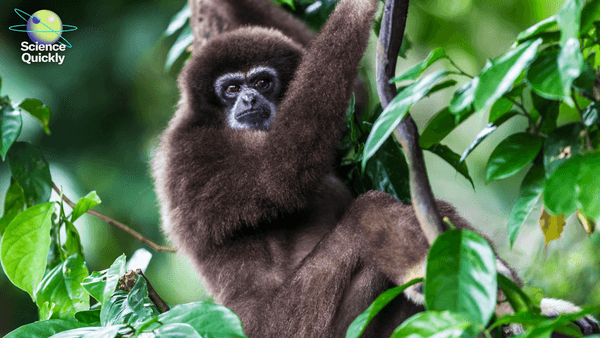
Varjacques: East Kalimantan is a place of incredibly high biodiversity with endangered species like the proboscis monkey, Bornean orangutan, Southern Bornean gibbon, gray gibbon, red langur and long-tailed macaque.
A more well-known method of wildlife monitoring is camera traps. But camera traps only capture what’s in their field of vision. With audio, species that are making sounds from far away can still be tracked. That means you can get a much more comprehensive picture of the wildlife’s health and movement.
At the lab, Wendy’s computer is open to a software with a bunch of sound waves on a track. The audio appears like turquoise dust on an indigo continuum called a spectrogram. Wendy selects a cluster that repeats in a pattern, labeling it the Rhinoceros Hornbill. Each species has its own sonic fingerprint.
Erb: I mean, it’s the best feeling scanning through these spectrograms and just waiting for, like, some discovery to pop up. Like, you just don’t know. Like, maybe there’s going to be an orangutan there, or maybe you will record a clouded leopard or a sun bear. Like, you never know, like, what’s coming on that next pass of the screen.
It’s so exhilarating. I love it.
Varjacques: With the help of AI, Erb sifts through thousands of hours of recordings and identifies which species are where as a baseline. The idea is that as the city is built, scientists can use this baseline to understand how construction is impacting the ecosystem. The government has set clear environmental impact goals, and the sounds of the forest are one way to measure the true effects.
Erb: You don’t know what you’re losing if you haven’t figured out what was there before you started.
Varjacques: What Wendy’s learning is telling, but many questions still remain.
Erb: So our big question is really to understand, what is here now in Nusantara? What came before Nusantara was a twinkle in the president’s eye? And what can we anticipate in the future? What should we worry about for the future? What can we mitigate?
Varjacques: That’s where Abidin comes in. Abidin is from Pemaluan, a village at the periphery of Nusantara’s footprint. He’s part of the Balik people, an Indigenous group in Kalimantan that’s lived in harmony with the forest for generations. Certain animal sounds are culturally significant to the Balik.
Abidin: The most distinct sound is the sound of monkeys or gibbons. Back then, our ancestors used their sound as a sign.
Usually gibbons at dawn, just before morning, they would call. If they call at around nine or 10 in the morning and everything feels eerily quiet, that’s usually a sign indicating that someone will pass away in the village. In the past, the most dominant sound came from the White-breasted Waterhen, then hornbills with their loud calls.
The most iconic one is the Great Argus.
Now we can hear other sounds. Our people say that usually the chainsaw is the loudest.
Varjacques: We take an electric bus past the major construction zones and the nearly finished state-of-the-art hospital and Swiss-Belhotel to a boulevard lined with gray and white buildings, all curved lines and living roofs. Construction crews are putting glass windows on the balconies. These are the ministry buildings surrounding a sort of national mall.
At one end, a bottle-green structure made of hundreds of steel lines comes together in the shape of a giant Garuda or eagle, the national emblem. This is the presidential palace. At the other end stands a Statue of Liberty–like Garuda monument. In the middle, a large organically shaped pond with zigzagging bridges snakes around lush greenery, offering unobstructed viewpoints of both structures.
People are taking selfies. We’re in the center of Nusantara, which the government is showing off to locals, tourists and, it hopes, foreign investors. Indonesia committed 20 percent of the city’s budget but has planned for 80 percent of it to be financed through foreign investment. Despite offering long-term corporate tax breaks and unprecedented land and ownership rights to potential investors, momentum has stalled.
Potential backers are hesitant because of construction delays, a presidential transition and major doubts about the commercial viability of a city that doesn’t yet exist and is located in a remote jungle area. Abedin finds some shade on a bench and lights a cigarette. A security guard immediately comes up and tells him that smoking is not allowed in Nusantara.
Abedin puts out his smoke and mutters, “Fuck this place.”
The government has already evicted some Balik people from their homes and warned others that they will have to relocate. Abidin’s home, which houses his wife and 12 kids, is safe for now, but everything around him is forever transformed.
Abedin: I’m worried about my children’s future.
In terms of education, they are far behind compared to our brothers and sisters from Sumatra, from Java. Especially in city life, you have to be smart, right? Meanwhile they, so to speak, are still relying on the lifestyle of the past. What can we do in the city? I myself can’t live in the city. I don’t understand what I can do.
If we become scavengers in our own hometown, it’s better to just die.
Varjacques: Erb’s acoustic monitoring project can seem like too little too late in the face of such irrevocable change.
Erb: Maybe this work, like we can’t actually stop anything from happening, and sometimes that feels really sad and hard to sit with, ’cause maybe you're like, “But we, we could do something. Things could be different.”
But maybe they can’t. Or maybe, like, it’s also not really our place to do that.
Varjacques: Erb’s collaborative research process has engaged the community at every step of the way to determine what the local people want out of the bioacoustic recordings. The community asked Erb and her team to create an illustrated children’s book about the animals traditionally found in and around the forest and a platform or app to easily be able to play and access the sounds.
Erb’s funding ran out after 18 months of recording, and she and her lab are still sifting through the data. She’s not the only one to have lost funding
In January 2025 a new president, Prabowo Subianto, took office and in his first year slashed the budget for Nusantara, raising major questions about its future.
The government maintains it is committed to finishing the city, but it’s delayed the president’s planned move-in date to the new palace. Erb’s endeavor is a reminder to listen to the voices of not only the local people but also the forest and the more-than-human world.
Erb: The question is, can we tune our ears? Can we pay attention? Can we notice when the natural world is feeling a little sick?
Abidin: I can teach my children the sounds of animals in the forest. Even though there are changes now, I still feel this is my home.
Feltman: That’s all for today’s Friday Fascination. We’ll be back on Monday with our usual science news roundup.
Science Quickly is produced by me, Rachel Feltman, along with Fonda Mwangi, Allison Rodgers and Jeff DelViscio. This episode was reported and co-hosted by Leah Varjacques and edited by Alex Sugiura. This story was made possible by a grant from the Pulitzer Center and published in partnership with Project Multatuli and Mongabay. Emily Makowski, Marielle Issa and Aaron Shattuck fact-check our show. Our theme music was composed by Dominic Smith. Subscribe to Scientific American for more up-to-date and in-depth science news.
For Scientific American, this is Rachel Feltman. Have a great weekend!
