
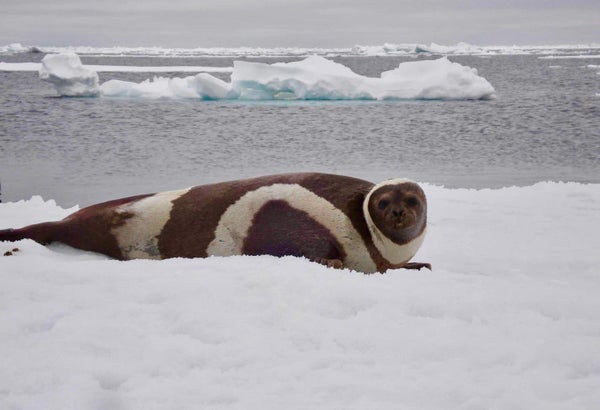

The Arctic is warming twice as fast as the rest of the planet, meaning more and more sea ice is melting every year.
“It’s really concerning—the rapid loss of sea ice up there—for a lot of reasons.”
Tracey Goldstein, a researcher and conservationist at U.C. Davis. She says one of those reasons is animals like ice seals need the ice to haul out on and give birth. Another reason? As the Arctic warms, the fish the seals eat may be moving to deeper and colder waters. So the seals have to travel farther to hunt them.
On supporting science journalism
If you're enjoying this article, consider supporting our award-winning journalism by subscribing. By purchasing a subscription you are helping to ensure the future of impactful stories about the discoveries and ideas shaping our world today.
“So the combination of all of that over time is probably going to affect their health and their body condition. And that will make them not just underweight but also more susceptible to other diseases.”
And those diseases may also be encroaching upon arctic marine mammals because (spotting a trend here?) Arctic sea ice is melting.
“Totally unintended consequence of all that, but yes. When there used to be an ice bridge, certain populations would stay separate from each other, so they couldn’t come in contact and give each other their bacteria, their viruses, et cetera. But once those channels started to open, animals were able to move further and came into contact with new species they hadn’t come into contact with in the past.”
Goldstein and her colleagues documented the spread of a disease called phocine distemper virus from 2001 through 2016. It’s related to the measles and causes skin lesions, coughing, pneumonia, seizures and sometimes death in marine mammals.
Goldstein’s team scanned historical and contemporary marine mammal blood samples for antibodies against the virus. They also hunted for evidence of live infections in nasal swabs taken of mammals. And they found that flareups of the virus were linked to years with extreme losses in sea ice—suggesting that open waters aided the spread of the pathogen, perhaps along the melted coastline north of Siberia.
Their analysis is in the journal Scientific Reports. [E. VanWormer et al., Viral emergence in marine mammals in the North Pacific may be linked to Arctic sea ice reduction]
Mammals that depend on ice to survive may already be slated for extinction as the Arctic melts, Goldstein says. And more frequent epidemics like this viral one could hasten the blow. But humans may be affected, too.
“Up in the Arctic, people subsist on these species, so they really rely on these animals for their livelihood and well-being. And as those animals disappear, or as their habitat disappears, that’s also going to heavily affect humans in that area. So overall, I think the overall health of the environment and the animals and the people up in the Arctic over time is just going to continue to deteriorate.”
Unless, of course, we humans take meaningful action to slow the planet’s warming.
—Christopher Intagliata
[The above text is a transcript of this podcast.]
