

Karen Hopkin: This is Scientific American’s 60 -Second Science. I’m Karen Hopkin.
Hopkin: They say it’s darkest before the dawn. And that’s just the way that sweat bees like it.
These tropical insects, which live on an island in the middle of the Panama Canal, visit night-blooming flowers under cover of darkness. And a new study shows that the shapes made by gaps in the rainforest canopy help them find their way home.
On supporting science journalism
If you're enjoying this article, consider supporting our award-winning journalism by subscribing. By purchasing a subscription you are helping to ensure the future of impactful stories about the discoveries and ideas shaping our world today.
The work appears in the journal Current Biology. [Sandra Chaib et al., Dorsal landmark navigation in a Neotropical nocturnal bee.]
Eric Warrant: Even though most bees are active in bright daylight, there are a few species that have become nocturnal due to competition and due to predators.
Hopkin:Eric Warrant, a professor of zoology at the University of Lund in Sweden.
Warrant: This is particularly true of the warmer parts of the world, such as…the steamy rainforests of Panama.
Hopkin: Warrant and his colleagues have been studying these night flyers, called Megalopta genalis, for more than 20 years.
Warrant: We have discovered that, like all bees, Megalopta is able to learn visual landmarks around the nest and presumably also along the foraging route.
.gif)
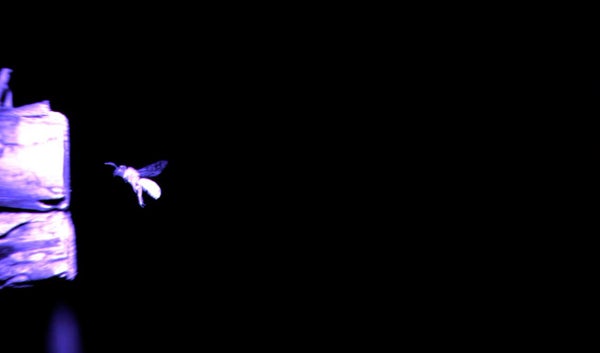
The nocturnal bee Megalopta genalis lands on its nest stick at night, filmed in Infrared light with a high speed camera. Credit: Emily Baird
Hopkin: They use these landmarks to find their way through the vast forest…and to recognize their nests. No easy feat, especially considering the size of these nocturnal navigators.
Warrant: Exactly how they manage to do this with such tiny eyes and with such a small brain is still to a large extent a mystery.
Hopkin: But it seemed that the first step would be to simply look up.
Warrant: There is one visual cue that is quite obvious in this otherwise profoundly dim environment. And these are the bright patches of night sky seen through gaps in the forest canopy directly above.
Hopkin: But do the bees raise their eyes while flying forward in the dark? To find out, the researchers got to messin’ with the Megalopta.
Sandra Chaib: We placed the Megalopta nest, which is a hollowed-out stick, at a stand in the forest.
Hopkin:Sandra Chaib, a University of Lund doctoral student who worked on the project.
Chaib: On both sides of the nest, we placed two additional mock nest sticks which we had drilled holes in to resemble nests.
Hopkin: Above each nest, they placed a distinctive visual landmark: a single black bar to mark the real nest and a pattern of stripes in different orientations above the fake nests.
Chaib: The bee was allowed to forage for a few nights to get acquainted with the area.
Hopkin: And then one night, when the bee was away, Chaib would shuffle the landmarks. And when the busy bee got back…
Chaib: … she immediately entered the nest under the landmark she had learned.
Hopkin: Which was one of the fakes.
Chaib: Of course, after a few seconds, she realized her mistake and she came back out again.
Hopkin: But after a short flight to get reoriented...she would again make the same mistake. So it seems the bees were sneaking in a last look up before flying in the front door.
And the same thing happened when the researchers used circles of different sizes to form more canopy-like patterns to mark the entrance to the nests.
Chaib: She took a look at the pattern from underneath, and flew directly into the mock nest.
Hopkin: The results were as clear as day. But, there in the dark, they weren’t exactly easy to see.
Warrant: Even if we put a hand in front of our face it’s very difficult to see it.
Chaib: Since it was totally dark, I used night goggles to monitor the nest.
Hopkin: And an infrared camera to film the bees’ comings and goings…after sunset and before dawn.
Chaib: It’s not the most pleasant thing, getting up in the middle of the night to set up the cameras.
[Sounds of the rainforest
Chaib: On the other hand, the rainforest is the most amazing place at that time. Many animals are the most active at this time.
Hopkin: Even the humble sweat bees…which will showcase their remarkable skills for anyone who’s prepared to watch.
For Scientific American’s 60-Second Science, I’m Karen Hopkin.
