

Last summer's total solar eclipse sliced right through Columbia, Missouri. "It was remarkable. As a biologist I generally reserve that word 'remarkable' for biological phenomena."
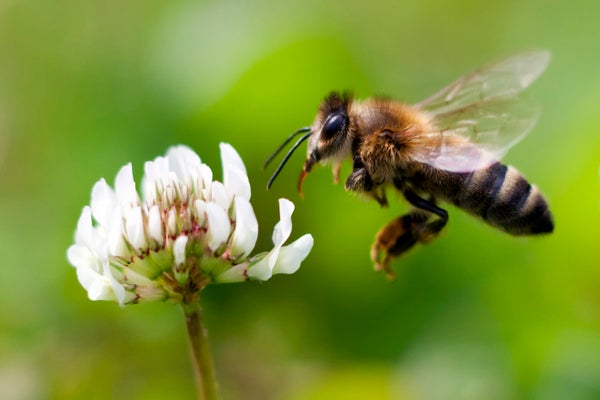
Candace Galen is based at the University of Missouri, in Columbia. And, being a biologist, she thought, why not use this astronomical phenomenon to study a biological one? Specifically: as the skies darkened, would daytime pollinators, like bumblebees and honeybees, call it quits?
"What better activity during an eclipse than to go out with a recorder and record the bees?
On supporting science journalism
If you're enjoying this article, consider supporting our award-winning journalism by subscribing. By purchasing a subscription you are helping to ensure the future of impactful stories about the discoveries and ideas shaping our world today.
So Galen asked 400 citizen scientists—including young students—to place audio recorders in 16 flower patches along the path of totality, in Oregon, Idaho and Missouri. When they analyzed the audio, they found that during partial eclipse, bee buzzing continued. But when totality hit, the bees went silent…and only the conversational buzz of human observers could be heard. Then, as the moon passed and the sun again lit up the sky, the bees regained their buzz.
The full write-up is in the Annals of the Entomological Society of America. [Candace Galen et al., Pollination on the Dark Side: Acoustic Monitoring Reveals Impacts of a Total Solar Eclipse on Flight Behavior and Activity Schedule of Foraging Bees]
Galen and her colleagues did notice one strange detail: the individual buzzes lasted longer than normal during the partial eclipse periods. Perhaps, Galen says, because the bees were flying more slowly to navigate darker conditions. Or maybe they were returning to their nests, thinking the day was through. It's hard to tell from the recording, she says. Which is why, come the next American total solar eclipse in 2024, she'll be back out listening once again.
"I'm a scientist, my curiosity is never satisfied, right?"
—Christopher Intagliata
[The above text is a transcript of this podcast.]

