

Rachel Feltman: For Scientific American’s Science Quickly, I’m Rachel Feltman.
If you love math, you’re probably already subscribed to Scientific American’s weekly newsletter Proof Positive. But if you’re under the impression that you don’t love math, Proof Positive may prove you wrong.
Here to give us a taste of some of the surprising and delightful stories you’ll find in Proof Positive is Manon Bischoff. Manon is a theoretical physicist and an editor at Spektrum der Wissenschaft, the German-language sister publication of Scientific American.
On supporting science journalism
If you're enjoying this article, consider supporting our award-winning journalism by subscribing. By purchasing a subscription you are helping to ensure the future of impactful stories about the discoveries and ideas shaping our world today.
Thank you so much for coming on to chat with us today.
Manon Bischoff: Thank you for inviting me.
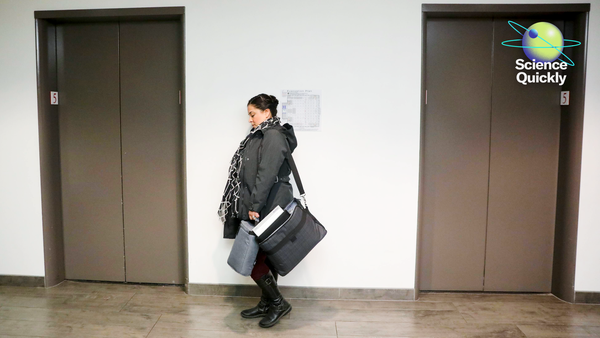
Feltman: So one of the things that you cover in your newsletter is how math impacts our everyday lives. One recent example is that mathematicians figured out why waiting for the elevator can seem to take forever, which is very relevant to my life—my building has two elevators, and one of them is currently out of commission. [Laughs.] So can you tell us more about how that experiment worked?
Bischoff: Yeah, so you just described it: you press the elevator button, and you’re hoping to go down or up or whatever, and the first elevator that comes, it just goes the wrong direction, right?
Feltman: Yeah.
Bischoff: And it almost feels personal, so like the building is plotting against you. [Laughs.] I know that feeling. [Laughs.] But actually, it’s not just bad luck or Murphy’s Law; it’s really happening—the building is really plotting against you. [Laughs.] And this is for mathematical reasons.
This phenomenon was studied by physicists in the 1950s, by George Gamow and Marvin Stern, and they worked in the same building but on different floors, and they had only one elevator, like you now. And they noticed the elevator that arrives first is going the wrong direction.
And Gamow even kept track of it, so he noticed that five times out of six cases, the first elevator goes the opposite direction. And he talked with his colleague about it, and they started to think about it. And it seems paradoxical because the elevator goes up and down equally often, right? So why does it go the wrong way for most of the time for you?
And there’s a quite easy explanation to it. So imagine you’re just on the top of a building, or close to the top, and every elevator that reaches you must first come from below and then shortly afterward it’s going down again. So at your floor there [is] just a tiny moment in time when the elevator is going down, and there’s a much longer stretch of time when it’s going up first. And if you arrive at the elevator at a random moment in time, it’s much more likely that you will catch it while going up and not while going down. And that’s the explanation to it.
Feltman: Wow, that’s so interesting. How did you come across that study?
Bischoff: I was just doing some research, and then I read this study that Gamow and Stern were doing and—or it’s, like, a small report, and they were doing, like, some jokes about it. And it was really fun to read it, and [I] wrote it down, and while—yeah, you can make, like, a small diagram, and then you really notice, “Ah, it makes sense, actually, that it’s plotting against you.” [Laughs.]
Feltman: Another everyday math example that you had in the newsletter was that, you know, math can help us live more deliciously. What did mathematicians have to say about optimally cutting a pizza? You know, I would say any pizza that you cut is optimally cut pizza because you get to eat pizza ...
Bischoff: [Laughs.]
Feltman: But mathematically, what is the answer?
Bischoff: If we would share a pizza, then we would both like to have, like, the same amount, and we would also like not just to have the same amount of dough but also the same amount of topping. So where I get my pizza they don’t put the topping, like, evenly, but usually, it’s just crumbled in one place, and the rest is, like, bare. [Laughs.] And if we would share it and you would get all the pepperoni, for example, I would be a little bit mad at you, I guess. [Laughs.]
So mathematicians were thinking about, “Okay, so how can we divide it fairly so that there’s not just the dough that is the same amount on both sides but also the topping?” And they figured out that there’s actually always a way to do it fairly.
So if you think about it, you would just naturally do—like, slice it in half through the middle point of the pizza, right? But if you [don’t] cut it directly, but you just rotate your knife, then the amount of topping is varying on both sides. So on one half there’s, let’s say, more pepperoni on the right half, and if you rotate it slightly, then you will have less pepperoni on one half and a little bit more on the other. And the amount of topping is changing smoothly and not just abruptly. That’s the important point mathematically. So you can really show that there’s always some moment while you rotate your knife at which there’s the same amount of the topping on both sides.
Feltman: So maybe the takeaway for everyday folks who aren’t, you know, sitting there with a bunch of graphing tools, is just to keep rotating, eyeball it and know that there is a fair solution and you just need to feel it out. [Laughs.]
Bischoff: Exactly. I mean, it’s a little bit mean because the mathematicians just proved that there is a solution, but they didn’t tell you how you get it—I mean, you rotate it, but they don’t tell you how to find the best angle. [Laughs.] So you have to figure it out by yourself, and it may take some time. But yeah, there’s a fair solution. [Laughs.]
Feltman: Well, a reason to study some math, I guess, if people need some inspiration. And mathematicians had some thoughts on cutting up ham sandwiches, too, right?
Bischoff: Maybe you noticed it—I like to connect math with food. [Laughs.] I really like this connection. So mathematicians like to generalize things. So when they did this pizza theorem, this was, like, a 2D version of the theorem. So you have a two-dimensional disc, which was the pizza, and you had two objects, so it was the pizza dough and the topping, and you wanted to cut it evenly.
And then they thought, “What happens if you go to three dimensions and with three objects instead of two?” So they looked at this ham sandwich, and you had one slice of bread, one slice of ham, and another slice of bread. And now, again, the person who does the sandwich doesn’t take too much care, and it’s not just [Laughs] layered in a fine way, just on top of each other, but a little bit spread out.
And if we want to share this sandwich fairly, then we would need to find the perfect cut, which cuts everything in half: so the upper part of the bread, the ham and the lower part of the bread. And mathematicians could show that, in a similar way as for the pizza, that if you do a cut and you just vary the angles continuously, smoothly, then you will always find one cut that is perfect and that will just divide the sandwich fairly.
Feltman: Other than food what are some of your favorite practical applications of math?
Bischoff: Yeah, it’s a hard question because math just turns out to be everywhere in our life—of course, you can describe everything mathematically. But I have, like, one fact that I really like about everyday math. It has to do shuffling cards. So I don’t know if you like card games.
Feltman: Mm, yeah.
Bischoff: And every time you shuffle a deck of cards, you actually write history—I don’t know if you know that.
Feltman: No. [Laughs.]
Bischoff: [Laughs.] So that means that if you take a deck of cards with 52 cards and you shuffle them thoroughly—so you really shuffle them good—then it’s almost sure that you created a card arrangement that no human on the Earth has ever created before.
Feltman: Oh, wow. [Laughs.]
Bischoff: [Laughs.] It’s mind-blowing, right? So ...
Feltman: Yeah.
Bischoff: And the reason for this is that the number of all possible [arrangements] is just huge. So if you have 52 cards, the number of arrangements is 52!, which is 52 x 51 x 50 x 49, and so on, until 2 x 1. And that’s a number—I will not read it because it would take [Laughs] way too much time and it’s quite boring, but it’s a 68-digit number.
Feltman: Wow, that’s something very fun to think about.
Bischoff: Yeah, and if you create just one example of this 68-digit number, you can just guess that the probability that another human being created the same arrangement is just so low, probably you just created [for] the first time this arrangement ever on Earth.
Feltman: What do you wish that people knew about math? What do you think that they maybe misunderstand about it?
Bischoff: I think that one big misunderstanding is that you need to be very intelligent or, like, a genius to understand math or to like math, and I think that’s completely wrong. So as long as you’re interested in it—and there are so many interesting stories about math or facts about math that everyone can be fascinated by it.
Also, that this genius myth that everyone has—like, mathematicians are, like, unbeatable and they’re never doing a mistake—that’s totally wrong. So one of my favorite stories is about Alexander Grothendieck. He was one of the most influential mathematicians of the 20th century, and he did, like, really complicated stuff.
But he got asked once by a colleague just, “Here, Alex, tell me a prime number, please,” so one number that is just divisible by 1 and by itself. And he said 57, which sounds like a prime number, but it’s not. [Laughs.] So it’s divisible by 3. And I mean, it’s such a simple thing to check that 57 is not a prime number, and it shows you that even a genius like Grothendieck [Laughs] can be wrong on so—such simple stuff. That shows that math is a lot about ideas and not just about calculating things.
Feltman: Well, thank you so much for coming on to share these fun math stories with us, and I’m sure our listeners will enjoy reading more of them in your newsletter.
Bischoff: I hope so. [Laughs.] Thanks for having me.
Feltman: That’s all for today’s episode. Check out Proof Positive for more surprisingly relatable math stories. You can also subscribe to SciAm newsletters focused on health, space, parenting and more. Go to ScientificAmerican.com/newsletters to subscribe.
We’ll be back on Friday to learn about the multiyear international effort to rename the condition formerly known as PCOS.
Science Quickly is produced by me, Rachel Feltman, along with Fonda Mwangi, Sushmita Pathak and Jeff DelViscio. This episode was edited by Alex Sugiura. Shayna Posses and Aaron Shattuck fact-check our show. Our theme music was composed by Dominic Smith. Subscribe to Scientific American for more up-to-date and in-depth science news.
For Scientific American, this is Rachel Feltman. See you next time!
