

Rachel Feltman: For Scientific American’s Science Quickly, I’m Rachel Feltman. You’re listening to part two of our summer reading series. Today I’m chatting with SciAm’s books and culture lead, Bri Kane. She’s going to tell us more about the magazine’s Summer Reading Challenge, plus some of her own favorite summer reads.
Bri, thanks so much for coming on to chat with us today.
Bri Kane: Yeah. Thank you so much for having me, Rachel. I’m so excited to talk to you.
On supporting science journalism
If you're enjoying this article, consider supporting our award-winning journalism by subscribing. By purchasing a subscription you are helping to ensure the future of impactful stories about the discoveries and ideas shaping our world today.
Feltman: I think we did this last summer, talking about some summer reads to recommend for our listeners. But this summer is extra special because of our Summer Reading Challenge. So why don’t we start by you telling us a little bit about that?
Kane: Yeah, I mean, summer is the best time of year to read, to find all of the books you’ve been saving up and to take them on vacation with you. So we’re doing Scientific American’s first-ever Summer Reading Challenge this year, where it’s basically book bingo. You get the bingo card on our website or our social media, and you read along and do some bookish activities with us this summer, and you can win some really cool prizes. I got some special reading challenge tote bags and stickers, as well as all of our classic Scientific American stickers and fun stuff.
Feltman: Amazing. Well, let’s start with your first recommendation. Why don’t you tell me about a nonfiction book you’re excited about?
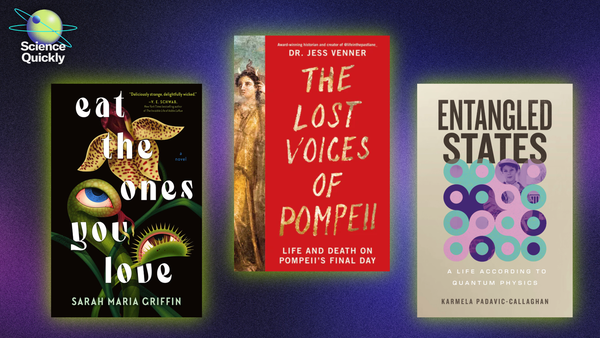
Kane: Yeah, Entangled States, by Karmela Padavic-Callaghan, came out this year, and I’m still thinking about it even though I finished it a few weeks ago. It’s a queer physicist turned science journalist who writes [these] memoirish physics essays. It’s incredible. I mean, they connect the concepts of, like, quantum physics and ultracold particles to learning about yourself as a queer person and coming to America to get a better education and what living this life really means in our modern world, but again, somehow connects it to quantum physics, which is not something I’ve thought about much recently, but I’ve been thinking about it a lot more since reading this book.
Feltman: Yeah, it’s also not even our first recommended book involving queer physics this year. [Laughs.]
Kane: Exactly. There’s something happening in physics, and I’m really excited about it. I mean, this—it’s really heartfelt, it’s really relatable, but it’s also a really fast read. Like, it’s really not that long, and I flew through it. I thought it was incredible.
Feltman: Well, and that leads me to an important question, which is: What makes something a good beach read to you? Obviously these are summer reads, maybe not specifically beach reads, but I feel like that’s the quintessential summer reading situation.
Kane: For me, a beach read is something that I don’t wanna put down, that I can read really quickly at the beach, that’s really exciting as soon as I open it up. Even if I put it down to run into the waves or to build a little sandcastle, as soon as I pick it back up, I wanna be enthralled and like, “Oh, my god, I can’t believe that I was even able to put this down for a moment.”
And this one is definitely like that. The short essays really grab you, but because they’re short, you have lots of nice little checkpoints to finish your reading and go do something else in between chapters.
Feltman: Oh, wow. That is a perfect summer read feature. But as much as having bite-sized reads on the beach, you know, can satisfy some folks, others, they wanna sink their teeth into something and really get lost in the sauce of a book, wherever they are—including on the beach. So what recommendations do you have for them?
Kane: I mean, if you’re looking for a big, dense nonfiction for this summer, I think The Lost Voices of Pompeii, it’s by Dr. Jess Venner, is an absolute must read. I mean, we all remember learning about Pompeii and the excitement of the volcanoes and all of the destruction that happened so quickly. It’s really exciting to think about. But there’s these huge gaps in the historical record, and there’s only so much we can understand about those final moments. This book really tries to tackle that and address the difficulty in tackling that in a really interesting way. If you’re trying to slowly read a nonfiction over a long trip or a long vacation, this is definitely one that’s worth it to make room in your luggage. Like, this one is going to have you putting down and telling everyone around you, “Did you know this about Pompeii?” for days on end.
Feltman: Yeah, that sounds great. Not my cup of tea, personally, but that’s what’s so awesome about Scientific American’s book coverage: there’s something for everyone. [Laughs.]
Kane: Even if you weren’t a volcano kid, this one is still a really cool science history book, and it will get you a bingo box.
Feltman: Ooh, yeah. Remind us what some of the bingo boxes are. There’s some really fun ones in there.
Kane: Yeah, we’re trying to read from authors that are underrepresented in science. We’re trying to read some STEMinist romance, some ecohorror, trying out audiobooks, trying out annotating your books or keeping a books journal. I do this. I’ve been doing it religiously for a few years, and I think it’s really helped my reading life.
We’re also buddy reading with SciAm staff, so if you listen in and read any of these books along with me this summer, that counts as a buddy read. But we’re doing all sorts of really fun stuff: going to the library, reading your book outside, reading science history books. I mean, there’s a ton.
Feltman: I know there’s an audiobook square, which—I’m an audiobook girlie, so I’m excited that people will be checking out audiobooks if they don’t already. Libro.fm is my, my favorite audiobook platform, so I definitely recommend readers check them out. You can support local bookstores by using them, so what’s better than that?
Kane: Yeah, we have a playlist on Libro.fm, and we have a StoryGraph that’s up. And like I said, on our website and any of our social medias, you can find the bingo card and tune in to see what we’re reading to accomplish the challenge, just as SciAm staff.
Feltman: I’m behind on my summer challenge reading, but I’m really excited about the ecohorror square. I love horror, and ecohorror is a wonderful genre.
A recent book that I read that really fits the bill if folks are looking for one to fit the square is Make Me Better, by Sarah Gailey. and I would say Sarah’s very offbeat book Spread Me—which is often described as if John Carpenter’s The Thing was very queer and sexy but still unsettling—I would say one could argue it’s a STEMinist romance. So that’s my hot take on that book. Sarah, thank you so much for writing it. [Laughs.]
Kane: I mean, yeah, I brought you an ecohorror today ’cause I know that you love a horror book, but mine is more Little Shop of Horrors, but what if it was really horrible?
Feltman: [Gasps.] I can’t wait.
Kane: Yeah, Eat the Ones You Love, by Sarah Maria Griffin: It was on our staff favorites last year, but I’m still recommending it to anyone looking for something a little horrifying in the science world. It’s basically a plant, who turns out to be a plant monster, is living in this, like, decrepit mall, and a girl gets a job there.
She may or may not fall in love with the florist who works at the mall as well and is parenting this plant that is trying to take over the world but first take over their love life. It’s so wild. It was so much fun, and I have to say, for a really far-out premise, it really lands the ending. Like, it really does not pull any punches all the way to the last page.
Feltman: Wow. I’m definitely looking forward to checking that one out. And I know it was one of our favorites last year, but I didn’t get around to it, so there’s no wrong time to dive in.
Kane: There’s a lot of books that come out every year. I don’t know if you’ve ever thought about it, Rachel, but I can’t keep up with them. So I’m always reading backlist. I’m always catching up on what’s fun and, like, seeing what people are talking about reading online and adding to my ever growing TBR. So I mean, yeah, it came out last year, but it’s still fantastic to read this year.
Feltman: Yeah, absolutely. Well, okay, so speaking of very buzzy books, tell me about your last recommendation for today.
Kane: I’m finally catching up with everyone else who’s been telling me that this series is amazing, it’s hysterical, once you start it, you can’t stop it. It is Dungeon Crawler Carl, by Matt Dinniman. I’m reading the first one for our Summer Reading Challenge, read the first book in a sci-fi series, and I have to agree, all of the hype is real.
It’s really good. It’s funny. It’s called [litRPG], which, as far as I can understand, just means the protagonist is inside a game. But the monsters are really creative. I like the game inventory system within the world; it’s pretty funny, and it’s very self-aware. It’s poking jokes at our current reality, our current reality TV, as well as our reality TV audience. But it has a lot of really fun aliens in there, and I’m really enjoying Donut the cat.
Feltman: Yeah, I’ve been hearing that I need to read those books for ages, and I am also planning on using it for the reading challenge as, you know, being the first in, in a sci-fi series. If people haven’t gotten into Murderbot yet, that is a favorite among the SciAm staff and another one you can check off that first in a series with—also great audiobooks that are largely available via library apps like hoopla and Libby. So you can check off so many boxes and not spend any of your money.
Kane: I’ve heard the audiobook for Dungeon Crawler Carl is, like, amazing, but I have to say ...
Feltman: I’ve heard that, too.
Kane: I’ve been reading the paperback, though, and this is one of those books that every time I read it on the train or, like, in the park, there’s at least one person who goes, “Oh my god, I read that, too. I’m on the fifth book, it’s so good,” or, “Oh, my gosh, I just started that. Isn’t it amazing?”—like, which is just really fun to be part of, like, the reading community, especially during the summer, when we’re all trying to get outside a little bit more. It’s like, yeah, what I’m reading isn’t a secret. I have really good taste in books.
Feltman: Yeah, totally. No, I do think Dungeon Crawler Carl—that is surprisingly hard to say. [Laughs.]
Kane: It’s so hard. It’s part of the fun reading it, is just the tongue twister of telling people what you’re reading.
Feltman: But it is one of those books that it’s, like, it’s just wildly popular enough while still feeling, like, slightly off of the beaten path. It's a nerd book. Let’s be real, it’s a nerd book. That, and I think that is the sweet spot for a book that will make people come up to you and be like, “I also love that book.” Like, in reality, many people are reading this book, many people are typing, but it still feels, like, special that you’re reading it. I love books like that.
Kane: I feel like I’m in, like, a secret club reading it. Like, I’m like in this, like, private club that everyone is reading it, but no one knows that we’re all in this secret club together reading it. It’s like the biggest book club ever.
Feltman: Totally. I feel the same way about Murderbot, honestly, even though there’s an incredible Apple TV adaptation starring Alexander Skarsgård, so I’m like, “Okay, everyone should actually know about this book now; let’s be real.” But people have not tuned in, so you gotta.
Kane: Yeah, another author that I love that has a book coming out I’ve been waiting for as soon as I heard it was coming out this year is: Kimberly Lemming has another in her sci-fi series, which I’m so excited about. I already saw the cover in an advanced copy that I got in the mail, and I’m saving that one for my summer vacation ’cause she’s amazing. I have no doubt that I’m gonna love this book, so I can save it for a special day.
Feltman: Well, Bri, thank you so much for coming on. It’s always a delight. And would you, you know, remind our listeners again, ’cause we can’t remind them too many times, why they should join the Summer Reading Challenge?
Kane: Yes, go on our website or our Instagram or any social media to find our bingo card. Read along all summer with us and the Scientific American staff to win some really exclusive prizes, including a book hand-selected for you as a reader by SciAm staff. So this is really special. We have a whole prize box that you can win, and we have 40 people that can win. I wanted to get as prizes many as I can, ’cause I want all of the readers to participate. And like we said earlier, there’s a lot of different options to participate, and I highly suggest finding a few books that check a few boxes off so that you can get bingo just for one vacation.
Download our bingo card at sciam.com/readingchallenge.
Feltman: That’s all for today’s episode. We’ll be back with one more summer reading segment on Friday.
Science Quickly is produced by me, Rachel Feltman, along with Fonda Mwangi, Sushmita Pathak and Jeff DelViscio. This episode was edited by Alex Sugiura. Marielle Issa and Aaron Shattuck fact-check our show. Our theme music was composed by Dominic Smith. Subscribe to Scientific American for more up-to-date and in-depth science news.
For Scientific American, this is Rachel Feltman. See you next time!
