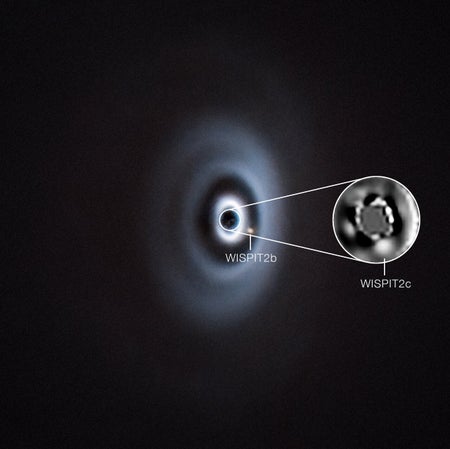
‘Inside-out’ planetary system perplexes astronomers
Four worlds around a small, dim star are challenging theories of planet formation

‘Inside-out’ planetary system perplexes astronomers
Four worlds around a small, dim star are challenging theories of planet formation

This vanished star may mark a ‘failed supernova’—and a newborn black hole
A “disappearing” star in the Andromeda galaxy is the closest and best candidate for a newborn black hole that astronomers have ever seen


The largest-ever satellite of its kind just unfurled its wings in low-Earth orbit
BlueBird 6 features the biggest commercial communications array antenna ever deployed in orbit around Earth, spanning some 2,400 square feet

Scientists may have discovered a pulsar at the Milky Way’s heart—a result that could reveal new physics
If a pulsar that may lie at the center of our galaxy is confirmed, it could enable more precise measurements of the spacetime around the Milky Way’s central supermassive black hole

What came before the big bang?
Physicists cannot access anything that existed before the start of time and space, but they have theories

Elon Musk says SpaceX will prioritize a city on the moon instead of a colony on Mars
SpaceX’s decision to focus on establishing a lunar city ahead of building a Mars colony represents a significant shift in Elon Musk’s space exploration ambitions

How the ‘Quad God’ lands impossible jumps
How do figure skaters like Ilia Malinin keep landing harder and harder jumps?

Babies keep the beat as Artemis slips, solar flares blast and PFAS rise
Babies show innate rhythm as NASA’s Artemis II mission hits delays, a major solar flare erupts and concerns grow over PFAS “forever chemicals”

The science behind why some auroras have such stunning wave patterns
Auroras, shimmering bands of light that shoot through the night sky near the Earth’s poles, can follow patterns known as arcs
The last great U.S. particle collider is no more. What comes next could be even better
After 25 years, Brookhaven National Laboratory’s Relativistic Heavy Ion Collider—the U.S.’s largest and only particle collider—has ceased operations, but its science lives on

How can galaxies ever collide in an ever-expanding universe?
You might think galaxies can’t ever find each other in our runaway cosmos, but it turns out gravity can sometimes overcome even the stretching of space itself

Space archaeologists may have found a long-lost Soviet lander on the moon
Scientists have spent decades searching for the final resting place of Luna 9, the first spacecraft to soft-land on the moon. Now they’re on the cusp of finding it