NASA’s Voyager 2 survives daring ‘big bang’ maneuver
After 49 years in space, NASA’s Voyagers are running low on power—but an audacious move should extend the tenures of the two spacecraft

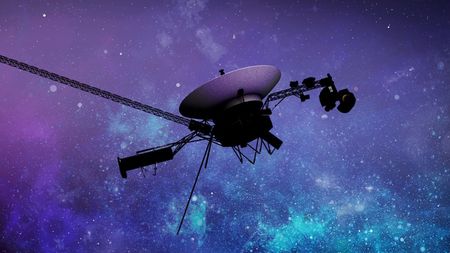
NASA’s Voyager 2 survives daring ‘big bang’ maneuver
After 49 years in space, NASA’s Voyagers are running low on power—but an audacious move should extend the tenures of the two spacecraft

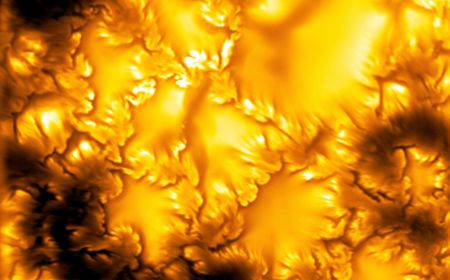
Spectacular images reveal never-before-seen whirlpools on the sun
Strange whirlpools of plasma seen in the sharpest images ever captured of our star help explain the deep origins of Earth-threatening space weather and more


Surf’s up! Here’s how to ride the waves on Saturn’s moon Titan
Lakes of liquid methane on Titan, Saturn’s largest moon, could offer exhilarating—and terrifying—opportunities for otherworldly surfing

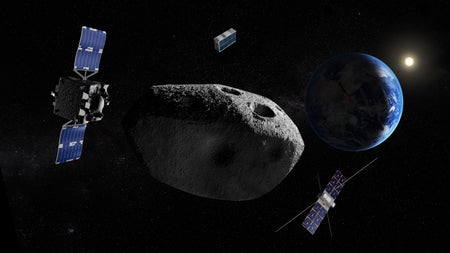
Spacecraft will swarm asteroid Apophis during fateful 2029 Earth flyby
Space agencies around the globe are coordinating missions to visit the asteroid Apophis during a close encounter with Earth in 2029

Rescue mission to save NASA’s Swift space telescope is imperiled in orbit
A private spacecraft launched to boost the decaying orbit of NASA’s Swift Observatory is now suffering from potentially mission-ending malfunctions

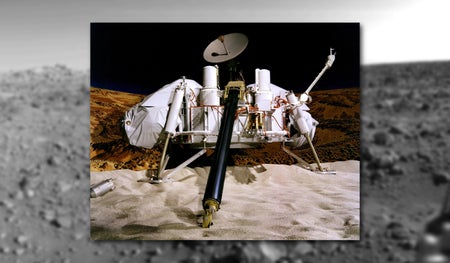
Has NASA already found life on Mars?
In searches for past and present Martian life, some scientists say we’ve been too cautious to see what’s right in front of us

This decade-long ‘movie’ of the sky will be revolutionary
Using the new Vera C. Rubin Observatory, astronomers are beginning the largest and deepest survey of the sky. What will they see?

Is there a ‘best’ solar eclipse?
Duration, location, aviation: What makes the best possible view of a total solar eclipse?

August’s solar eclipse inspires science involving jets, balloons and Einstein’s general theory of relativity
Solar eclipses are a rare and brief opportunity for scientists to gather data on everything from the physics of the sun to air pressure in the upper atmosphere

Is Earth the only planet with total solar eclipses?
Other planets have moons, too. Do they get eclipses like we do?

What will happen to Earth’s moon in the far future?
The moon is Earth’s constant companion. But will that always be the case?

Interstellar Comet 3I/ATLAS is almost as old as the universe itself
The evidence is mounting: this interstellar visitor is even older and weirder than anyone thought