
Lightning long ago escaped the bounds of Earth’s atmosphere—scientists have already discovered lightning blazing through the skies of Jupiter, Saturn and Neptune. Now they think they’ve found it on Mars, too.
But actually spotting lightning on the Red Planet has proved challenging. Earth’s lightning is so striking because of our world’s thick atmosphere and strong magnetic field. In comparison, Mars has only a tenuous atmosphere and small patches of a puny magnetic field. On the latter planet, scientists have hypothesized, lightning would not be dramatic arcs of electricity erupting overhead but more like glowing sparks set off by electrostatically charged dust swirling through the skies.
“We cannot describe it as a lightning bolt from the Earth, but the principle is similar,” says Ondřej Santolík, a space physicist at the Czech Academy of Sciences. “It’s kind of difficult to guess what it looks like because nobody has taken a picture yet.”
On supporting science journalism
If you're enjoying this article, consider supporting our award-winning journalism by subscribing. By purchasing a subscription you are helping to ensure the future of impactful stories about the discoveries and ideas shaping our world today.
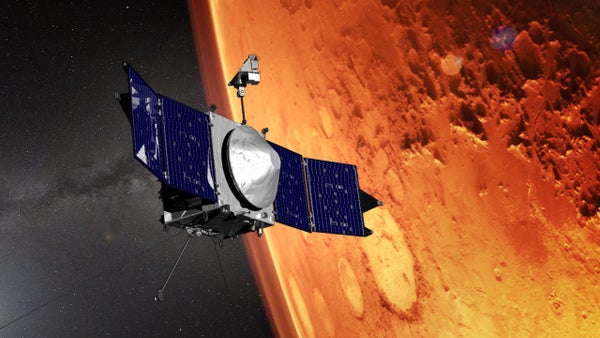
Santolík is one of scientists behind new research, published on February 27 in Science Advances, that has announced possible evidence of a lightning strike on Mars, an event that occurred in June 2015 and whose signature was detected in data gathered by NASA’s Mars Atmosphere and Volatile Evolution (MAVEN) mission. The paper comes just a few months after other researchers published an entirely different type of evidence for Mars lightning based on data gathered by a microphone on NASA’s Perseverance rover.
“It sort of gives a feeling that we’re closing in on Mars lightning,” says Karen Aplin, a space physicist at the University of Bristol in England, who researches lightning but was not involved in either study.
Confirming the presence of lightning on Mars isn’t just a matter of scientific curiosity, Aplin notes. Any form of lightning could threaten space technology, and lightning has also been shown to spark chemistry that might contribute to the development of life.
MAVEN is an orbiter mission, so it offers a long-distance view of Mars lightning. In their work, Santolík and his colleagues looked for a phenomenon called whistlers. When lightning strikes, it heats and ionizes the surrounding air, which can act as a natural antenna to blast lightning-generated radio waves through and out of a planet’s atmosphere. Picked up on a receiver, these waves have a whistlelike tone, hence the name.
All told, the team reviewed 108,418 snapshots from MAVEN in search of Martian whistlers, a daunting task. “That needs to be done visually because it’s very hard to do it by a machine because of the noise features in the data,” Santolík says. In the end, the scientists found only one candidate. “It’s very surprising that we found it at all,” Santolík says. The researchers spent a year confirming that the observation fit with what they would expect from lightning.
Whether any similar observations will be available into the future is unclear because NASA has been out of contact with MAVEN for nearly three months now.
Meanwhile the recent paper based on Perseverance data found dozens of examples of crackling sounds produced by small electrical discharges during dust storms near the rover. These observations are not contradictory but likely don’t represent quite identical phenomena. That’s perfectly plausible—Earth has different types of electrical discharges as well, with the lightning of thunderstorms being very different from the glow of Saint Elmo’s fire, Aplin notes.
For Santolík, as tantalizing as the observations are, they remain a poor consolation prize. He’s a member of the team that built a specially designed lightning detector to fly on the Russian-made lander for the Rosalind Franklin Mars rover, a project led by the European Space Agency (ESA), which was once planned to launch in 2022. The plan changed, however, when this international partnership dissolved just months before launch after Russia’s full-scale invasion of Ukraine.
ESA has scrambled to build its own lander for the rover’s new 2028 launch date—and to speed construction, it opted not to install instruments on the platform. Santolík and his colleagues recently received their instrument back but now don’t expect it to ever see the Red Planet, much less the world’s elusive lightning.