
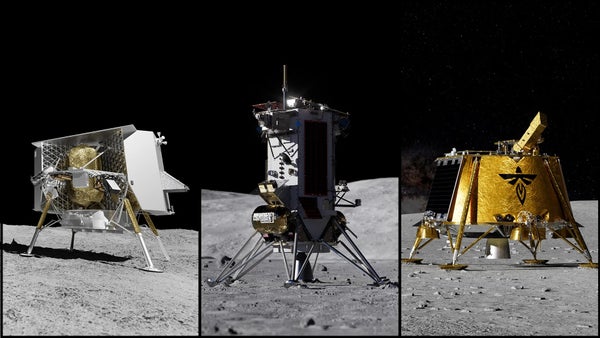
NASA is ramping up its efforts to establish a sustained human presence on the moon—including potentially shifting resources away from its efforts to explore Mars.
On Tuesday the space agency announced that three companies have been selected to receive a total of nearly $600 million to land four missions on the lunar surface in late 2028. The companies—Astrobotic, Firefly Aerospace and Intuitive Machines—are charged with landing crucial NASA science payloads that the agency says will help it build a permanent base on the moon’s surface. Astrobotic will conduct two of the four missions, according to NASA.
“We’re building a proving ground for Moon Base operations,” said Ryan Stephan, NASA’s Moon Base acting director of cargo landers, in a statement. “Accelerating our Moon mission ordering cadence and launch opportunities enable us to move quickly to learn, iterate, and improve.”
On supporting science journalism
If you're enjoying this article, consider supporting our award-winning journalism by subscribing. By purchasing a subscription you are helping to ensure the future of impactful stories about the discoveries and ideas shaping our world today.
But before humans return to Earth’s largest satellite, NASA could launch its first robotic lunar rover, agency administrator Jared Isaacman said at a press event on Tuesday announcing the missions. While other countries, including Japan and India, have successfully landed rovers on the moon in recent years—and others have tried and failed—NASA has never managed the feat.
To finally achieve the milestone, Isaacman said, the agency could repurpose a rover that was originally supposed to go to Mars. The Polar Rover for Observation, Mapping and In-Situ Exploration (PROMISE) was initially a testbed for the Red Planet rovers Curiosity and Perseverance but now may finally be put to use on the moon instead.
“We are thinking very hard right now about sending PROMISE to the moon,” said Isaacman at a press event on Tuesday announcing the missions.
The four endeavors are part of a grand overhaul of NASA’s lunar ambitions since Isaacman took the helm at NASA in December of last year. In an executive order issued that month, the Trump administration instructed the space agency to focus its energies on the moon, setting goals such as landing people on the lunar surface by 2028 for the first time since Apollo 17 in 1972 and initiating construction on a permanent crewed base by 2030.
That order sparked NASA’s new, ambitious multistage plan. In March, Isaacman unveiled a $30-billion road map to speed up lunar landings and help get the base under way. A key linchpin is the agency’s Artemis IV mission, in which NASA astronauts will land on the moon for the first time in more than 50 years. It has no definite launch date, but NASA is aiming for a launch in the first half of 2028. Then NASA wants to be able to ferry astronaut crews to a semipermanent base on the lunar south pole by 2032. The final stage involves establishing a permanent outpost, complete with power from a nuclear reactor, by 2036.
All told, the plan will involve 79 launches, 73 lunar landers and 10 moon buggies, and multiple drones, various habitat modules and other pieces of infrastructure.
Now we’re getting a glimpse of at least some of those missions. Astrobotic will receive $297.9 million to conduct two missions, while Firefly Aerospace and Intuitive Machines will receive $144.2 million and $148.3 million, respectively, to conduct a single mission each. Each flight will utilize an updated version of an already flown lander design, and all will carry identical scientific payloads. Those instruments included a set of high-tech cameras designed to produce a 3D view of the landing site to help scientists better understand the conditions on the moon for a larger spacecraft to touch down in the future, as well as a laser navigational array and an instrument to study radiation.
“By flying the same science instruments on multiple landers, we will better understand potential hazards during landing and build out a global network of environmental data and location markers on the Moon,” said Joel Kearns, deputy associate administrator for exploration in NASA’s Science Mission Directorate, in the same statement. “It’s akin to having weather stations in different locations on Earth. These three payloads are flight-proven and their data is critical to supporting safe human exploration of the lunar surface.”
The selection of the three companies comes shortly after one of the other firms key to NASA’s lunar ambitions hit a major setback. A Blue Origin New Glenn rocket, which has been selected as the launch vehicle for several planned moon missions, exploded on the launchpad in May. Blue Origin maintains that it will be back up and running soon enough to avoid any major delays to NASA’s timeline, however.